Every great story begins as a scattered collection of thoughts — a powerful opening scene, a compelling character, a twist you can’t stop thinking about. But without organization, even the most brilliant ideas can collapse under confusion.
If you’ve ever filled notebooks with random scenes, saved voice notes of dialogue, or typed fragments into your phone at 2 a.m., you’re not alone. The difference between a messy draft and a compelling novel isn’t talent — it’s structure.
In this guide, you’ll learn practical, step-by-step methods to organize your story ideas so they flow logically, build emotional tension, and transform into a complete narrative.
Why Organizing Your Story Ideas Matters
Before diving into techniques, let’s understand why organization is so crucial.
When your ideas aren’t structured:
- Plot holes appear.
- Characters behave inconsistently.
- Pacing feels uneven.
- Subplots get forgotten.
- You lose motivation halfway through.
When your ideas are organized:
- You write faster.
- Your story feels cohesive.
- Revisions become easier.
- Emotional arcs land properly.
- You stay confident and focused.
Organization doesn’t restrict creativity — it channels it.
Step 1: Brain Dump Everything First
Before structuring anything, empty your mind onto paper or screen.
Write down:
- Random scenes
- Dialogue snippets
- Character backstories
- Worldbuilding details
- Possible twists
- Emotional themes
Don’t judge or edit. This stage is about collecting raw material.
Think of it as dumping puzzle pieces on the table before assembling them.
Tip: Use separate sections for:
- Characters
- Plot ideas
- Setting notes
- Themes
- Questions you still need to answer
Once everything is visible, patterns begin to emerge.
Step 2: Identify Your Core Concept
Every story needs a central spine — the main idea holding everything together.
Ask yourself:
- What is this story really about?
- Who is it primarily about?
- What does the protagonist want?
- What stands in their way?
You should be able to summarize your story in 1–2 sentences.
For example:
- A grieving detective hunts a serial killer who leaves messages meant only for him.
- A shy teenager discovers she can rewrite reality — but each change erases a memory.
This core concept becomes your anchor. Every idea you organize must support it.
Step 3: Choose a Structure Framework
Structure helps you arrange your ideas in a logical progression. You don’t need to follow rigid formulas, but frameworks provide guidance.
Here are common storytelling models:
1. Three-Act Structure
Act 1 – Setup
- Introduce characters and world
- Inciting incident
- First major decision
Act 2 – Confrontation
- Rising obstacles
- Complications
- Midpoint twist
- Escalating stakes
Act 3 – Resolution
- Final confrontation
- Climax
- Aftermath
2. The Hero’s Journey
Popularized by Joseph Campbell, this structure includes stages like:
- Call to adventure
- Refusal of the call
- Trials
- Transformation
- Return
3. Save the Cat Beat Sheet
Created by Blake Snyder, this framework breaks the story into specific beats like:
- Opening Image
- Catalyst
- Fun and Games
- Dark Night of the Soul
- Finale
Choose one framework and map your ideas onto it. You’ll instantly see gaps and overlaps.
Step 4: Build a Story Outline
Now that you have structure, create a rough outline.
Your outline can be:
- Bullet-point based
- Paragraph summaries
- Index cards
- Mind maps
- Spreadsheet format
Here’s a simple scene-by-scene outline format:
- Opening scene
- Inciting incident
- First obstacle
- Complication
- Midpoint revelation
- Major setback
- Climax
- Resolution
Each point should answer:
- What happens?
- Why does it matter?
- How does it change the protagonist?
If it doesn’t move the story forward, reconsider it.
Step 5: Organize Characters Separately
Your story ideas often revolve around characters. Keep a dedicated section for them.
For each main character, define:
- Goal
- Fear
- Strength
- Flaw
- Internal conflict
- External conflict
- Character arc (how they change)
Example:
Protagonist Arc
- Starts: Self-doubting and withdrawn
- Middle: Forced to lead
- End: Confident and self-aware
When you organize character arcs, your plot becomes clearer because events must trigger growth.
Step 6: Create a Timeline
Chronology prevents confusion.
Write down events in order:
- Backstory events
- Present-day scenes
- Flashbacks
- Parallel plots
If your story includes multiple timelines, use:
- Color coding
- Separate columns
- Labeled chapters
A timeline ensures:
- Cause and effect makes sense
- Character ages are consistent
- World events align logically
Step 7: Use a Story Organization Table
Here’s a practical table you can use to structure your ideas clearly:
| Story Element | Key Questions to Answer | Example Notes |
| Core Concept | What is the main idea? | A girl can see memories in objects |
| Protagonist | What do they want? Why? | Wants to uncover her mother’s disappearance |
| Antagonist | What opposes the protagonist? | Corrupt historian hiding secrets |
| Inciting Incident | What starts the story? | Finds a necklace showing hidden memory |
| Midpoint | What major shift occurs? | Learns mother is alive but imprisoned |
| Climax | Final confrontation? | Public exposure of antagonist |
| Theme | What deeper message? | Truth cannot stay buried |
| Setting | Where and when? | Modern coastal town |
| Stakes | What happens if they fail? | Mother remains lost forever |
| Character Arc | How do they change? | From passive to fearless |
Use this table as a checklist to make sure no critical component is missing.
Step 8: Group Ideas by Purpose
If you have dozens of scenes, categorize them by function:
- Introduction scenes
- Character development scenes
- Conflict escalation scenes
- Revelation scenes
- Climax-related scenes
- Resolution scenes
This prevents repetitive scenes and improves pacing.
For example, if you notice five “character reflection” scenes in a row, you may need to insert action or conflict.
Step 9: Organize Subplots Carefully
Subplots add depth, but they can derail your story if unmanaged.
Ask:
- Does this subplot connect to the main theme?
- Does it impact the protagonist?
- Does it resolve before or during the climax?
Create a mini-outline for each subplot:
- Introduction
- Development
- Turning point
- Resolution
Then align subplot milestones with main plot milestones.
Step 10: Track Emotional Beats
Plot events matter, but emotional shifts are what readers remember.
For each major scene, note:
- Emotional state before
- Emotional trigger
- Emotional state after
Example:
- Before: Hopeful
- Trigger: Betrayal
- After: Devastated but determined
This ensures emotional progression rather than repetition.
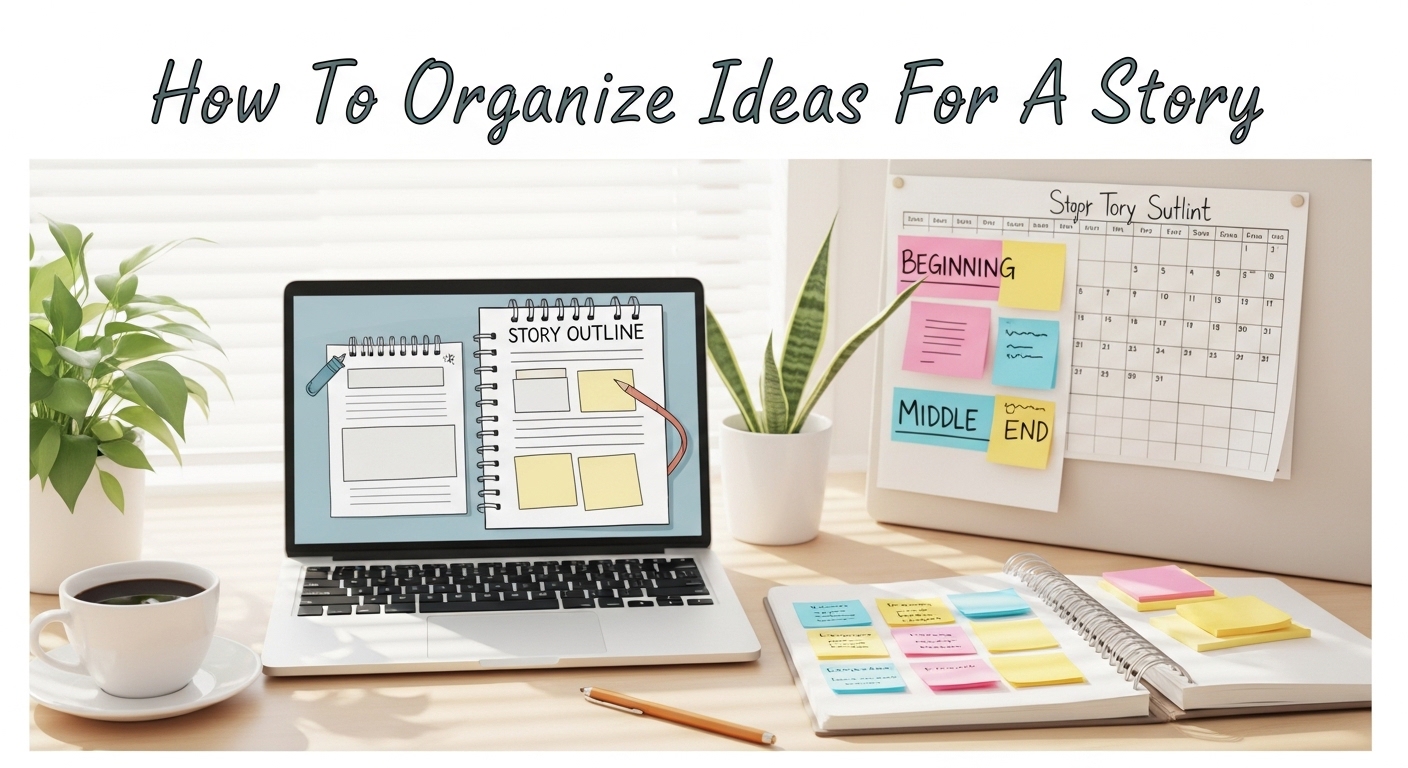
Step 11: Use Visual Tools
Different writers organize differently.
Consider:
- Mind maps for brainstorming
- Sticky notes on a wall
- Whiteboard plotting
- Digital boards like Trello-style systems
- Spreadsheet trackers
Visual organization helps you see the story as a whole instead of isolated scenes.
Step 12: Identify Gaps and Plot Holes
After organizing everything, review critically.
Check for:
- Unanswered questions
- Missing motivations
- Convenient coincidences
- Weak stakes
- Inconsistent logic
Ask yourself:
If I removed this scene, would the story still work?
If yes, it may not be necessary.
Step 13: Refine Into a Writing Roadmap
Your final organized outline should function as a guide — not a prison.
It should:
- Show the direction
- Clarify emotional growth
- Define turning points
- Highlight major reveals
But allow flexibility.
Sometimes better ideas emerge while writing. Adjust the outline when needed — but keep the core structure intact.
Common Mistakes When Organizing Story Ideas
Avoid these pitfalls:
Overplanning
Spending months organizing without writing.
Underplanning
Jumping into drafting with no direction.
Ignoring Theme
Scenes that don’t support the central message weaken impact.
Disconnected Subplots
Side stories that never connect back to the main conflict.
Inconsistent Character Arcs
Growth that happens without cause.
Balance preparation and creativity.
A Simple Workflow to Follow
Here’s a streamlined process you can use:
- Brain dump all ideas
- Identify core concept
- Choose structure model
- Outline major beats
- Develop character arcs
- Build timeline
- Align subplots
- Fill gaps
- Start drafting
Follow this sequence, and your story will feel intentional rather than accidental.
Final Thoughts: Organization Creates Freedom
Organizing your story ideas doesn’t make your writing mechanical. It makes it powerful.
Structure gives you clarity.
Clarity builds confidence.
Confidence fuels creativity.
When your ideas are thoughtfully arranged, your story flows naturally. Confusion fades. Momentum builds.
The most compelling novels aren’t just imaginative — they’re architected.
So take your scattered thoughts, lay them out clearly, connect them with purpose, and build something unforgettable.
Because great stories aren’t found.
They’re designed.