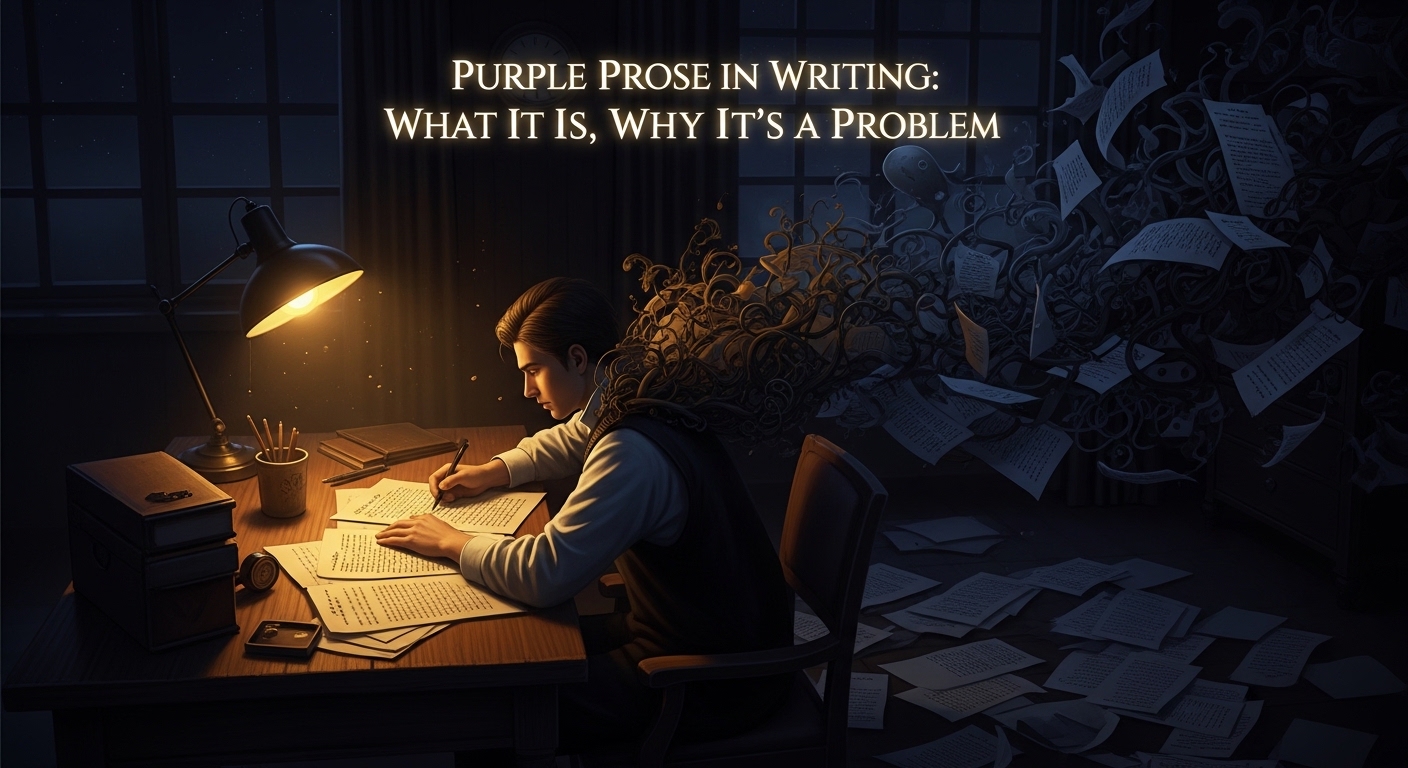
There is a certain kind of writing that feels lush at first glance, ornate, expressive, almost musical in its rhythm. It dazzles with adjectives, stretches metaphors until they shimmer, and leans heavily into emotion. Yet, somewhere along the way, it begins to suffocate the very story it is meant to elevate. This is what writers and critics often call purple prose. For many writers, especially those deeply invested in language and atmosphere, falling into this style can happen almost unconsciously. It begins with a desire to impress or to evoke intensity, but it often ends in distraction, confusion, or reader fatigue. Understanding what purple prose is, why it weakens writing, and how to avoid it is not about stripping away beauty from language. It is about learning restraint, clarity, and purpose, skills that ultimately make writing far more powerful.
What Is Purple Prose?
Purple prose refers to overly elaborate, excessive, or flowery writing that draws attention to itself instead of serving the story. It is characterized by long-winded descriptions, unnecessary adjectives, and metaphors that feel forced or overextended. Rather than enhancing meaning, it overwhelms it. The term itself has historical roots, originally used to criticize writing that was too ornate for its own good, suggesting a kind of literary indulgence that prioritizes style over substance.
In practice, purple prose often appears when a writer tries too hard to make a scene feel emotional or vivid. Instead of allowing the reader to experience the moment naturally, the writing insists on telling them how to feel. For example, a simple moment like a sunset might be stretched into multiple sentences filled with dramatic imagery, layered comparisons, and emotional cues that leave little room for interpretation. The result is not richness, but clutter.
It is important to note that descriptive writing is not inherently problematic. Vivid imagery, lyrical language, and strong voice are essential components of compelling prose. The issue arises when these elements are overused or misapplied, turning the writing into something heavy and self-conscious.
Why Writers Fall Into Purple Prose
The temptation toward purple prose often comes from a genuine place. Many writers equate complexity with quality, believing that more words, more description, and more elaborate phrasing will make their work feel sophisticated. This is especially common among emerging writers who are still developing confidence in their voice. They may feel the need to prove their ability, and in doing so, they overcompensate.
Another reason is emotional investment. When a writer cares deeply about a scene or character, they may struggle to hold back. Every detail feels important, every sensation worth capturing. The result is writing that tries to do too much at once, layering emotion upon emotion until it becomes overwhelming.
Influence also plays a role. Writers who admire highly descriptive authors may attempt to emulate their style without fully understanding the balance those authors maintain. What seems like effortless lyricism in published work is often the result of careful editing and restraint, not unchecked embellishment.
Finally, there is the simple joy of language. Writing can feel like painting with words, and sometimes writers get carried away in the process. While this enthusiasm is valuable, it needs to be guided by intention and awareness.
Why Purple Prose Is a Problem
At its core, purple prose disrupts the relationship between the writer and the reader. Instead of drawing the reader into the story, it creates distance. The reader becomes aware of the writing itself, noticing the effort behind every sentence rather than engaging with the narrative.
One of the main issues is readability. Overly complex sentences and excessive description slow down the pace, making it difficult for readers to follow the story. What should feel immersive instead becomes laborious. Readers may find themselves rereading passages not because they are profound, but because they are unclear.
Another problem is emotional manipulation. Purple prose often tells readers how to feel rather than allowing them to arrive at emotions organically. This can feel forced or even insincere. Genuine emotion in writing comes from authenticity and subtlety, not from piling on dramatic language.
Clarity is also compromised. When too many words are used to describe something, the core idea can become obscured. The reader may struggle to understand what is actually happening, as the writing prioritizes decoration over meaning.
Perhaps most importantly, purple prose undermines trust. Readers want to feel that the writer respects their intelligence and imagination. When the writing becomes overly indulgent, it can feel as though the writer is trying too hard to impress rather than communicate.
The Difference Between Rich Prose and Purple Prose
Not all descriptive writing is excessive, and it is crucial to distinguish between rich prose and purple prose. Rich prose enhances the story. It uses vivid language and imagery, but it remains purposeful and controlled. Every word contributes to the overall effect, and nothing feels unnecessary.
Purple prose, on the other hand, lacks this sense of control. It is driven by excess rather than intention. Where rich prose invites the reader in, purple prose overwhelms them. The difference often lies in balance. A well-crafted sentence can be beautiful and evocative without being excessive.
Consider the role of specificity. Rich prose often relies on precise details rather than broad, exaggerated descriptions. It chooses the right word instead of many words. This precision creates clarity and impact, allowing the writing to feel both vivid and grounded.
Tone also plays a role. Rich prose aligns with the tone of the story, supporting its mood and themes. Purple prose can feel out of place, as though it belongs to a different kind of narrative altogether.
Recognizing Purple Prose in Your Own Writing
One of the challenges of purple prose is that it can be difficult to recognize in your own work. What feels powerful and expressive during the writing process may reveal itself as excessive during revision. Developing the ability to identify these moments requires distance and critical awareness.
A useful approach is to read your work aloud. Purple prose often becomes more apparent when heard rather than read silently. Sentences may feel overly long, repetitive, or unnatural. If a passage feels exhausting to read, it is likely too dense.
Another indicator is redundancy. If multiple words or phrases are used to convey the same idea, it may be a sign of excess. Strong writing tends to be concise, even when it is descriptive.
You can also look for moments where the writing draws attention to itself. If a sentence feels like it is trying to impress rather than communicate, it may need to be simplified.
Feedback from others is invaluable as well. Fresh readers can often spot issues that the writer has become blind to. They can point out where the writing feels heavy or unclear, providing insight that can guide revision.
How to Steer Clear of Purple Prose
Avoiding purple prose is not about stripping your writing of personality or emotion. It is about learning to channel those elements effectively. One of the most important strategies is to focus on clarity. Before adding descriptive language, ensure that the core idea of the sentence is clear and direct.
Editing plays a crucial role. The first draft is often where excess occurs, and that is perfectly natural. The revision process is where refinement happens. Cutting unnecessary words, simplifying sentences, and choosing more precise language can transform a passage.
Another approach is to trust the reader. You do not need to explain every detail or emotion. Allow space for interpretation. Suggest rather than insist. This creates a more engaging and immersive experience.
Paying attention to pacing is also important. Not every moment in a story requires detailed description. Knowing when to slow down and when to move quickly helps maintain balance. Over-description can disrupt the flow, while selective detail can enhance it.
Reading widely can also help. Exposure to different styles and voices provides a sense of what works and what does not. It allows you to see how skilled writers use language effectively without falling into excess.
A Practical Comparison
To better understand the distinction, consider the following table that highlights the key differences between effective prose and purple prose.
| Aspect | Effective Prose | Purple Prose |
| Language Use | Precise and purposeful | Overly elaborate and excessive |
| Sentence Structure | Clear and varied | Long, complex, and often convoluted |
| Imagery | Vivid but controlled | Overloaded with metaphors and descriptions |
| Emotional Impact | Subtle and authentic | Forced and exaggerated |
| Reader Experience | Immersive and engaging | Distracting and overwhelming |
| Clarity | Easy to understand | Often confusing or unclear |
| Focus | Serves the story | Draws attention to itself |
This comparison illustrates that the issue is not description itself, but how it is used. Effective prose prioritizes communication, while purple prose prioritizes embellishment.
Finding Your Balance as a Writer
Every writer has a unique voice, and part of the journey is learning how to refine it. If you find yourself leaning toward purple prose, it does not mean your writing is flawed. It often means you have a strong appreciation for language and expression. The goal is to harness that strength in a way that serves your story.
Experimentation can be helpful. Try writing a scene in a more restrained style, focusing on clarity and simplicity. Then compare it to a more descriptive version. This exercise can reveal how different approaches affect the overall impact.
It is also worth remembering that different genres and contexts allow for different levels of description. Literary fiction may embrace more elaborate language, while other genres may prioritize speed and clarity. Understanding the expectations of your audience can guide your choices.
Ultimately, balance comes from awareness. Knowing when to lean into description and when to hold back is a skill that develops over time. It requires practice, reflection, and a willingness to revise.
Conclusion
Purple prose is not simply a stylistic flaw; it is a reminder of the delicate balance between expression and clarity. Writing that tries too hard to impress often loses sight of its purpose, while writing that embraces restraint can achieve far greater impact. By understanding what purple prose is, recognizing its signs, and learning how to revise with intention, writers can create work that is both beautiful and effective. The goal is not to eliminate richness from language, but to ensure that every word serves the story. In doing so, you allow your writing to breathe, to resonate, and ultimately, to connect with readers in a way that feels genuine and lasting.