When someone asks how many words are in a 200-page book, the question seems simple at first glance. But in reality, the answer depends on a range of variables that shape how text appears on a page. Page count alone doesn’t define word count because books are designed differently depending on their purpose, audience, and format.
A 200-page novel printed in a compact paperback format will contain far more words than a 200-page large-print edition of the same book. Similarly, an academic textbook with diagrams and spacing will carry fewer words per page compared to a dense literary manuscript. That’s why publishers, editors, and writers rarely rely on page count alone. Instead, they calculate word count using standardized assumptions.
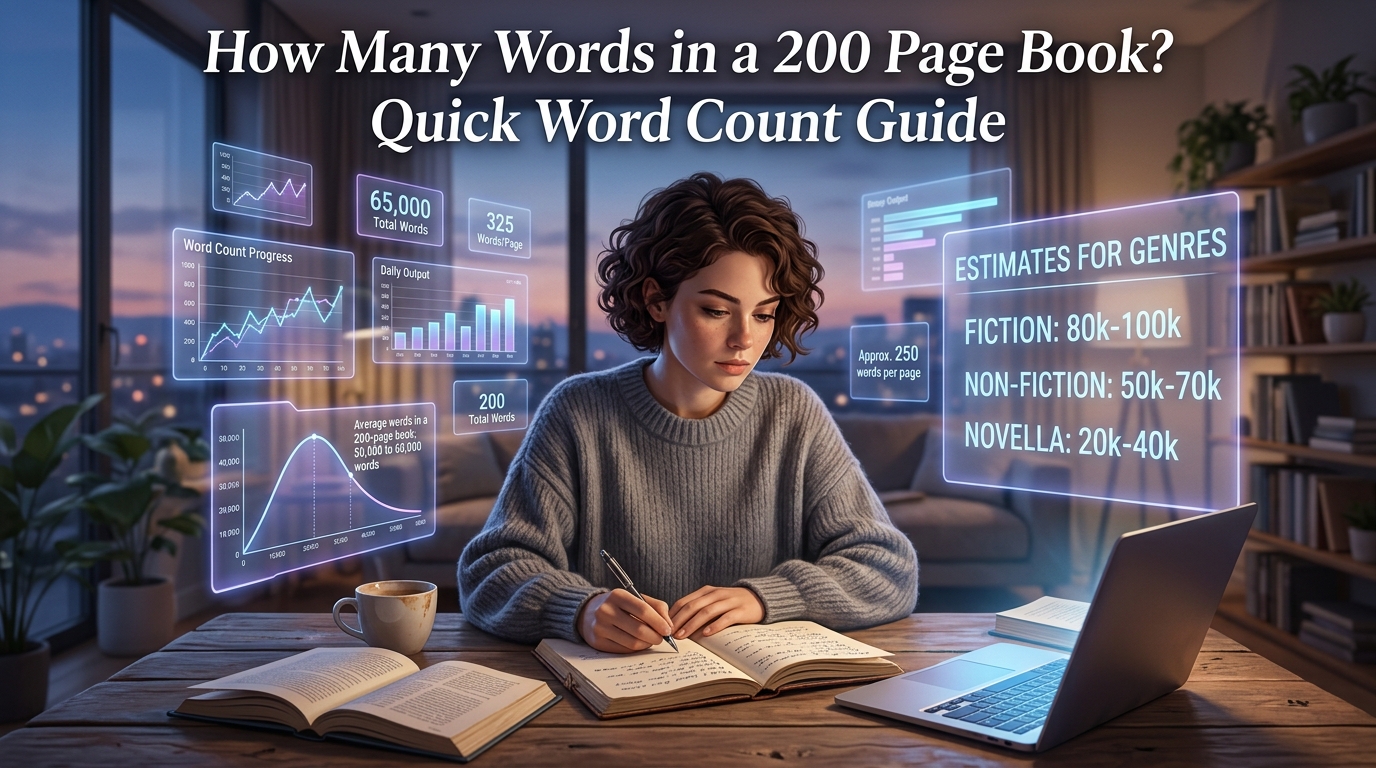
Still, for writers planning a manuscript or readers trying to estimate reading time, it helps to have a reliable range. A 200-page book typically contains anywhere between 50,000 and 80,000 words, depending on formatting choices. This estimate gives a useful starting point, but to truly understand the numbers, it’s important to explore what affects words per page.
The Average Words Per Page Explained
The concept of “words per page” is central to understanding total word count. In most professionally formatted books, a single page contains between 250 and 400 words. This variation depends on font size, line spacing, margins, and trim size.
A standard manuscript format—often used by writers submitting to publishers—assumes around 250 to 300 words per page. This format uses double spacing, 12-point font, and wide margins to allow room for editing. However, once the manuscript is typeset for publication, the same content becomes more compact, increasing the number of words per page.
In printed novels, especially trade paperbacks, it’s common to see around 300 to 350 words per page. Hardcover editions may vary slightly depending on design preferences, while mass-market paperbacks tend to be denser, sometimes reaching 400 words per page.
This means that the total word count of a 200-page book can shift significantly depending on whether you’re referring to a manuscript draft or a finished printed product.
Estimating Word Count for a 200-Page Book
To give a clearer picture, it helps to calculate word count using different averages. If we take a conservative estimate of 250 words per page, a 200-page book would contain around 50,000 words. On the higher end, using 400 words per page, the total rises to approximately 80,000 words.
These figures align with common publishing standards. Many novels fall within this range, especially in genres like literary fiction, romance, and mystery. Nonfiction books may also land in this bracket, though they often include elements like headings, charts, and spacing that reduce word density.
Rather than thinking of a fixed number, it’s more accurate to view word count as a spectrum. A 200-page book is not defined by a single figure but by a range shaped by design and content.
A Practical Word Count Table
To make this easier to visualize, here’s a table that shows how word count changes based on different words-per-page averages:
| Words Per Page | Total Words in 200 Pages |
| 250 words | 50,000 words |
| 275 words | 55,000 words |
| 300 words | 60,000 words |
| 325 words | 65,000 words |
| 350 words | 70,000 words |
| 375 words | 75,000 words |
| 400 words | 80,000 words |
This table highlights how small changes in formatting can significantly impact total word count. Even a difference of 50 words per page can add or subtract 10,000 words across an entire book.
How Book Genre Influences Word Count
Genre plays a subtle but important role in determining how many words fit into 200 pages. Fiction genres tend to follow certain conventions, both in storytelling and formatting. For instance, literary fiction often leans toward moderate word density, while thrillers may use shorter paragraphs and more white space to create pacing.
Fantasy and science fiction books, on the other hand, often include longer descriptions and world-building elements, which can increase total word count even within the same page limit. A 200-page fantasy novel might feel more text-heavy compared to a contemporary romance of the same length.
Nonfiction introduces another layer of variation. Memoirs may resemble novels in structure and density, but self-help books often include headings, quotes, and exercises that reduce the number of words per page. Academic books may include charts, references, and diagrams, further affecting overall word count.
So while the page count remains constant, the genre shapes how those pages are filled.
The Role of Formatting and Design
Formatting decisions are one of the biggest factors influencing how many words appear in a book. Elements like font type, font size, line spacing, and margins all contribute to the final layout.
A book printed in a larger font with generous spacing will naturally contain fewer words per page. This is common in books designed for accessibility, such as large-print editions or books aimed at younger readers. In contrast, compact formatting with smaller fonts and tighter spacing allows more words to fit on each page.
Trim size also plays a role. A larger book page can accommodate more text, while smaller formats limit how much content fits on each page. For example, a 6×9-inch book will generally hold more words per page than a 5×8-inch edition.
Publishers carefully balance these elements to create a reading experience that feels comfortable while maintaining cost efficiency. For writers, understanding these design choices helps set realistic expectations for how a manuscript translates into printed pages.
Manuscript Pages vs Printed Pages
One of the most common sources of confusion comes from the difference between manuscript pages and printed pages. Writers often measure their work in manuscript pages, but these do not directly correspond to the pages in a finished book.
A standard manuscript page typically contains about 250 to 300 words due to double spacing and formatting conventions. When the same text is formatted for publication, it becomes more condensed, meaning fewer printed pages are needed.
For example, a 60,000-word manuscript might be around 240 manuscript pages but could shrink to roughly 180–200 pages once published, depending on design choices. This is why publishers rely on word count rather than page count when evaluating submissions.
Understanding this distinction is essential for writers planning a 200-page book. The goal should be to target a word count range rather than focusing solely on page numbers.
Reading Time and Word Count
Word count doesn’t just matter for writers and publishers; it also affects readers. The number of words in a book directly influences how long it takes to read.
On average, an adult reads between 200 and 300 words per minute. Using this estimate, a 50,000-word book would take roughly 3 to 4 hours to read, while an 80,000-word book might require 5 to 7 hours.
This means a 200-page book can vary significantly in reading time depending on its word density. A lightly formatted book with fewer words per page will feel quicker to read, while a dense text-heavy book may require more time and focus.
For authors, this insight is useful when considering audience expectations. A fast-paced, shorter read may appeal to casual readers, while a longer, denser book might attract those looking for depth and detail.
Why Word Count Matters More Than Page Count
In the publishing world, word count is the primary metric used to evaluate a book. Agents, editors, and publishers rely on word count to assess whether a manuscript fits within industry standards for its genre.
Page count, on the other hand, is more of a visual and marketing consideration. It influences printing costs, pricing, and how a book is perceived on a shelf. However, it doesn’t provide a consistent measure of content because it varies so much with formatting.
For writers aiming to create a 200-page book, focusing on a target word count—typically between 50,000 and 80,000 words—is a more reliable approach. Once the manuscript is complete, design choices can be adjusted to achieve the desired page length.
Tips for Writers Planning a 200-Page Book
When setting out to write a book of this length, it helps to think in terms of structure and pacing rather than strict page limits. A 200-page book offers enough space to develop characters, build a narrative, and explore ideas without becoming overwhelming.
Writers often find it useful to break their work into sections or chapters, each contributing to the overall word count. By tracking progress in words rather than pages, it becomes easier to stay aligned with publishing expectations.
It’s also important to consider the intended format early on. A book designed for print may require different formatting decisions compared to an eBook, where font size and spacing can be adjusted by the reader.
Ultimately, the goal is not to hit an exact page number but to create a balanced and engaging reading experience.
Final Thoughts on Word Count and Page Length
The question of how many words are in a 200-page book doesn’t have a single fixed answer, but it does have a reliable range. Most books of this length fall between 50,000 and 80,000 words, shaped by formatting, genre, and design choices.
Understanding this range helps writers plan their projects more effectively and gives readers a better sense of what to expect. It also highlights an important truth about books: page count is just one piece of the puzzle.
What truly matters is how the words are used—how they tell a story, convey ideas, and connect with the reader. Whether a 200-page book contains 50,000 words or 80,000, its impact depends on the quality of its content, not just its length.
By focusing on word count while remaining flexible with formatting, writers can create books that meet both creative and practical goals. And in the end, that balance is what turns a collection of pages into a meaningful reading experience.