When writers begin planning a book, one of the first practical questions that comes to mind is deceptively simple: how many words are in a 300-page book? It sounds like a straightforward calculation, but the truth is far more nuanced. Page count and word count are connected, yet they are influenced by several variables such as formatting, genre, font size, spacing, and publishing standards.
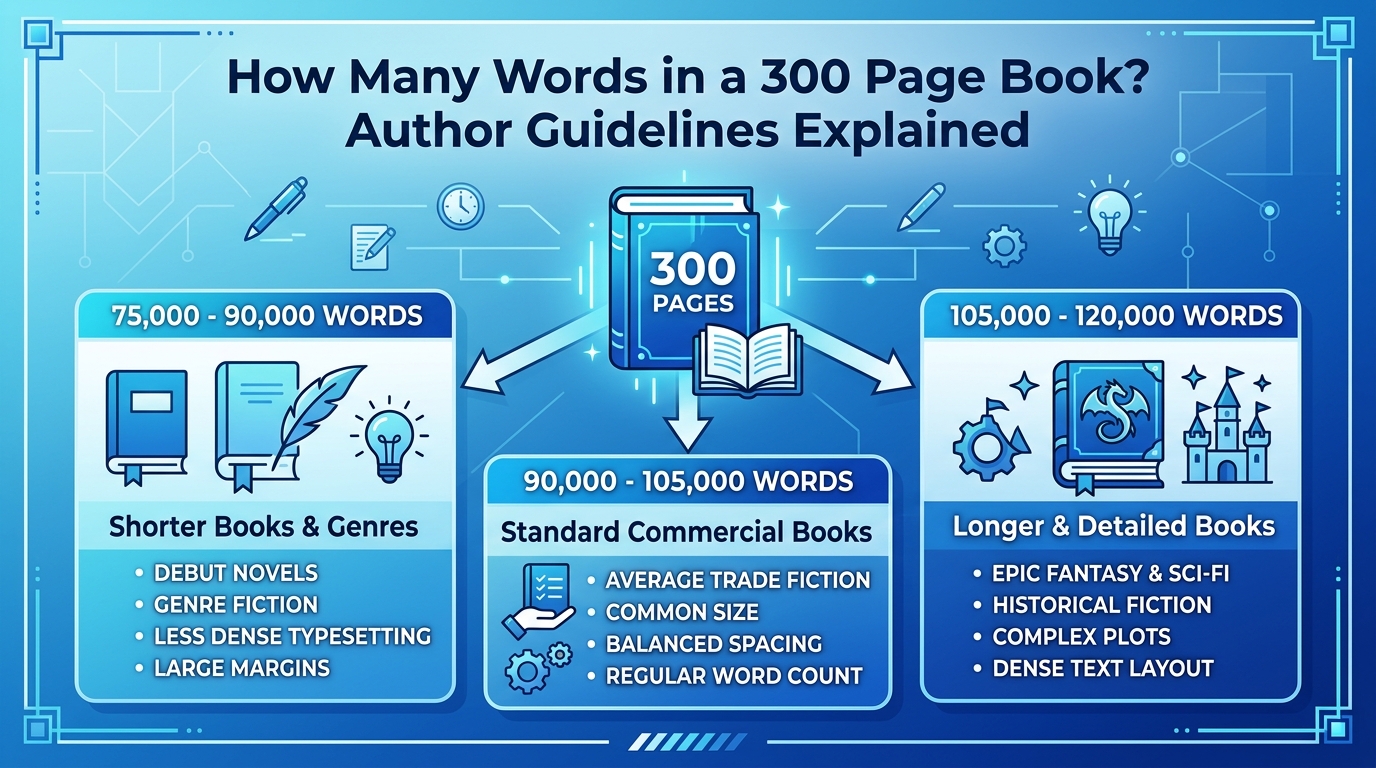
A 300-page book can range anywhere from 75,000 to 120,000 words depending on how it is formatted. This wide range often surprises new writers who assume that a page is a fixed unit of measurement. In reality, a “page” is a flexible concept that changes depending on whether you are writing a manuscript, designing a paperback, or formatting an ebook.
To make sense of this, it helps to understand the difference between manuscript pages and printed book pages. A standard manuscript page, typically formatted in double-spaced text using a 12-point font like Times New Roman, usually contains around 250 to 300 words. On the other hand, a printed book page—especially in a trade paperback—may hold anywhere from 300 to 400 words depending on layout choices.
This means that when someone refers to a “300-page book,” they are often talking about the final printed version, not the manuscript you submit to a publisher or prepare for self-publishing.
The Average Word Count of a 300 Page Book
If we take a balanced approach and assume an average of 300 to 350 words per printed page, a 300-page book will typically contain between 90,000 and 105,000 words. This estimate sits comfortably in the middle of most publishing expectations and is widely accepted across multiple genres.
However, it is important to recognize that this is not a strict rule. Books with larger fonts, wider margins, or more dialogue may have fewer words per page, while dense nonfiction texts with smaller fonts may exceed this average.
To give you a clearer perspective, here is a breakdown of how word count can vary based on words per page:
| Words Per Page | Total Words (300 Pages) |
| 250 words | 75,000 words |
| 275 words | 82,500 words |
| 300 words | 90,000 words |
| 325 words | 97,500 words |
| 350 words | 105,000 words |
| 400 words | 120,000 words |
This table illustrates how formatting alone can shift the total word count significantly, even when the page count remains fixed at 300.
Why Page Count Alone Can Be Misleading
Relying solely on page count can lead to confusion, especially for new authors. This is because page count is not standardized across all formats. A 300-page hardcover novel may not match a 300-page ebook or a 300-page manuscript document.
For example, ebooks are particularly fluid in terms of layout. The number of “pages” changes depending on the device, font size, and reader preferences. This makes word count a much more reliable metric when planning your book.
In traditional publishing, editors and agents almost always evaluate manuscripts based on word count rather than page count. This is because word count provides a consistent measure of length regardless of formatting.
Genre Expectations for a 300 Page Book
Different genres come with different expectations, and understanding these norms is essential if you want your book to meet industry standards. A 300-page book can fit comfortably within many genres, but the expected word count may vary.
In general fiction, a 300-page novel typically falls between 80,000 and 100,000 words. This range is considered ideal for most adult fiction, including literary novels, contemporary stories, and general narratives.
Fantasy and science fiction often lean toward the higher end of the spectrum. A 300-page fantasy novel might feel slightly compressed, as these genres frequently exceed 100,000 words due to world-building and complex plots.
Romance novels, on the other hand, may sit closer to 70,000 to 90,000 words, even if they reach 300 pages in print. This is because they often use more dialogue and simpler language, which can affect word density.
Nonfiction books vary widely depending on the topic. A 300-page self-help book may contain around 70,000 to 90,000 words, while a detailed academic or historical work could exceed 100,000 words.
Understanding your genre helps you determine whether your 300-page goal aligns with reader expectations.
Formatting Choices That Affect Word Count
Formatting plays a critical role in determining how many words fit into 300 pages. Small changes in layout can significantly alter the final page count without changing the actual content.
Font size is one of the most influential factors. Larger fonts increase readability but reduce the number of words per page. Similarly, line spacing affects density. Double-spaced text is standard for manuscripts, but printed books often use single spacing with slight adjustments.
Margins and page dimensions also matter. A book with wide margins and larger trim size will have fewer words per page compared to a compact paperback with tighter margins.
Even elements like chapter breaks, headings, and paragraph spacing contribute to overall page count. A book with frequent chapter breaks may reach 300 pages with fewer words than a continuous narrative.
Manuscript vs Printed Book: A Key Distinction
One of the most common mistakes writers make is confusing manuscript pages with printed pages. When you are writing your book in a word processor, you are typically working with manuscript formatting, which is designed for readability and editing rather than final presentation.
A 300-page manuscript, using standard formatting, usually contains around 75,000 to 90,000 words. However, when that manuscript is typeset and printed, it may expand or contract depending on design choices.
This is why publishers rarely ask for page counts when evaluating submissions. Instead, they request word counts because they provide a more accurate representation of the book’s length.
For self-publishing authors, understanding this distinction is equally important. When you upload your manuscript to a publishing platform, the final page count will be determined during the formatting process, not by your original document.
How to Estimate Your Book’s Length While Writing
If you are aiming for a 300-page book, the best approach is to focus on word count rather than pages. Setting a target word count allows you to maintain consistency and avoid surprises later in the publishing process.
A practical goal for a 300-page book is around 90,000 words. This gives you enough flexibility to adjust formatting without falling too far above or below your target page count.
Many writers find it helpful to break this goal into smaller milestones. For example, writing 1,000 words per day will allow you to complete a 90,000-word manuscript in approximately three months.
Tracking your progress in terms of words rather than pages also helps maintain momentum and clarity throughout the writing process.
The Role of Editing in Final Word Count
Editing is another factor that can influence the final length of your book. First drafts are often longer than the final version, as writers tend to include extra details, repetitions, or unnecessary scenes.
During the editing process, you may cut thousands of words to improve clarity and pacing. Conversely, you might add content to strengthen character development or expand on key ideas.
This means that your initial word count target should include some flexibility. A manuscript that starts at 100,000 words may be refined down to 90,000 words, ultimately fitting perfectly into a 300-page format.
Professional editors often focus on tightening language and improving flow, which can reduce word count without sacrificing depth or quality.
Self-Publishing vs Traditional Publishing Standards
The approach to word count and page count can differ slightly between self-publishing and traditional publishing, although the underlying principles remain the same.
Traditional publishers adhere more strictly to genre expectations and market standards. They often prefer manuscripts that fall within established word count ranges, as these are easier to market and produce.
Self-publishing offers more flexibility, allowing authors to experiment with length and formatting. However, reader expectations still play a significant role. A book that feels too short or excessively long for its genre may struggle to find an audience.
Even in self-publishing, aiming for a word count that aligns with industry norms is generally a wise strategy.
Why Word Count Matters More Than Page Count
Ultimately, word count is the most reliable measure of a book’s length. It provides consistency across formats and allows writers, editors, and publishers to communicate clearly.
Page count, while useful for readers, is a variable metric that depends on design choices. This is why professionals in the publishing industry rely on word count as the standard benchmark.
For writers, focusing on word count also simplifies the creative process. Instead of worrying about how many pages your book will occupy, you can concentrate on telling a compelling story or delivering valuable information.
Finding the Right Balance for Your Book
A 300-page book is a comfortable and widely accepted length for many types of writing. It offers enough space to develop ideas, build characters, and engage readers without becoming overwhelming.
The key is to strike a balance between content and structure. Rather than aiming for a specific page count, focus on delivering a complete and satisfying experience for your audience.
If your story or subject naturally fits within 90,000 words, it will likely translate into a 300-page book with standard formatting. If it requires more or fewer words, that is perfectly acceptable as long as it serves the purpose of your work.
Final Thoughts on Writing a 300 Page Book
Understanding how many words are in a 300-page book is not about finding a single fixed number. Instead, it is about recognizing the factors that influence length and learning how to work within them.
A 300-page book typically contains between 75,000 and 120,000 words, with 90,000 words being a common and practical target. By focusing on word count, considering your genre, and paying attention to formatting, you can plan your book effectively and avoid unnecessary complications.
Writing a book is as much about structure as it is about creativity. When you understand how word count and page count interact, you gain greater control over your project and can approach the writing process with confidence and clarity.
In the end, the goal is not to hit an exact number of pages but to create a book that feels complete, engaging, and worth the reader’s time.