Publishing a book on Amazon through Kindle Direct Publishing (KDP) has become one of the most accessible ways for writers to enter the global publishing market. It has lowered barriers that once made traditional publishing feel almost unreachable. You no longer need a literary agent, a publishing house approval, or upfront printing investment just to see your book listed. Amazon’s system allows almost anyone to upload a manuscript and make it available worldwide within hours.
However, this accessibility creates a misunderstanding that publishing a book is “free.” While Amazon does not charge an upfront publishing fee, the real cost of producing a book that can actually compete in the marketplace is a completely different story. Publishing on Amazon is not about paying the platform—it is about investing in the quality, presentation, and marketing of your book.
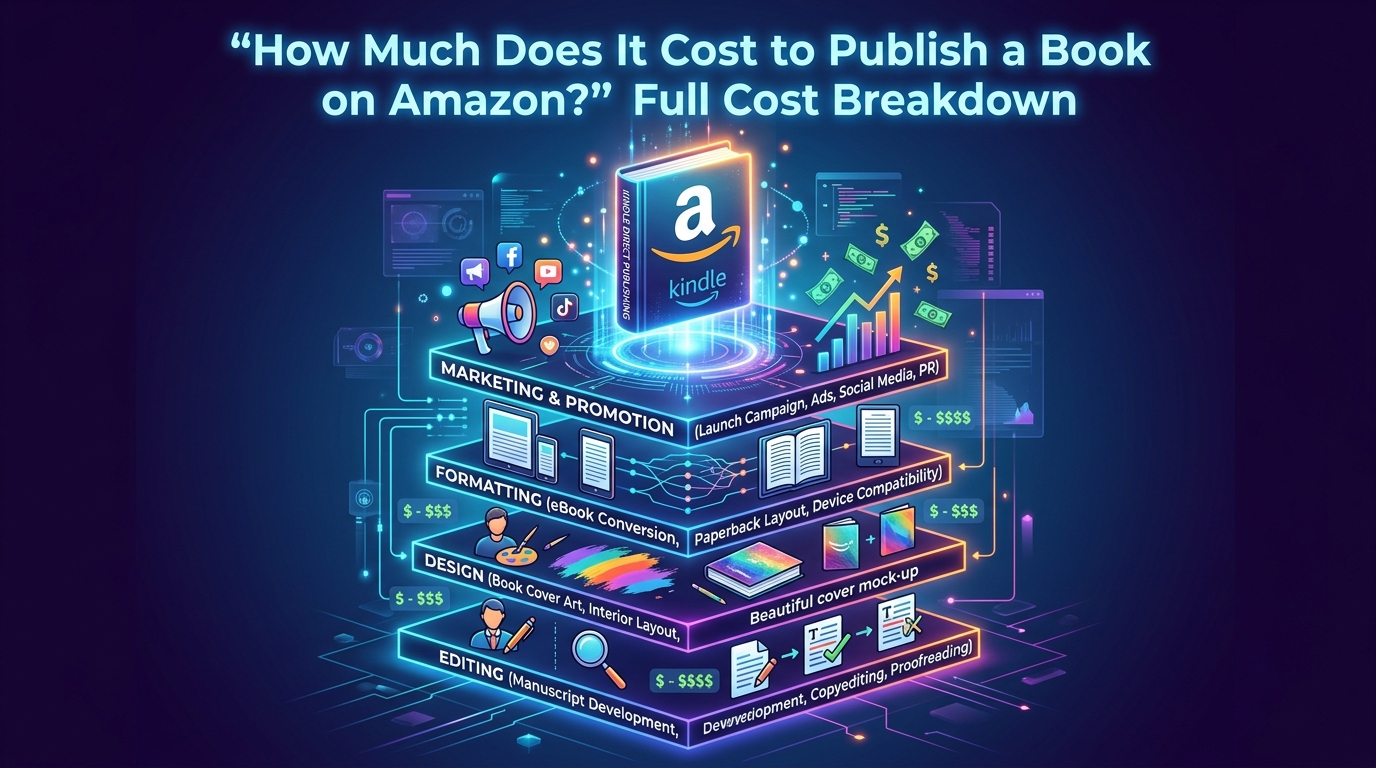
When you break it down carefully, publishing costs fall into several hidden but essential layers: editing, design, formatting, branding, distribution preparation, and marketing. Each layer contributes to whether your book simply exists or actually sells.
In reality, Amazon publishing costs range from almost zero to over $5,000 depending on how professional you want your final product to be. The difference between these ends of the spectrum is not just money—it is perception, readability, and commercial success.
Why Amazon Publishing Feels Free but Isn’t Truly Free
Amazon Kindle Direct Publishing operates on a royalty-based model. This means the platform does not charge authors to upload or list their books. Instead, Amazon earns its share after a sale occurs, mainly through printing costs for paperbacks and delivery fees for ebooks.
This structure creates an illusion of zero-cost publishing. Technically, you can write a manuscript, upload it, design a basic cover using free tools, and publish a book without spending a single dollar. But this version of “free publishing” comes with limitations that are often ignored.
The reality is that Amazon does not evaluate or improve your manuscript. It does not check whether your story is engaging, whether your formatting is readable, or whether your cover attracts buyers. It simply provides the platform. Everything that determines whether your book succeeds is your responsibility.
So while Amazon removes the traditional gatekeepers of publishing, it replaces them with a different requirement: production quality. You are no longer paying a publisher—you are becoming one.
The Real Cost Range of Publishing a Book on Amazon
The total cost of publishing depends entirely on your goals. A basic DIY book can be produced with minimal financial investment, especially if you handle editing and design yourself. However, most books that succeed commercially fall into a more professional investment range.
At the lowest level, you might spend nothing upfront, relying entirely on free tools and self-editing. This approach is common among first-time writers testing the platform. However, such books often struggle with visibility and reader trust.
A more realistic independent publishing budget falls between $1,000 and $3,500. This includes professional editing, a custom cover design, formatting assistance, and marketing.
At the high end, authors who treat their book as a business product often spend $5,000 or more. These books are usually supported by full editorial teams, branding strategy, advertising campaigns, and launch planning.
The key idea is that Amazon does not scale costs—you do. Your investment reflects how seriously you want your book to compete.
Editing Costs: The Most Critical Investment in Publishing
Editing is the foundation of any professional book. Even the most talented writers produce drafts that require refinement. Editing is not a single step but a layered process that improves clarity, structure, and readability.
The first stage is developmental editing, which focuses on the overall structure of the book. This is especially important for fiction and nonfiction works that require logical flow. In fiction, this might involve adjusting character arcs, pacing, or plot consistency. In nonfiction, it may involve reorganizing chapters or strengthening arguments.
Next comes line editing, which works at the sentence level. It improves tone, removes redundancy, and enhances readability without changing meaning. Copy editing follows, focusing on grammar, spelling, punctuation, and factual consistency.
Finally, proofreading ensures the manuscript is clean and ready for publication. It is the final safety net before the book goes live.
The cost of editing depends on word count, complexity, and editor experience. Short manuscripts may cost a few hundred dollars, while full-length books often range from $1,000 to $4,000 or more for complete professional editing.
Many authors attempt to skip editing to save money, but this is one of the most damaging decisions in self-publishing. Readers quickly notice errors, and negative reviews can permanently affect sales performance. Editing is not just polishing—it is credibility building.
Cover Design: The First Sales Tool Your Book Has
On Amazon, your cover is your first marketing asset. Readers do not pick books based on summaries alone—they respond visually first. This is especially important because Amazon is a browsing-driven marketplace where dozens of similar books appear side by side.
A professional cover communicates genre, tone, and quality within seconds. A poorly designed cover does the opposite—it creates doubt, even if the content is strong.
Cover design pricing varies widely. Pre-made covers or DIY tools may cost almost nothing, but they lack uniqueness and branding strength. Custom professional covers typically range from $100 to $800 or more, depending on the designer and complexity.
High-performing covers are usually not just visually attractive—they are strategically designed. They follow genre conventions so readers immediately recognize what type of book they are looking at. This psychological alignment plays a major role in click-through rates.
A strong cover often has more influence on initial sales than even writing quality, because it determines whether readers give your book a chance at all.
Formatting: Making Your Book Readable and Professional
Formatting is one of the most overlooked parts of publishing, yet it directly affects reading experience. A book can lose credibility instantly if the spacing is inconsistent, chapters are misaligned, or text appears cluttered on Kindle devices.
Formatting includes both ebook and print versions. Ebook formatting ensures the text adjusts properly across devices like phones, tablets, and Kindle readers. Print formatting involves fixed layouts, margins, page numbers, headers, and spine alignment.
While many authors attempt DIY formatting using free tools, mistakes are common. These errors often appear subtle but significantly affect readability. Professional formatting services ensure your book meets Amazon’s technical requirements and maintains a clean visual structure.
Costs for formatting typically range from $0 for DIY work to $50–$500 for professional services. While this is not the most expensive part of publishing, it plays a crucial role in reader satisfaction, especially for paperback editions.
ISBN, Copyright, and Ownership Structure
Amazon provides free ISBNs for paperback books, which is sufficient for most independent authors. However, some writers prefer to purchase their own ISBNs to maintain full control over publishing identity. This allows them to publish under their own imprint rather than Amazon’s assigned publisher label.
A single ISBN can cost around $100–$125 depending on the region. Authors publishing multiple books often purchase bundles to reduce long-term costs.
Copyright registration is another optional expense. While copyright protection is automatic in many countries, formal registration strengthens legal protection in case of disputes. This usually costs a small administrative fee.
These expenses are not mandatory, but they reflect a more professional publishing approach, especially for authors building long-term brands or publishing multiple books.
Marketing Costs: The Most Unpredictable but Essential Expense
Marketing is where most self-published authors either succeed or fail. Publishing a book does not guarantee visibility. Amazon contains millions of books, and without marketing, even high-quality work can remain undiscovered.
Marketing includes Amazon Ads, social media promotion, email list building, influencer outreach, and external advertising. Costs vary significantly depending on strategy and scale.
Some authors spend almost nothing and rely on organic growth. Others invest hundreds or thousands of dollars in paid campaigns to accelerate visibility. Amazon Ads, in particular, can be effective but require careful optimization to avoid wasted spending.
Marketing is not a one-time cost but an ongoing process. Even successful books continue to invest in promotion to maintain visibility in search rankings.
Complete Cost Breakdown Table (Expanded and Realistic View)
| Stage of Publishing | DIY Approach | Standard Professional Setup | Advanced Publishing Level |
| Editing | $0 – $300 | $500 – $2,000 | $2,000 – $4,000+ |
| Cover Design | $0 – $50 | $100 – $400 | $400 – $1,000+ |
| Formatting | $0 – $100 | $50 – $300 | $300 – $500+ |
| ISBN | Free – $125 | $125 | $125+ |
| Copyright | Optional $0 – $65 | $65 | $65+ |
| Marketing | $0 – $100 | $200 – $1,000 | $1,000 – $5,000+ |
| Total Cost Estimate | $0 – $500 | $1,000 – $3,500 | $3,500 – $10,000+ |
Final Reality: What You Are Actually Paying For
Publishing on Amazon is not a transaction—it is a production process. The platform itself removes entry barriers, but it does not remove competition. Every cost involved in publishing exists for one reason: to make your book competitive in a global marketplace.
A book is not judged by how easily it was uploaded. It is judged by how it looks, how it reads, and how it connects with readers. That is where the real investment lies.
In the end, Amazon publishing costs are not about the platform—they are about the standard you set for your work. A low-budget book can exist, but a professionally invested book can compete, grow, and succeed over time.