Self-publishing a paperback book has become one of the most accessible ways for writers to enter the publishing industry. What once required literary agents, publishing houses, and lengthy approval processes can now be done independently through platforms like Amazon KDP, IngramSpark, and Draft2Digital. Yet one major question continues to shape every author’s journey: how much does it actually cost to self-publish a paperback book?
The answer varies widely because every author approaches publishing differently. Some writers publish a paperback almost entirely on their own for less than a few hundred dollars, while others invest several thousand dollars into editing, design, printing, and marketing. The total cost depends on the quality level you want, the services you outsource, the length of your manuscript, and the publishing goals you hope to achieve.
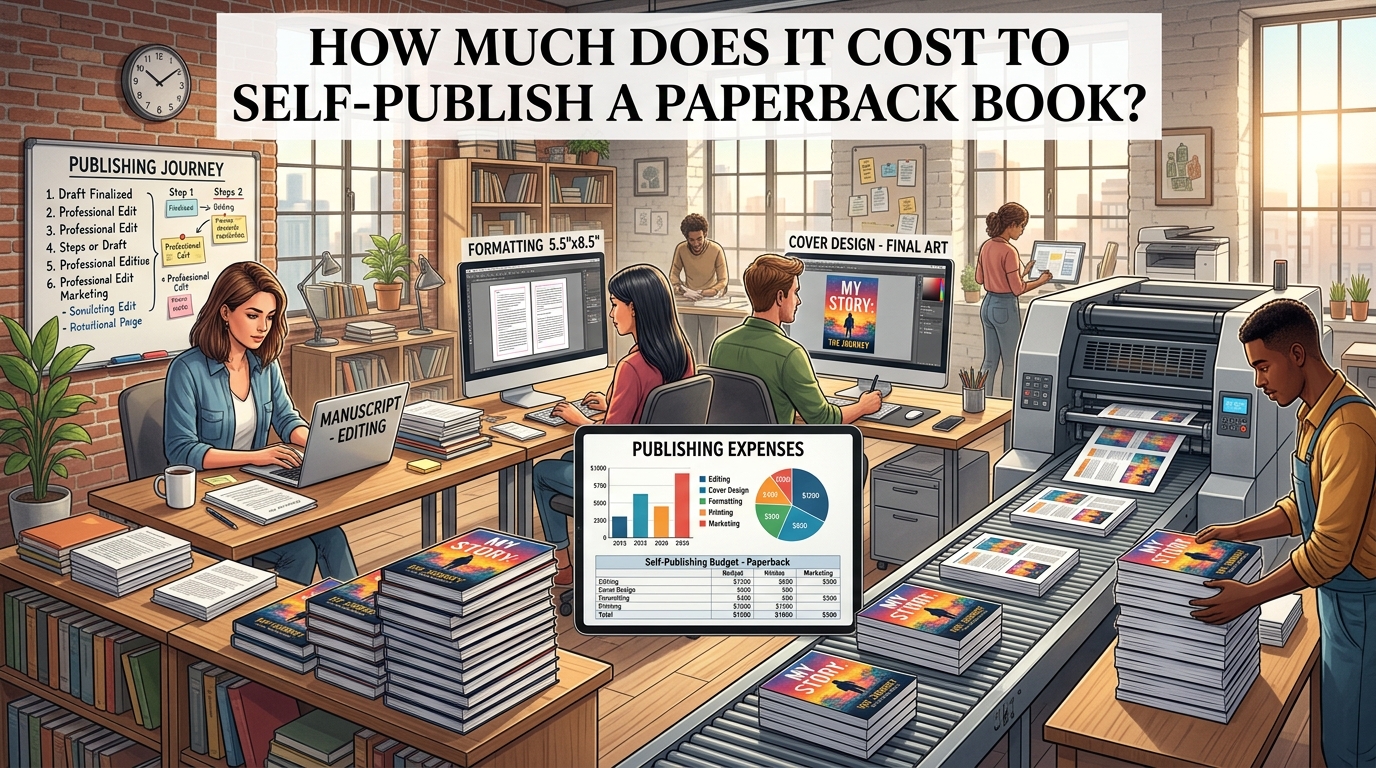
A professionally produced paperback usually costs between $500 and $5,000 depending on editing quality, cover design, formatting, and marketing choices. Industry reports and publishing guides consistently show that editing and cover design consume the largest portion of most publishing budgets.
Before calculating your publishing budget, it is important to understand that self-publishing is not just about uploading a file online. A paperback book requires preparation, production, distribution, and promotion. Each stage carries its own financial considerations, and knowing where your money goes can help you avoid unnecessary spending while still creating a professional-quality book readers will trust.
Understanding the Real Cost of Self-Publishing
Many first-time authors hear that self-publishing is “free,” especially because platforms like Amazon KDP allow you to upload a manuscript without upfront publishing fees. Technically, this is true. You can upload your manuscript and publish it without paying a publisher. However, producing a paperback readers will actually buy is another matter entirely.
Readers judge paperback books quickly. They notice cover quality, interior formatting, grammar, spacing, and print quality almost instantly. If your book appears amateurish, it can damage credibility regardless of how strong the story or information may be.
That is why experienced indie authors often invest heavily in editing and presentation. According to several recent publishing cost studies, the average professional self-publishing budget falls between $1,500 and $3,000 for a standard paperback novel.
The good news is that self-publishing offers flexibility. You control every expense. You can publish on a minimal budget, expand gradually, or invest aggressively depending on your goals.
Average Cost Breakdown for a Paperback Book
The following table provides a realistic estimate of common paperback self-publishing expenses in 2026.
| Publishing Service | Low Budget | Mid-Range Professional | Premium Professional |
| Developmental Editing | $0 | $800 | $3,000+ |
| Copy Editing | $200 | $600 | $1,500+ |
| Proofreading | $100 | $350 | $700+ |
| Cover Design | $50 | $400 | $1,500+ |
| Interior Formatting | $0 | $150 | $500 |
| ISBN Purchase | $0 | $125 | $295 |
| Printing Proof Copies | $20 | $100 | $300 |
| Marketing & Promotion | $0 | $500 | $5,000+ |
| Author Website | $0 | $100 | $500 |
| Total Estimated Cost | $370+ | $3,125+ | $11,000+ |
These numbers vary depending on book length, genre, designer reputation, and marketing ambitions.
Editing Costs for a Paperback Book
Editing is usually the largest investment in the self-publishing process. It is also the most important one. Even brilliant stories can lose readers if they contain grammar mistakes, pacing issues, repetitive dialogue, or confusing structure.
Developmental Editing
Developmental editing focuses on the overall structure of your manuscript. This includes pacing, storytelling flow, character development, chapter organization, and readability.
Fiction writers often spend between $800 and $3,000 on developmental editing depending on manuscript length and editor experience. Some editors charge per word, often between $0.03 and $0.08 per word.
This stage is particularly valuable for first-time authors because it improves the book before line-level edits begin.
Copy Editing
Copy editing focuses on grammar, clarity, consistency, punctuation, and sentence flow. For paperback books, this stage is essential because print readers tend to notice errors more than digital readers.
Professional copy editing commonly costs between $400 and $1,200 for a standard-length manuscript.
Many indie authors consider copy editing the minimum professional editing requirement.
Proofreading
Proofreading is the final quality check before publishing. It catches typos, formatting issues, spacing inconsistencies, and overlooked mistakes.
Proofreading generally costs between $200 and $600 depending on manuscript length.
Skipping proofreading may save money initially, but it can hurt reviews and reader trust later.
Cover Design Costs
Paperback cover design directly impacts sales. Readers often decide within seconds whether a book looks professional enough to buy.
A custom paperback cover usually costs between $200 and $800 for independent authors. High-end designers may charge more than $1,500 for specialized genres or illustrated covers.
Budget-conscious writers sometimes use pre-made covers or freelance marketplaces, where decent designs can cost between $50 and $200. While this can work for some genres, custom covers tend to perform better in competitive markets like fantasy, romance, thriller, and self-help.
A paperback cover is more complicated than an ebook cover because it includes the front cover, spine, and back cover layout. The spine width changes depending on page count and paper type, which means paperback covers must be formatted precisely for printing platforms.
Interior Formatting Expenses
Formatting determines how your book looks inside. This includes margins, page numbers, chapter headings, font spacing, trim size, and alignment.
Poor formatting immediately signals inexperience to readers. A professionally formatted paperback feels polished and easier to read.
Some authors use free formatting tools such as Kindle Create or Reedsy Book Editor. Others purchase software like Vellum or Atticus for long-term publishing projects. Professional formatting services usually range from $50 to $500.
Formatting costs increase for books with images, illustrations, charts, tables, or complex layouts.
ISBN and Barcode Costs
Every paperback book requires an ISBN if you want wide distribution. An ISBN acts as the unique commercial identifier for your book.
Amazon KDP provides free ISBNs for paperback books, which works well for many indie authors. However, free ISBNs usually list Amazon as the publisher instead of your own publishing imprint.
Purchasing your own ISBN offers greater publishing control and branding flexibility. In the United States, a single ISBN costs around $125, while bulk ISBN packages reduce the per-unit cost.
Some authors skip purchasing ISBNs initially and upgrade later after establishing their publishing brand.
Printing Costs for Paperback Books
Paperback printing works differently from traditional bulk publishing. Most indie authors now use print-on-demand services, which print books only when customers place orders.
This means you usually do not pay massive upfront printing costs.
Instead, the platform deducts printing expenses from your royalties after each sale.
A standard 250-page black-and-white paperback often costs around $3 to $6 per copy to print depending on trim size, paper quality, and distribution region.
If you order author copies for events, giveaways, or launches, your upfront costs will increase.
For example, printing 100 paperback copies can cost between $300 and $800 depending on specifications.
Marketing Costs and Promotion
Many new authors underestimate marketing expenses. Publishing the book is only half the process. Readers still need to discover it.
Marketing budgets vary dramatically. Some indie authors spend nothing initially and rely entirely on social media, organic reach, and word-of-mouth recommendations. Others invest thousands into advertising campaigns.
Common marketing expenses include:
- Amazon Ads
- Facebook or Instagram ads
- TikTok promotions
- ARC reader campaigns
- Book bloggers and influencers
- Email newsletter software
- Promotional graphics
- Book trailers
Many experienced self-publishers recommend starting small and scaling marketing only after understanding audience behavior. Reddit discussions from indie publishing communities repeatedly emphasize that heavy advertising for a first book may not generate strong returns immediately.
Organic audience-building often proves more sustainable for new authors.
Optional Costs That Many Authors Forget
Several smaller expenses can quietly increase your publishing budget.
Author Website
An author website adds professionalism and helps readers discover future books. Basic websites may cost under $100 annually, while professionally designed author sites can exceed several hundred dollars.
Copyright Registration
Some countries allow official copyright registration for legal protection. In the United States, registration currently costs around $65.
Proof Copies
Most authors order proof copies before publication to check printing quality, formatting, and cover alignment. These copies may cost between $10 and $30 each including shipping.
Software Subscriptions
Writing and editing software subscriptions can also increase long-term expenses. Tools like Grammarly, ProWritingAid, Canva, and Scrivener are common among self-publishing authors.
Can You Self Publish a Paperback for Free?
Technically, yes.
An author can write their own manuscript, design their own cover, use free formatting tools, accept a free ISBN from Amazon, and publish through KDP without upfront publishing costs.
However, completely free publishing often comes with trade-offs in quality, discoverability, and reader trust.
Readers today compare indie books against professionally published titles. That means design, editing, and formatting standards are much higher than they were a decade ago.
A low-budget approach works best for hobby writers, personal memoirs, niche projects, or authors willing to learn publishing skills independently.
What Most Successful Indie Authors Actually Spend On
Across self-publishing communities, one consistent trend appears repeatedly: authors who prioritize editing and cover quality tend to achieve better reader engagement.
Discussions among indie authors frequently point out that overspending on vanity publishing packages often leads to disappointment, while strategic spending on essential services delivers stronger results.
Most experienced self-publishers recommend focusing spending on:
- Professional editing
- Strong genre-specific cover design
- Clean formatting
- Reader-focused marketing
These four areas usually create the biggest impact on reader experience and long-term sales potential.
Paperback Publishing Platforms and Their Costs
Amazon KDP
Amazon KDP is one of the most widely used self-publishing platforms for paperback books because it allows authors to publish with no upfront fees. Writers can upload manuscripts and cover files for free, while Amazon handles printing through its print-on-demand system. This means books are only printed after customers place orders, helping authors avoid large inventory costs. KDP also provides access to Amazon’s global marketplace, making books available in multiple countries. Royalties are calculated after printing expenses are deducted from the sale price.
IngramSpark
IngramSpark is popular among professional indie authors because it offers wider distribution to bookstores, libraries, and retailers worldwide. Unlike Amazon KDP, IngramSpark focuses heavily on wholesale distribution and bookstore accessibility. Although setup fees may apply, the platform is known for strong print quality and broader physical retail reach.
Draft2Digital
Draft2Digital mainly focuses on ebook distribution but also provides useful publishing tools for independent authors. It simplifies formatting, distribution management, and publishing across multiple retailers. Many beginners prefer it because of its user-friendly system and automated publishing features.
Each platform has different royalty structures, print costs, and distribution advantages.
How to Reduce Self-Publishing Costs Without Sacrificing Quality
Reducing publishing expenses does not necessarily mean producing a low-quality book. Many successful indie authors lower costs strategically.
Authors often save money by self-formatting their books, hiring freelance editors instead of agencies, using pre-made covers, and focusing on organic marketing before paid ads.
Another common strategy is building publishing skills gradually. Learning basic formatting, marketing, and design fundamentals can significantly reduce future publishing expenses.
Many indie authors also spread costs over time rather than paying everything upfront. They may complete editing first, save for cover design later, and delay marketing campaigns until launch approaches.
Is Self-Publishing a Paperback Worth the Cost?
For many writers, self-publishing offers creative freedom that traditional publishing cannot match. Authors maintain ownership rights, pricing control, publishing timelines, and royalty percentages.
Financially, paperback self-publishing can absolutely become profitable, but success rarely happens overnight.
According to recent publishing data, professional-quality self-published books tend to perform better commercially than minimally produced titles.
That does not mean authors must spend thousands immediately. It means thoughtful investment in reader experience usually matters more than cutting every possible corner.
A paperback book represents more than printed pages. It becomes part of your author brand, credibility, and long-term publishing career.
Final Thoughts
The cost to self-publish a paperback book can range from almost nothing to several thousand dollars depending on your publishing goals, quality expectations, and marketing strategy.
A minimal DIY paperback may cost under $500, while a professionally produced release often falls between $1,500 and $5,000. Editing, cover design, formatting, and marketing remain the biggest expenses throughout the process.
The most important thing for authors to understand is that self-publishing is flexible. You decide where to invest, where to save, and how quickly to grow your publishing career.
For first-time authors especially, the smartest approach is usually balanced spending rather than extreme budgeting. Investing in a strong cover, clean editing, and readable formatting often creates a far greater impact than expensive publishing packages or excessive advertising.
Paperback self-publishing is no longer reserved for industry insiders. With the right planning, realistic budgeting, and professional presentation, independent authors can successfully publish books that compete confidently in today’s publishing market.