Academic writing has evolved dramatically over the past decade. Traditional publishing houses no longer control every valuable source of information available to researchers, students, and independent scholars. Today, self-published books have become increasingly common across industries, particularly in business, technology, creative writing, memoirs, and specialized research fields. Because of this shift, universities and institutions now encounter self-published works far more frequently in assignments, dissertations, journal articles, and independent research projects.
Harvard referencing remains one of the most widely used citation styles across universities worldwide. While many students understand how to cite traditionally published books, confusion often begins when the source is independently published. Questions usually arise about whether self-published books are credible, how the publisher name should appear, and what information is required when an author acts as both writer and publisher.
Understanding how to reference a self-published book correctly is important because citation accuracy directly affects academic integrity. A poorly formatted reference can weaken the professionalism of an otherwise strong paper. More importantly, proper referencing allows readers to trace the original material, evaluate the source, and understand the context behind the information used in academic work.
Harvard referencing follows a structured author-date system. Even though self-published books differ from traditional publications, the fundamental Harvard citation structure remains mostly the same. However, there are subtle differences in how the publisher is listed, how publication details are displayed, and how digital editions should be referenced.
What Is a Self-Published Book?
A self-published book is a work released independently by the author without the involvement of a traditional publishing company. In self-publishing, the writer typically controls editing, formatting, cover design, distribution, and marketing. Modern publishing platforms have made independent publishing easier than ever, allowing authors to distribute books globally in digital and print formats.
Self-published books appear in many forms. Some are academic works written by independent researchers. Others include autobiographies, niche educational guides, professional manuals, or creative literature. Platforms such as Amazon Kindle Direct Publishing and print-on-demand services have significantly increased the visibility of independently published material.
From an academic perspective, a self-published source is not automatically unreliable. Many respected professionals release independent work outside mainstream publishing systems. However, institutions often expect students to evaluate such sources carefully before using them in research.
When referencing these books in Harvard style, the key challenge lies in identifying the publisher correctly. Since the author frequently acts as the publisher, the citation structure requires slight adjustments compared to traditionally published books.
Why Correct Harvard Referencing Is Important
Referencing is more than a technical requirement. It is a system that supports transparency, credibility, and scholarly ethics. Harvard referencing allows readers to locate the original source while demonstrating that the writer has engaged with existing research responsibly.
Incorrect citations can create confusion regarding authorship and publication details. In academic settings, poor referencing may also lead to accusations of plagiarism, even when the omission was accidental. Proper Harvard referencing ensures that credit is given accurately and consistently.
When dealing with self-published books, accuracy becomes even more important because publication details are sometimes less standardized than those of traditional publishers. Some self-published works may omit clear publisher information, ISBN numbers, or publication cities. Understanding how Harvard style adapts to these cases helps maintain consistency throughout academic writing.
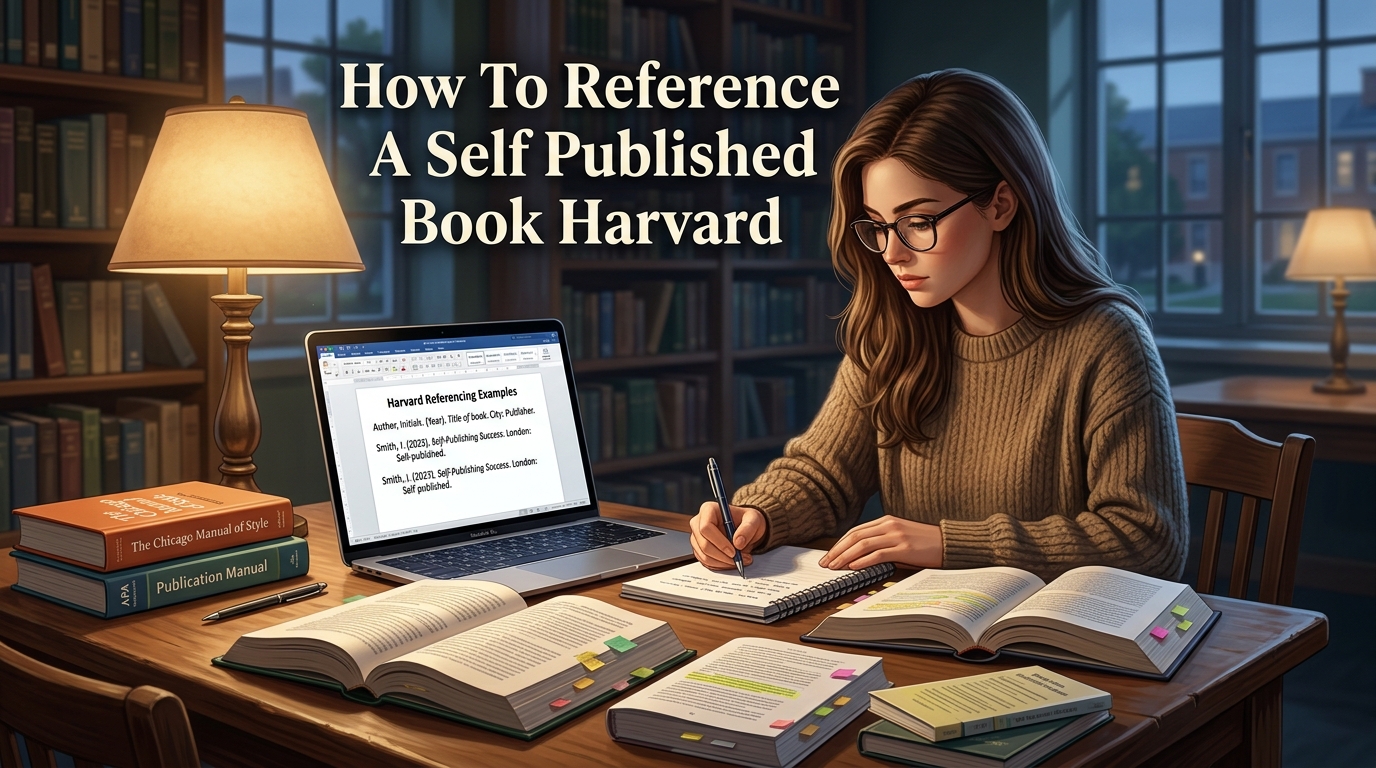
The Basic Harvard Reference Format for a Self-Published Book
The standard Harvard reference structure for a self-published book generally follows this format:
| Element | Format |
| Author | Surname, Initial(s). |
| Year | (Year of publication) |
| Title | Book title in italics |
| Publisher | Self-published or author name |
| Location | City of publication |
An example of a basic self-published book reference would look like this:
Smith, J. (2022) Modern Creative Writing Techniques. Self-published, London.
In this example, the phrase “Self-published” replaces the name of a traditional publishing company. Some universities also allow the author’s own name to appear as the publisher if that information is clearly stated in the book.
How Harvard In-Text Citations Work for Self-Published Books
Harvard referencing uses an author-date citation system inside the body of the text. The in-text citation for a self-published book works exactly the same way as any other book citation.
A narrative citation might appear like this:
Smith (2022) explains that independent publishing has transformed modern authorship.
A parenthetical citation would appear like this:
Independent publishing continues to reshape the literary industry (Smith, 2022).
If a direct quotation is used, the page number should also be included.
For example:
“Digital publishing has democratized access to readers worldwide” (Smith, 2022, p. 45).
The self-published status of the book does not affect the format of the in-text citation. The difference only appears in the full reference list entry.
Referencing a Self-Published Book With the Author as Publisher
Many self-published books explicitly list the author as the publisher. In these cases, Harvard style may present the citation differently depending on institutional guidelines.
A common format looks like this:
Brown, T. (2021) The Future of Independent Research. T. Brown Publishing, Manchester.
If no publishing imprint exists and the author independently produced the work, some institutions prefer the simpler format:
Brown, T. (2021) The Future of Independent Research. Self-published, Manchester.
Students should always review their university’s Harvard style guide because minor variations often exist between institutions.
Referencing Self-Published eBooks in Harvard Style
Digital publishing has made self-published eBooks extremely common. Harvard referencing for eBooks includes additional details related to online access and digital format.
The general structure usually follows this pattern:
Author Surname, Initial(s). (Year) Title. eBook edition. Publisher. Available at: URL (Accessed: Date).
An example would look like this:
Johnson, P. (2023) Digital Entrepreneurship Today. eBook edition. Self-published. Available at: https://www.example.com (Accessed: 14 May 2026).
Including the access date is important because online content may change or become unavailable over time.
Some institutions also require the platform name, especially if the book was accessed through Kindle, Google Books, or another digital library service.
How to Reference a Print-on-Demand Self-Published Book
Print-on-demand services create another layer of complexity in Harvard referencing. Many independent authors use services that print copies only when orders are placed. Despite the different production method, the reference format remains largely unchanged.
A typical citation may appear as follows:
Walker, S. (2020) Independent Publishing Strategies. Self-published, Birmingham.
The print-on-demand nature of the book usually does not need to be mentioned unless specifically relevant to the discussion.
Evaluating the Credibility of Self-Published Sources
One reason students hesitate to cite self-published books is concern over academic credibility. Traditional publishing generally involves editorial review, professional proofreading, and external quality control. Self-published works may not always undergo the same process.
However, credibility should be evaluated based on the author’s expertise, evidence, citations, and relevance rather than publication method alone. Many professionals, researchers, and industry experts choose self-publishing to maintain creative control or publish specialized work quickly.
When using a self-published source in academic writing, it is wise to assess the author’s background carefully. A book written by a recognized expert may still hold strong academic value even without a traditional publisher.
Universities sometimes advise students to use self-published material cautiously, especially when stronger peer-reviewed sources are available. Nevertheless, in emerging fields or niche topics, self-published books may provide unique insights unavailable elsewhere.
Common Mistakes When Referencing Self-Published Books
Many referencing mistakes occur because students try to force self-published books into the structure used for traditional publishers. One common issue involves omitting the publisher entirely. Even if the author self-published the work, the publisher section should still contain “Self-published” or the author’s publishing imprint.
Another frequent mistake involves confusing printing companies with publishers. A printing service is not necessarily the publisher. Students should identify who actually released the book rather than who physically printed it.
Some writers also forget to italicize the book title, which is a key Harvard formatting requirement. Others omit publication locations when their institution still expects them.
In digital references, failing to include access dates or URLs can create incomplete citations. Consistency is essential throughout the reference list.
Differences Between Harvard Variations
Harvard referencing is not controlled by a single universal authority. Different universities often customize the style slightly. Because of this, the citation format for self-published books may vary between institutions.
One university may require “Self-published” in the publisher field, while another may prefer the author’s name. Some institutions still request city names, while others no longer require publication locations.
For example:
Miller, R. (2022) Creative Independence in Publishing. Self-published.
Another institution may format it as:
Miller, R. (2022) Creative Independence in Publishing. Leeds: Self-published.
These differences highlight the importance of checking institutional guidelines before finalizing academic work.
Referencing Self-Published Books With Missing Information
Some independently published books contain incomplete publication details. In these situations, Harvard referencing adapts by using standard abbreviations.
If no publication date exists, “n.d.” meaning “no date” is used.
Example:
Clark, E. (n.d.) Modern Freelance Writing. Self-published, Bristol.
If the place of publication is missing, it may be omitted depending on institutional guidelines.
When author information is unavailable, the title may move into the author position, though this is less common for books.
The goal is always to provide enough information for readers to identify and locate the source as accurately as possible.
Harvard Reference Examples for Different Self-Published Sources
The following table demonstrates how different types of self-published books may appear in Harvard style.
| Source Type | Harvard Reference Example |
| Print self-published book | Adams, L. (2021) The Independent Writer. Self-published, Oxford. |
| Self-published eBook | Reed, P. (2024) Digital Publishing Today. eBook edition. Self-published. Available at: https://www.example.com (Accessed: 14 May 2026). |
| Author as publisher | Hill, D. (2020) Creative Research Methods. D. Hill Publishing, Glasgow. |
| No publication date | Green, S. (n.d.) Modern Marketing Insights. Self-published, London. |
| Online PDF book | Carter, J. (2022) Entrepreneurship Basics. Self-published. Available at: https://www.example.com (Accessed: 14 May 2026). |
These examples show how Harvard referencing remains flexible while maintaining consistency.
How Self-Publishing Has Changed Academic Research
The rise of self-publishing has transformed the information landscape. Academic researchers no longer rely exclusively on university presses and established publishing houses. Independent authors now contribute valuable content in fields such as business innovation, digital marketing, software development, psychology, and entrepreneurship.
This shift has expanded the range of accessible perspectives available to students and scholars. At the same time, it has increased the importance of source evaluation and accurate referencing practices.
Harvard referencing continues to provide a reliable structure for integrating these newer forms of publishing into academic work. Whether a source comes from a major academic press or an independent author, the purpose of citation remains the same: transparency, traceability, and intellectual honesty.
Tips for Students Using Self-Published Sources
Students often feel uncertain about whether they should use self-published books at all. The answer largely depends on the assignment, the field of study, and the quality of the source itself.
In subjects that prioritize peer-reviewed evidence, self-published books should generally support rather than replace academic journal articles. In creative writing, business, entrepreneurship, or media studies, independently published books may carry greater relevance.
Before using a self-published source, students should evaluate the author’s qualifications, examine the evidence provided, and determine whether the work aligns with academic expectations. If uncertainty remains, consulting a lecturer or supervisor is usually the safest approach.
Once the source is approved for use, correct Harvard referencing ensures the citation appears professional and academically appropriate.
The Future of Harvard Referencing in the Digital Publishing Era
As publishing technology continues evolving, referencing systems must adapt alongside it. Self-publishing is no longer viewed as a fringe alternative. Many bestselling authors, industry professionals, and educators now publish independently while reaching global audiences.
Digital platforms have blurred the boundaries between traditional and independent publishing. Consequently, academic referencing styles increasingly accommodate these changes through flexible citation guidelines.
Harvard referencing remains one of the most adaptable systems because of its straightforward author-date structure. Whether referencing a printed academic text, an independently published memoir, or a digital eBook, the system continues to prioritize clarity and accessibility.
Students who understand how to reference self-published books correctly are better prepared for modern research environments where information comes from increasingly diverse publishing models.
Conclusion
Learning how to reference a self-published book in Harvard style is an essential academic skill in today’s publishing landscape. As independent publishing continues growing across industries, students and researchers encounter self-published sources more frequently than ever before.
Although self-published books differ from traditionally published works, Harvard referencing handles them with only minor adjustments. The author-date structure remains consistent, while the publisher field typically includes “Self-published” or the author’s publishing imprint.
Understanding the correct formatting for print books, eBooks, online editions, and missing publication details helps ensure accurate citations and stronger academic credibility. More importantly, proper referencing reflects professionalism, integrity, and respect for intellectual property.
Self-published sources can contribute meaningful insights to academic research when chosen carefully and cited correctly. By mastering Harvard referencing for these materials, students gain confidence navigating modern research environments shaped by digital publishing and independent authorship.