
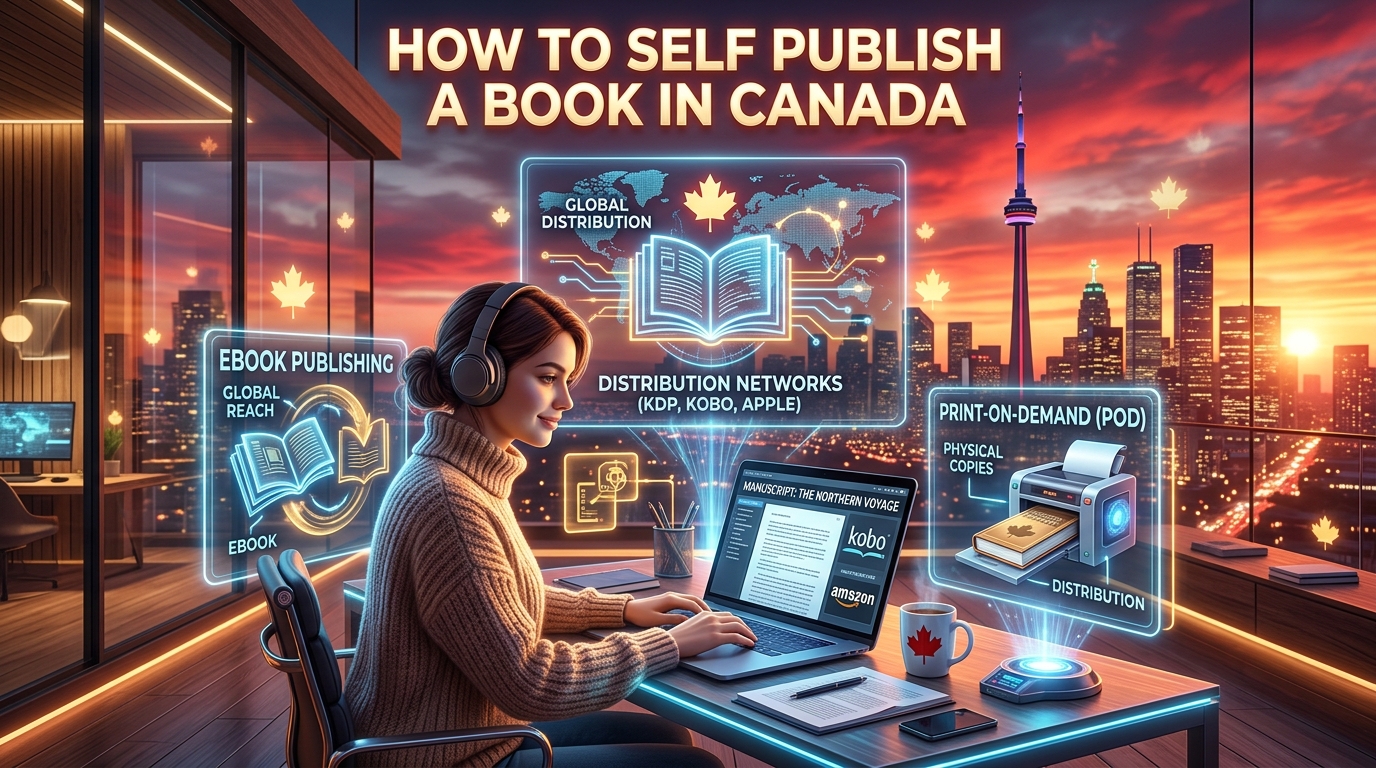
Self-publishing in Canada has changed dramatically over the last decade. What once required a traditional publishing contract, expensive printing agreements, and access to major bookstores can now be done independently from a laptop. Canadian writers today have more control than ever over how they publish, distribute, market, and profit from their books. Whether you are writing fiction, memoir, poetry, children’s literature, or nonfiction, the self-publishing route gives authors the opportunity to build a publishing career without waiting for industry gatekeepers.
The Canadian publishing landscape also offers one major advantage that many international authors envy: free ISBNs through the Canadian government. Unlike the United States, where authors often pay for ISBN registration, eligible Canadian publishers and self-publishers can obtain them without cost through Library and Archives Canada.
Still, self-publishing successfully involves far more than uploading a manuscript online. The process includes editing, formatting, cover design, distribution, pricing, branding, legal considerations, and long-term marketing. A professionally published book requires thoughtful planning from beginning to end.
This guide explains how to self-publish a book in Canada step by step while avoiding the most common mistakes that hold independent authors back.
Everything Authors Should Know About Self-Publishing
Many first-time writers believe self-publishing simply means printing a book independently. In reality, self-publishing means becoming the publisher yourself. That means you control the creative direction, publishing timeline, pricing, branding, royalties, and distribution channels.
Traditional publishing companies normally handle editing, design, printing, distribution, and marketing. When you self-publish, those responsibilities shift to the author. Some writers manage everything themselves, while others hire freelancers or publishing service providers to assist with production.
The advantage is freedom. You own your rights, maintain creative authority, and receive higher royalty percentages than most traditionally published authors. The challenge is that quality control depends entirely on you.
Canadian authors are increasingly choosing independent publishing because it allows faster publication, direct audience building, and greater financial control. With platforms like Amazon KDP, IngramSpark, Kobo Writing Life, and other global distribution systems, Canadian books can now reach international readers almost instantly.
Preparing Your Manuscript Before Publishing
Before thinking about covers or printing, the manuscript itself must be publication-ready. Many self-published books fail because authors rush this stage.
A finished draft is not the same thing as a finished book.
The first stage involves developmental refinement. This includes improving pacing, structure, dialogue, clarity, character arcs, and consistency. Fiction authors often focus heavily on narrative flow, while nonfiction writers may need to improve organization and readability.
After self-revision comes professional editing. Canadian publishing professionals strongly recommend hiring editors before publication because editing directly affects reader trust and review quality. Even excellent writers miss errors in their own work.
Editing usually happens in three levels. Developmental editing improves structure and content. Copyediting fixes grammar, readability, and consistency. Proofreading catches final formatting and typographical issues before release.
Skipping editing might save money initially, but poorly edited books often struggle commercially and receive negative reviews that are difficult to recover from.
Choosing the Right Publishing Format
Canadian authors today typically publish in three primary formats: ebook, paperback, and hardcover. Some also release audiobooks.
Each format serves a different audience. Ebook readers prioritize convenience and affordability. Print readers often prefer physical ownership and collector value. Audiobook audiences continue growing rapidly because of mobile listening habits.
Every format requires separate production preparation. Ebook formatting differs significantly from print formatting because digital devices resize content dynamically. Print books require precise margin settings, bleed areas, trim sizes, and print-ready files.
Importantly, each version of your book requires its own ISBN in Canada. Paperback editions, hardcovers, ebooks, and audiobooks all need separate identifiers if distributed independently.
Getting Free ISBNs in Canada
One of the most valuable publishing benefits available to Canadian authors is the ability to receive free ISBNs from Library and Archives Canada.
An ISBN, or International Standard Book Number, acts as the global identifier for your book. Retailers, distributors, bookstores, and libraries use ISBNs to track and organize publications.
Canadian self-publishers who meet eligibility requirements can create an ISBN account online through the official government publishing portal.
Who Qualifies for Free Canadian ISBNs?
Eligible publishers generally must:
| Requirement | Explanation |
| Canadian residency or business presence | Self-publishers must reside in Canada or operate from Canada |
| Publishing control | You must control the content and publishing rights |
| Distribution availability | The publication must be made available in Canada |
| Qualifying publication type | Books, ebooks, audiobooks, and educational publications qualify |
Many new authors are surprised to learn that low-content books such as blank journals, planners, and notebooks may not qualify for ISBN assignment under Canadian eligibility rules.
Another important detail involves timing. Recent discussions among Canadian self-publishers suggest ISBN account approval times may occasionally take several weeks because of application volume.
Because of this, authors should apply for ISBN access early in the publishing process rather than waiting until launch week.
Designing a Professional Book Cover
Readers absolutely judge books by their covers.
In online bookstores, your cover functions as your primary advertisement. A professionally designed cover communicates genre, tone, credibility, and production quality within seconds.
Many self-published books fail commercially because their covers appear amateurish. Poor typography, cluttered visuals, and incorrect genre design can instantly discourage readers.
Canadian authors often hire freelance cover designers or publishing studios for this stage. Designers typically create both ebook and print-ready versions because print covers require spine measurements and back-cover layouts.
A successful cover should achieve three goals simultaneously. It should attract attention, match reader expectations within the genre, and remain visually clear even as a small digital thumbnail.
For example, thriller covers often use dark tones and bold typography, while romance covers emphasize emotional imagery and softer aesthetics. Children’s books usually rely on vibrant colors and illustration-driven presentation.
Professional cover design is not simply decoration. It is part of your sales strategy.
Formatting Your Book for Publishing Platforms
Formatting determines how readable and professional your book appears once readers open it.
Print formatting includes chapter spacing, font selection, margin sizing, page numbering, headers, and paragraph alignment. Ebook formatting requires compatibility across Kindle devices, tablets, and smartphone reading apps.
A badly formatted book creates frustration for readers and damages credibility. Common issues include inconsistent spacing, broken chapter layouts, missing page breaks, and distorted ebook conversions.
Most authors either learn formatting software themselves or hire specialists. Programs such as Adobe InDesign, Atticus, Vellum, and Scrivener are commonly used for publishing layouts.
Canadian publishing experts often recommend testing both ebook and print proofs carefully before release to catch formatting problems early.
Choosing Where To Publish Your Book
One of the biggest decisions Canadian self-publishers face is selecting distribution platforms.
Different platforms serve different purposes, and many authors combine multiple services to maximize visibility.
Amazon Kindle Direct Publishing (KDP)
Amazon KDP remains the most dominant self-publishing platform globally. It allows authors to publish ebooks and paperbacks with direct access to Amazon marketplaces worldwide.
KDP offers relatively simple setup, print-on-demand technology, and strong international reach. Many Canadian authors begin here because the system is beginner-friendly.
IngramSpark
IngramSpark is widely respected for broader bookstore and library distribution. Many independent bookstores and libraries order through Ingram’s distribution network rather than Amazon directly.
Canadian authors often use both KDP and IngramSpark simultaneously to expand retail reach. Community discussions among self-publishers frequently describe IngramSpark as valuable for wider distribution opportunities.
Kobo Writing Life
Kobo has strong market presence in Canada and remains particularly popular among Canadian ebook readers. Publishing through Kobo Writing Life allows direct access to Kobo’s ebook ecosystem.
Direct Sales Through Personal Websites
Some authors also sell books directly through personal websites to maximize profit margins and build reader relationships. Direct selling allows greater pricing flexibility and customer ownership.
Print-On-Demand vs Bulk Printing
Canadian self-publishers generally choose between print-on-demand services and bulk printing.
Print-on-demand means books are printed only when readers place orders. This avoids inventory storage costs and reduces financial risk.
Bulk printing involves ordering larger quantities upfront. This can reduce per-book printing costs but requires storage, shipping management, and higher initial investment.
Most new authors start with print-on-demand because it allows low-risk publishing without warehouse management.
As readership grows, some authors transition into offset printing for conferences, bookstore events, and direct sales.
Understanding Canadian Legal Deposit Requirements
Many first-time Canadian authors are unaware of legal deposit obligations.
Library and Archives Canada requires publishers to provide copies of published works for national archival purposes. This process helps preserve Canadian publishing history.
The legal deposit requirement applies to many books published in Canada, including self-published titles.
Fortunately, the process is usually straightforward once your book becomes available publicly.
Authors should review current official guidelines carefully because requirements may vary depending on publication format and distribution method.
Pricing Your Self-Published Book
Pricing is both a psychological and strategic decision.
Many new authors either overprice their books due to emotional attachment or underprice them in hopes of attracting readers. Neither approach always works.
Several factors influence pricing, including genre expectations, page count, production cost, audience demographics, and platform royalty structures.
Ebooks typically sell at lower price points than print books. However, pricing too low can unintentionally reduce perceived value.
Canadian authors also need to consider exchange rates, international pricing conversions, and regional marketplace settings when distributing globally.
Testing pricing over time is common. Many independent authors adjust prices based on promotional campaigns, seasonal demand, or reader growth.
Marketing Your Book in Canada
Publishing a book without marketing is like opening a store in the middle of nowhere.
Visibility matters.
Self-publishing success today depends heavily on audience building. Readers need repeated exposure before deciding to purchase from an unfamiliar author.
Canadian authors use multiple marketing channels, including social media, email newsletters, author websites, podcast interviews, online communities, and book review outreach.
BookTok, Bookstagram, YouTube reviews, and reader communities have significantly changed modern book promotion. Independent authors now build audiences directly without depending entirely on bookstores or media outlets.
Local marketing still matters too. Canadian writers often participate in literary festivals, library events, independent bookstore signings, and regional writing communities.
Building an email list is particularly valuable because it creates direct communication with readers independent of social media algorithms.
Marketing should begin before launch, not after publication.
Building an Author Brand
Readers rarely buy books based only on one title anymore. They follow authors.
That is why branding matters.
Your author brand includes your tone, website, visual identity, online presence, and relationship with readers. Consistency builds trust and recognition over time.
Some authors create brands around specific genres, while others emphasize personal storytelling or educational authority.
Canadian authors who publish multiple books often see stronger long-term sales because each release strengthens visibility for previous titles.
Branding is not about pretending to be a corporation. It is about presenting yourself professionally and consistently.
Common Mistakes Canadian Self-Publishers Make
One major mistake involves rushing publication too early. Many writers become impatient after finishing a manuscript and skip essential editing or proofreading stages.
Another common issue is weak cover design. Readers subconsciously compare self-published books to traditionally published titles, and poor presentation immediately affects credibility.
Some authors also rely entirely on Amazon while ignoring broader distribution opportunities through libraries, bookstores, or Kobo.
Marketing neglect is another serious problem. Publishing platforms do not automatically generate readers. Authors must actively promote their books and grow audiences over time.
Finally, many writers underestimate how long publishing actually takes. A professional self-publishing process often requires several months from final draft to successful release.
How Much Does It Cost To Self Publish In Canada?
Self-publishing costs vary dramatically depending on production quality and publishing goals.
Some authors publish with extremely small budgets by handling editing, formatting, and cover creation independently. Others invest thousands of dollars into professional services.
Here is a general estimate of common self-publishing expenses in Canada:
| Publishing Service | Typical Cost Range |
| Developmental Editing | CAD $800 – $4,000 |
| Copyediting | CAD $500 – $2,500 |
| Proofreading | CAD $300 – $1,200 |
| Cover Design | CAD $200 – $1,500 |
| Formatting | CAD $100 – $800 |
| Marketing & Advertising | Flexible |
| ISBN | Free in Canada |
| Print Proof Copies | Variable |
The good news is that Canadian ISBNs are available free for eligible publishers, which reduces a significant expense compared to some other countries.
Is Self-Publishing in Canada Worth It?
For many writers, yes.
Self-publishing gives authors independence, ownership, creative freedom, and higher royalty potential. It also allows faster publication timelines than traditional publishing.
However, successful self-publishing requires professionalism, patience, and long-term thinking. Independent publishing works best when authors treat their books like both creative projects and business ventures.
The publishing industry has changed dramatically. Readers care far more about storytelling quality and presentation than whether a book came from a major publishing house.
Canadian writers today have access to tools, platforms, and global distribution systems that previous generations could only imagine.
Final Thoughts
Self-publishing a book in Canada is no longer viewed as a backup option for unsuccessful writers. It has become a legitimate publishing path used by entrepreneurs, novelists, educators, poets, and full-time independent authors around the world.
The process involves much more than uploading a manuscript online. It requires thoughtful preparation, professional production, strategic marketing, and patience. But the reward is ownership over your work and direct connection with readers.
Canada also provides unique advantages for independent authors through free ISBN registration and strong access to international publishing platforms.
Whether your goal is to publish a passion project, launch a writing career, share personal experiences, or build a publishing business, self-publishing gives you the opportunity to bring your ideas into the world on your own terms.