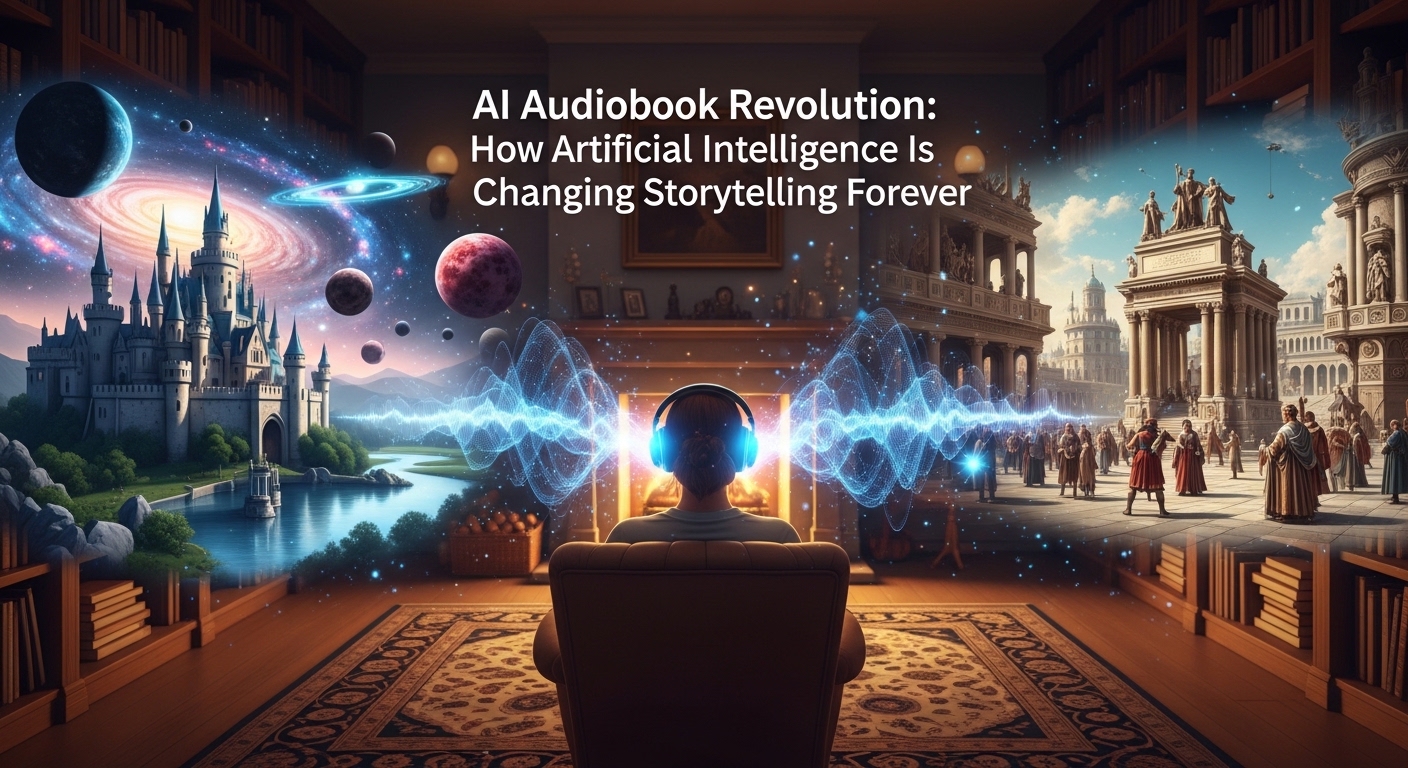
The Sound of Stories Is Changing
There was a time when storytelling lived on the page alone. Then came radio, film, and eventually audiobooks, each reshaping how narratives were experienced. Today, we are standing at another turning point. Artificial intelligence is not just enhancing storytelling; it is redefining how stories are created, narrated, distributed, and consumed.
The rise of AI-powered audiobooks signals more than a technological upgrade. It represents a shift in creative control, accessibility, and audience expectations. What once required studios, voice actors, and months of production can now be achieved in days. This transformation is not subtle, it is seismic.
Audiobooks themselves are no longer a secondary format. They are one of the fastest-growing segments in publishing, with double-digit growth continuing into recent years . AI has stepped into this momentum, accelerating it further and reshaping storytelling in ways that were unimaginable even a decade ago.
From Studio Booths to Algorithms
Traditional audiobook production has always been resource-intensive. Authors needed narrators, sound engineers, editors, and significant financial investment. Recording alone could take weeks, followed by post-production processes that stretched timelines even further.
Artificial intelligence has disrupted this model entirely. AI text-to-speech systems can now convert full manuscripts into audiobooks in a matter of hours. What used to cost thousands of dollars can now be produced at a fraction of the price, with savings estimated between 70% and 90% .
This shift is not just about efficiency. It changes who gets to tell stories. Independent authors, educators, and small publishers, once excluded by cost barriers, can now enter the audiobook space with ease. AI is democratizing storytelling, allowing more voices to be heard, quite literally.
The Rise of Human-Like AI Voices
Early text-to-speech systems were robotic and monotonous, often breaking immersion for listeners. That limitation is rapidly disappearing. Modern AI voice technology has reached a level where it can replicate tone, pacing, and even emotional nuance with surprising accuracy.
Recent advancements show that AI voices can achieve up to 97% accuracy in replicating human vocal characteristics. These systems can whisper, pause for dramatic effect, and adjust delivery based on context. In some cases, they are nearly indistinguishable from human narration.
This leap in realism is critical. Storytelling depends on emotional connection, and AI is beginning to understand that storytelling is not just about words, it is about how those words are delivered.
A New Era of Personalized Storytelling
One of the most exciting aspects of AI audiobooks is personalization. Traditional audiobooks offer a fixed listening experience. AI changes that by allowing stories to adapt to individual preferences.
Imagine listening to a novel narrated in your preferred accent, language, or tone. AI platforms now offer hundreds, even thousands, of voice options across dozens of languages. Some systems can even clone a specific voice, allowing authors or public figures to narrate their own stories without stepping into a recording booth.
This level of customization transforms storytelling into something more intimate. It shifts the experience from passive listening to personalized engagement, where the listener feels that the story is being told specifically for them.
Speed Meets Scale in Content Creation
The speed of AI audiobook production is one of its most disruptive advantages. A full-length book that once took months to produce can now be transformed into an audiobook in days.
This efficiency is particularly important in today’s fast-paced content economy. Authors can release audio versions simultaneously with print or digital editions, maximizing reach and revenue. Educational institutions can convert entire libraries into audio formats quickly, making learning more accessible.
AI also enables scalability. Publishers can produce multiple versions of the same book—different languages, voices, or tones—without repeating the entire production process. This ability to scale storytelling globally is reshaping the publishing landscape.
The Expanding Global Audience
Audiobooks have always been a powerful tool for accessibility, but AI amplifies this potential. With support for dozens of languages and accents, stories can now cross cultural and linguistic boundaries more easily than ever.
For visually impaired audiences, AI narration opens doors to a wider range of content. For multilingual listeners, it provides the option to experience stories in their native language. This inclusivity is one of the most meaningful impacts of AI in storytelling.
The global reach of audiobooks is expanding rapidly, driven by mobile consumption habits and the convenience of listening while multitasking. Whether commuting, exercising, or relaxing, listeners are integrating stories into their daily lives in new ways.
The Technology Behind the Magic
At the heart of AI audiobooks lies a combination of advanced technologies. Neural text-to-speech models, deep learning algorithms, and natural language processing work together to create lifelike narration.
Recent research has introduced systems capable of generating not just voices but entire soundscapes. These include background effects, spatial audio, and character-specific voices that enhance immersion.
AI is also learning subtle social cues. Studies show that synthetic voices can adjust speech patterns based on context, such as slowing down to convey politeness or emphasizing certain words for emotional impact. This level of sophistication brings AI closer to replicating the nuances of human storytelling.
Industry Adoption and Platform Evolution
The acceptance of AI audiobooks is no longer theoretical; it is happening in real time. Major distribution platforms have updated their policies to accommodate AI narration, allowing creators to publish AI-generated audiobooks with proper disclosure.
In fact, nearly a quarter of audiobook submissions in 2025 included AI narration or hybrid production approaches. This indicates that AI is not just an emerging trend; it is becoming a standard part of the industry.
Platforms are also integrating AI tools directly into their ecosystems, making it easier for authors to create and distribute audiobooks without external resources. This integration is accelerating adoption and normalizing AI-driven storytelling.
The Human Touch Debate
Despite its advantages, AI in audiobooks has sparked significant debate. Critics argue that AI lacks the emotional depth and authenticity of human narrators. For many listeners, the voice of a skilled narrator is an essential part of the storytelling experience.
This tension is evident in community discussions. Some listeners describe AI narration as “flat” or “robotic,” expressing reluctance to engage with AI-generated content despite its accessibility.
Voice actors, too, have raised concerns about job displacement and the ethical implications of voice cloning. The creative industry is grappling with questions about ownership, consent, and the value of human artistry.
Yet, others see AI as a tool rather than a replacement. Hybrid models—where human narrators collaborate with AI, are emerging as a potential middle ground, combining efficiency with emotional authenticity.
Cost, Accessibility, and Opportunity
To better understand the transformation, the table below compares traditional audiobook production with AI-driven methods:
| Aspect | Traditional Audiobooks | AI Audiobooks |
| Production Time | Weeks to months | Hours to days |
| Cost | $2,000–$8,000 per book | 70–90% cheaper |
| Voice Options | Limited to one narrator | Hundreds of voices |
| Language Availability | Requires new recording | Instant multi-language |
| Scalability | Low | High |
| Accessibility | Moderate | Very high |
This comparison highlights why AI is gaining traction so quickly. It is not just about innovation—it is about solving real problems in the storytelling ecosystem.
Creativity in the Age of AI
AI is not only changing how stories are told but also how they are written. Writers are beginning to think in audio-first formats, considering pacing, tone, and listener engagement during the writing process.
This shift is subtle but significant. Storytelling is becoming more dynamic, more immersive, and more responsive to audience behavior. AI tools can analyze listener engagement, identify drop-off points, and even suggest improvements to narration.
The result is a feedback loop where storytelling evolves continuously, guided by data as much as creativity.
Ethical Questions and Future Challenges
As with any technological revolution, the rise of AI audiobooks brings ethical challenges. Voice cloning raises questions about consent and identity. Should an AI be allowed to replicate someone’s voice without explicit permission? Who owns a synthetic voice?
There is also the issue of transparency. Listeners may want to know whether a narration is human or AI-generated. Industry guidelines are beginning to address this, requiring clear labeling of AI content.
Another concern is the potential homogenization of storytelling. If AI models are trained on similar datasets, will narratives begin to sound the same? Maintaining diversity and originality will be crucial as AI continues to evolve.
The Future of Storytelling Is Hybrid
The most likely future is not one where AI replaces human narrators entirely, but one where the two coexist. AI will handle scalability, accessibility, and efficiency, while human narrators will continue to bring depth, emotion, and artistry.
This hybrid approach allows creators to choose the best tool for each project. A complex literary novel may benefit from human narration, while educational content or indie projects may thrive with AI.
What is certain is that storytelling will continue to evolve. AI is not the end of human creativity—it is a new chapter in its history.
Conclusion: A Revolution Still Unfolding
The AI audiobook revolution is not a distant possibility; it is happening now. It is reshaping how stories are produced, shared, and experienced across the world.
By lowering barriers, expanding accessibility, and introducing new creative possibilities, AI is opening doors for storytellers and listeners alike. At the same time, it challenges us to rethink the role of human creativity in a technology-driven world.
Storytelling has always adapted to the tools of its time. From oral traditions to printed books to digital media, each evolution has expanded the reach of human imagination. AI is simply the next step in that journey, one that promises to make stories more inclusive, more dynamic, and more alive than ever before.
The question is no longer whether AI will change storytelling. It already has. The real question is how we choose to shape this transformation moving forward.