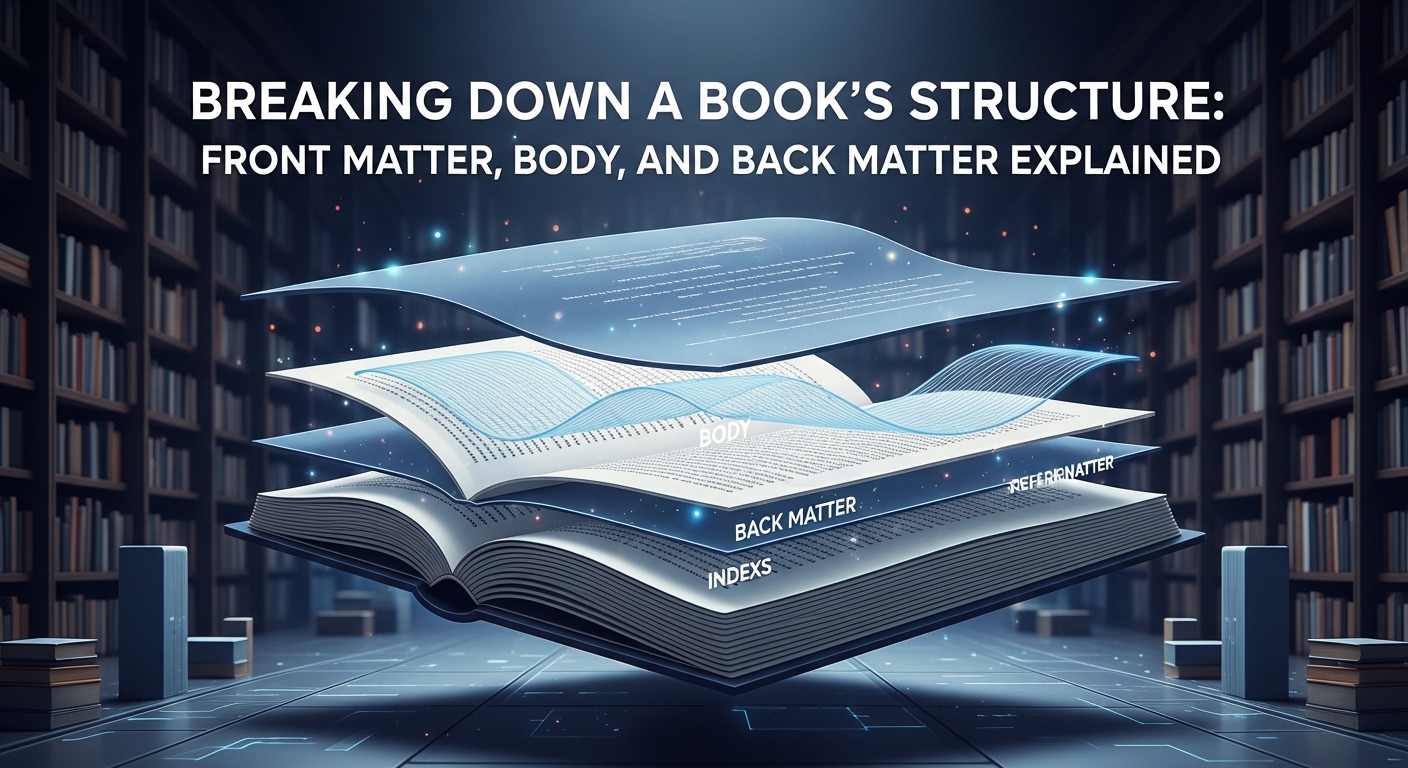
A book is more than just a sequence of pages bound together; it is a carefully constructed experience designed to guide a reader from curiosity to understanding and finally to reflection. Whether it is a novel, a memoir, or a non-fiction guide, every book follows a structural framework that helps organize its content in a meaningful way. This structure is traditionally divided into three major parts: front matter, body, and back matter. Each of these sections serves a distinct purpose, and together they create the complete architecture of a book.
Understanding how these sections function is not only useful for writers and publishers but also for readers who want to appreciate the craftsmanship behind the books they love. When you begin to notice how a book is assembled, you start to see storytelling and information delivery in a much more intentional way.
The structure of a book is not accidental. It is shaped by centuries of publishing conventions, reader expectations, and editorial practices. Even in modern digital publishing, these traditional components remain essential because they provide clarity, navigation, and professional presentation. To truly understand how a book works, it is important to break down each of these parts in detail and explore how they contribute to the overall reading experience.
Understanding the Role of Front Matter in a Book
Front matter is the opening section of a book, and it serves as the reader’s introduction to what lies ahead. It is often overlooked by casual readers, but it carries significant importance in framing the book’s identity and purpose. This section appears before the main content begins and includes all the preliminary pages that set the stage for the narrative or informational journey.
One of the key roles of front matter is to establish context. It tells the reader what the book is about, who created it, and sometimes why it exists. This is where the tone of the book is subtly introduced. In fiction, it might build anticipation. In non-fiction, it may establish credibility and authority. Regardless of genre, it is the book’s first handshake with the reader.
Front matter often includes the title page, copyright information, dedication, acknowledgments, and sometimes a foreword or preface. Each of these elements serves a unique function. The title page formally introduces the book’s name and author, while the copyright page ensures legal protection and publishing details. Dedications and acknowledgments add a personal and human touch, revealing the relationships and efforts behind the creation of the work.
A foreword is typically written by someone other than the author and helps build credibility, while a preface is usually written by the author to explain the motivation or background of the book. These sections, though not part of the main narrative, influence how readers perceive the content that follows.
Front matter acts as a quiet but powerful foundation. Without it, a book would feel abrupt and incomplete, lacking the professional framing that helps readers engage fully.
The Body: The Core of the Book’s Meaning
The body of the book is where the central content lives. This is the heart of the work, whether it is a story unfolding in chapters or an argument being developed across sections. Everything in the front matter leads to this point, and everything in the back matter builds upon it.
In fiction, the body consists of the narrative itself, characters, dialogue, setting, conflict, and resolution. It is where the emotional and imaginative journey takes place. In non-fiction, the body is structured around ideas, explanations, evidence, and analysis. It is where the author’s message is fully developed and explored in depth.
The body is typically divided into chapters or sections, which help organize information into digestible parts. These divisions are not random; they are carefully designed to maintain pacing, clarity, and engagement. A well-structured body ensures that the reader does not feel overwhelmed and can follow the progression of ideas or events smoothly.
What makes the body of a book so important is its ability to carry the entire weight of meaning. Without a strong body, even the most beautifully designed front and back matter would have little value. This is where the reader spends the majority of their time, and it is where the author’s voice is most fully expressed.
The flow of the body also reflects the author’s skill. A compelling narrative or well-organized argument keeps readers engaged from beginning to end. Transitions between chapters, the pacing of information, and the development of ideas all contribute to how effective the body of a book becomes.
Back Matter: The Final Layer of Meaning and Support
After the main content concludes, the book does not simply end. The back matter provides closure, additional information, and sometimes resources for further exploration. It is the final section of the book and often serves as a bridge between the book and the outside world.
Back matter may include appendices, glossaries, indexes, bibliographies, author notes, or references. In non-fiction books, these elements are especially important because they provide verification, expand on topics, or guide readers toward further study. In fiction, back matter might include author interviews, discussion questions, or previews of other works.
One of the key purposes of back matter is to enhance understanding. While the body delivers the main message, the back matter supports it by offering clarification or additional context. For example, a glossary helps readers understand specialized terms, while an index allows them to locate specific information quickly.
Another important role of back matter is to extend engagement beyond the final page. It encourages readers to continue thinking about the book or to explore related subjects. In this way, the book does not feel like a closed experience but rather an entry point into a larger intellectual or emotional journey.
Back matter also contributes to the professionalism of a book. It shows that the author and publisher have taken care to provide complete and structured information, reinforcing the credibility of the work.
How Front Matter, Body, and Back Matter Work Together
Although each section of a book serves a distinct purpose, they are deeply interconnected. A book is not a collection of separate parts but a unified structure where each component supports the others.
The front matter prepares the reader mentally and emotionally, setting expectations and providing context. The body delivers on those expectations by presenting the main content in a structured and engaging way. The back matter then reinforces, expands, and concludes the experience, ensuring that the reader leaves with clarity and satisfaction.
This flow creates a complete reading journey. Without front matter, the reader might feel disoriented. Without a strong body, the book lacks substance. Without back matter, the experience may feel unfinished. Together, they create balance and completeness.
Structural Components of a Book at a Glance
To better understand how these elements function, the following table breaks down the key components of each section and their primary roles within a book’s structure.
| Section | Component | Purpose and Function |
| Front Matter | Title Page | Introduces the book’s title and author formally |
| Front Matter | Copyright Page | Provides legal information and publishing rights |
| Front Matter | Dedication | Offers personal acknowledgment from the author |
| Front Matter | Foreword | Written by another contributor to establish credibility |
| Front Matter | Preface | Author’s explanation of the book’s origin or purpose |
| Body | Chapters/Sections | Deliver the main content and narrative or arguments |
| Body | Subheadings | Organize ideas and improve readability |
| Body | Illustrations/Data | Support and enhance understanding of content |
| Back Matter | Appendix | Provides supplementary or expanded information |
| Back Matter | Glossary | Defines specialized terms used in the book |
| Back Matter | Index | Helps locate specific topics or references |
| Back Matter | Bibliography | Lists sources and references used in the book |
Why Understanding Book Structure Matters
For readers, understanding book structure enhances appreciation and comprehension. It allows them to see how information is layered and how meaning is gradually built. For writers, it is essential for creating professional, publishable work that meets industry standards and reader expectations.
A well-structured book also improves readability. When content is organized logically, readers can navigate it more easily and retain information more effectively. This is especially important in academic and professional writing, where clarity and precision are crucial.
From a publishing perspective, structure also affects marketability. Books that follow clear structural conventions are easier to edit, design, and distribute. Publishers rely on these frameworks to ensure consistency across different works and genres.
The Invisible Architecture Behind Every Book
What makes book structure fascinating is that it often goes unnoticed. Readers are usually focused on the story or information itself, not the framework holding it together. Yet this invisible architecture plays a crucial role in shaping the entire experience.
Front matter quietly prepares the mind, the body immerses the reader in content, and the back matter gently guides them out of the experience. Together, they form a rhythm that feels natural, even though it is highly intentional.
This structure is one of the reasons books remain such a powerful medium. Despite changes in technology and reading formats, the fundamental organization of books continues to provide clarity and meaning.
Conclusion
Breaking down a book’s structure reveals the careful thought and design behind what might seem like a simple object. Front matter introduces and prepares, the body delivers depth and substance, and back matter completes the experience with support and reflection. Each part plays a vital role, and together they create a seamless journey for the reader.
Understanding this structure not only deepens appreciation for books but also equips writers with the knowledge to craft more effective and professional work. In the end, a book is not just what is written inside it, but how it is structured from beginning to end.