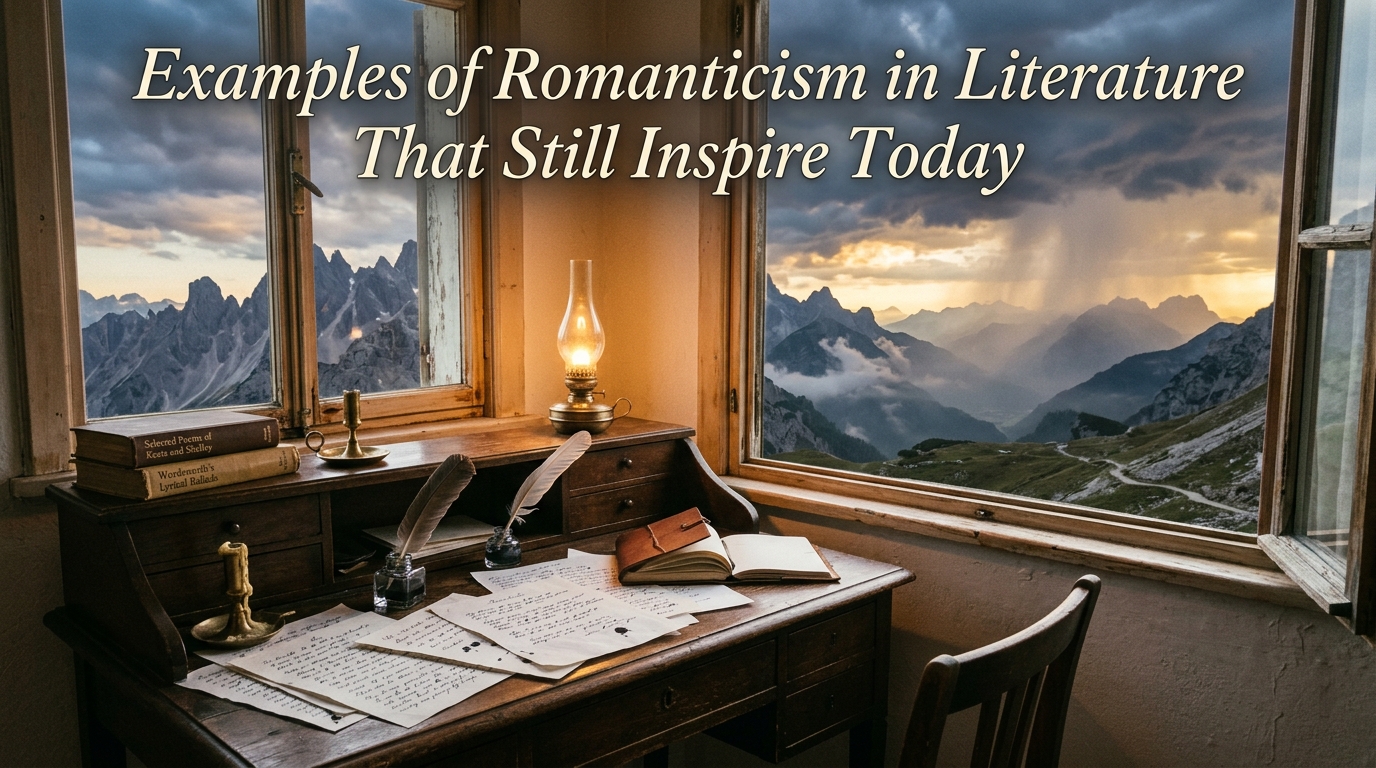
Romanticism in literature remains one of the most emotionally powerful and philosophically rich movements in literary history. Emerging in the late eighteenth century as a response to industrialization, scientific rationalism, and rigid social order, Romanticism placed human emotion, imagination, and individual experience at the center of artistic expression. It was not merely a style but a way of seeing the world, one that valued nature over machinery, intuition over logic, and freedom over conformity. Even today, centuries after its peak, Romantic literature continues to resonate deeply with readers because it speaks to timeless human desires: love, identity, rebellion, and connection with something greater than oneself.
This enduring influence is not accidental. Romantic writers explored themes that remain relevant in a modern world often dominated by technology and structure. They remind us of the importance of feeling deeply, questioning authority, and finding beauty in the ordinary. From poetry to novels, Romanticism has left behind a legacy that continues to inspire writers, filmmakers, and readers across generations.
The Core Spirit of Romanticism
To understand the examples that still inspire today, it is important to grasp what Romanticism truly represents. At its core, Romantic literature celebrates emotion, imagination, and the individual spirit. It often portrays nature as a powerful and healing force, contrasting it with the artificial constraints of society. Romantic works frequently explore themes of love, longing, solitude, and rebellion against social norms.
Writers associated with this movement believed that truth could be found not through logic alone but through emotional and spiritual experience. This belief gave rise to deeply introspective characters and narratives that focused on personal transformation. The emphasis on subjectivity allowed writers to create works that felt intensely personal yet universally relatable.
Nature as a Living Presence
One of the most defining features of Romantic literature is its portrayal of nature as more than just a backdrop. Nature becomes a living, breathing presence that reflects human emotions and offers insight into the human soul. In the poetry of William Wordsworth, nature is often depicted as a source of spiritual renewal and wisdom. His famous work Lines Composed a Few Miles Above Tintern Abbey illustrates how the natural world shapes memory, identity, and emotional well-being.
This idea continues to inspire modern literature and storytelling. Contemporary writers frequently use nature as a metaphor for inner conflict or healing. Whether it is a character finding peace in a quiet forest or confronting their fears in a storm, the Romantic vision of nature remains deeply influential. It reminds readers that even in an increasingly urbanized world, the connection between humans and nature is essential.
The Power of Emotion and Individual Experience
Romantic literature places immense value on emotional depth and personal experience. This is evident in works like Pride and Prejudice by Jane Austen, where the emotional journeys of characters take precedence over societal expectations. While Austen’s work is often categorized differently, its exploration of love, individuality, and emotional growth aligns closely with Romantic ideals.
Another powerful example is Frankenstein by Mary Shelley. This novel delves into the emotional turmoil of its characters, particularly the creature, whose longing for acceptance and identity makes him one of the most tragic figures in literature. The emphasis on inner conflict and emotional suffering reflects the Romantic fascination with the complexities of the human psyche.
These works continue to inspire because they validate the importance of feeling deeply. In a world that often prioritizes efficiency and logic, Romantic literature reminds us that emotions are not weaknesses but essential aspects of being human.
Rebellion Against Society and Tradition
Romantic writers often challenged societal norms and authority, celebrating the courage to think and live differently. This theme is vividly present in The Prelude, where personal growth and self-discovery take precedence over societal expectations. Similarly, Lord Byron created characters who embodied rebellion and defiance, often referred to as Byronic heroes.
The Byronic hero is flawed, passionate, and unwilling to conform, a figure that continues to appear in modern literature and film. These characters resonate with audiences because they reflect the universal struggle between individuality and societal pressure. The Romantic celebration of rebellion encourages readers to question norms and embrace their authentic selves.
The Idealization of Love and Beauty
Love in Romantic literature is often intense, transformative, and sometimes tragic. It is not merely a social arrangement but a profound emotional and spiritual connection. In works like Wuthering Heights by Emily Brontë, love is portrayed as a powerful force that transcends time and even death.
This intense portrayal of love continues to influence modern romance narratives. The idea that love can be both beautiful and destructive adds depth to storytelling, making relationships feel more authentic and compelling. Romantic literature’s exploration of love reminds readers that true connection often involves vulnerability, sacrifice, and emotional intensity.
Imagination and the Supernatural
Another hallmark of Romanticism is its embrace of imagination and the supernatural. Writers explored dreams, myths, and the unknown, often blurring the line between reality and fantasy. Samuel Taylor Coleridge exemplifies this in works like The Rime of the Ancient Mariner, where supernatural elements are used to explore themes of guilt, redemption, and the power of nature.
This imaginative approach continues to inspire genres such as fantasy and magical realism. Modern storytellers often draw on Romantic techniques to create immersive worlds that reflect deeper emotional truths. The willingness to explore the unknown allows literature to push boundaries and expand the possibilities of storytelling.
The Lonely Genius and the Creative Spirit
Romanticism also introduced the idea of the artist as a solitary genius, someone who sees the world differently and expresses that vision through creativity. This concept is evident in the works of John Keats, whose poetry reflects both the beauty and fragility of life. His work Ode to a Nightingale captures the tension between the desire for transcendence and the inevitability of mortality.
This portrayal of the artist continues to shape how creativity is perceived today. The idea that art comes from deep emotional and personal experience resonates with modern writers and creators. It reinforces the notion that creativity is not just a skill but a way of understanding and interpreting the world.
A Comparative View of Key Romantic Works
Below is a table that highlights some of the most influential Romantic works and the themes that continue to inspire contemporary audiences.
| Work | Author | Key Themes | Modern Influence |
| Tintern Abbey | William Wordsworth | Nature, memory, spirituality | Environmental writing and introspective narratives |
| Frankenstein | Mary Shelley | Creation, isolation, identity | Science fiction and ethical debates |
| Wuthering Heights | Emily Brontë | Passion, love, revenge | Complex romantic storytelling |
| The Rime of the Ancient Mariner | Samuel Taylor Coleridge | Guilt, redemption, nature | Supernatural and symbolic narratives |
| Ode to a Nightingale | John Keats | Beauty, mortality, transcendence | Philosophical and lyrical poetry |
Why Romanticism Still Matters Today
The continued relevance of Romanticism lies in its ability to address universal human experiences. In a fast-paced, technology-driven world, the Romantic emphasis on emotion, nature, and individuality feels more necessary than ever. It offers a counterbalance to modern life, encouraging people to slow down, reflect, and connect with their inner selves.
Romantic literature also inspires creativity by demonstrating that storytelling is not just about plot but about emotion and meaning. It shows that the most powerful stories are those that explore the depths of human experience. This influence can be seen in everything from contemporary novels to films and even digital storytelling.
Moreover, Romanticism’s focus on individuality and self-expression aligns closely with modern values. It encourages readers to embrace their uniqueness and challenge societal expectations. This message remains particularly relevant in a world where identity and authenticity are constantly being explored and redefined.
Conclusion
Romanticism in literature is far more than a historical movement; it is a lasting source of inspiration that continues to shape how stories are told and experienced. Through its celebration of emotion, nature, imagination, and individuality, it offers a vision of humanity that is both deeply personal and universally meaningful. The works of writers like William Wordsworth, Mary Shelley, Emily Brontë, and John Keats continue to resonate because they capture the essence of what it means to feel, to dream, and to seek connection in a complex world.
As literature evolves, the spirit of Romanticism remains alive, reminding us that even in an age of logic and technology, the heart still plays a vital role in how we understand ourselves and the world around us.