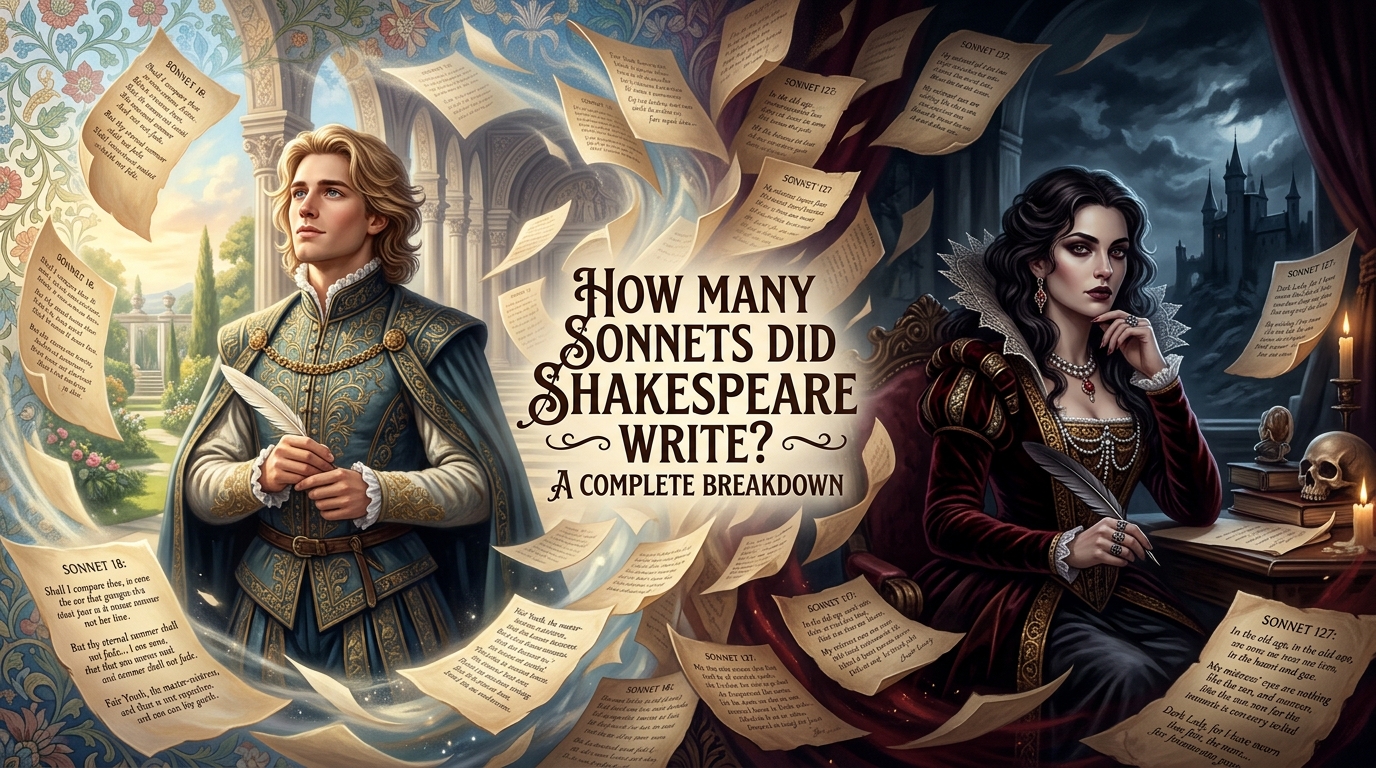
There is something endlessly fascinating about the poetic legacy of William Shakespeare. While he is widely celebrated for his plays, his sonnets occupy a quieter but equally powerful corner of literary history. Readers, scholars, and writers alike continue to ask a deceptively simple question: how many sonnets did Shakespeare actually write? The answer, while straightforward on the surface, opens the door to a much deeper exploration of authorship, structure, emotional complexity, and historical context.
Understanding Shakespeare’s sonnets is not just about counting them. It is about uncovering the emotional architecture of a poet who used a strict form to express some of the most fluid and intimate human experiences ever captured in language. His sonnets remain relevant centuries later because they speak to universal themes, love, time, beauty, betrayal, and mortality—with an intensity that still resonates in modern literature.
The Definitive Number: 154 Sonnets
The widely accepted answer is that William Shakespeare wrote 154 sonnets. These were first published together in 1609 in a collection commonly referred to as Shakespeare’s Sonnets. This publication is one of the most significant poetic compilations in English literary history, offering a complete sequence that appears carefully arranged, though its original order and intent remain subjects of scholarly debate.
The number 154 is not arbitrary. It reflects a cohesive body of work that demonstrates Shakespeare’s mastery of the sonnet form. Each poem adheres to a structured pattern while exploring different emotional and philosophical dimensions. The consistency of the collection has led scholars to agree that these 154 sonnets form a complete and intentional sequence, even if the precise narrative thread connecting them is still open to interpretation.
Understanding the Shakespearean Sonnet Form
To truly grasp the significance of these 154 sonnets, it is important to understand the form Shakespeare used. The Shakespearean sonnet, sometimes called the English sonnet, consists of 14 lines written in iambic pentameter. It follows a specific rhyme scheme: ABAB CDCD EFEF GG.
William Shakespeare did not invent the sonnet form, but he refined and popularized this particular structure in English literature. His adaptation allowed for a more dramatic progression of ideas, often culminating in a powerful closing couplet that delivers a twist, resolution, or emotional punch.
What makes his sonnets remarkable is not just their technical precision but their emotional range. Within the constraints of a rigid structure, Shakespeare created poems that feel spontaneous, intimate, and deeply human. This balance between form and feeling is one of the reasons his sonnets have endured for centuries.
The Structure of the Collection: A Narrative in Fragments
Although the 154 sonnets can be read individually, many scholars believe they form a loose narrative sequence. This sequence is typically divided into distinct thematic groups, each addressing different subjects and relationships.
The first 126 sonnets are often referred to as the “Fair Youth” sequence. These poems are addressed to a young man of great beauty and promise. In them, William Shakespeare explores themes of admiration, affection, jealousy, and the passage of time. The speaker urges the young man to preserve his beauty through procreation and later grapples with the inevitability of aging and loss.
The next set, sonnets 127 to 152, shifts focus to what is commonly called the “Dark Lady.” These poems present a more complicated and turbulent relationship. The tone becomes darker, more conflicted, and at times even cynical. The speaker expresses desire, frustration, and moral ambiguity, offering a stark contrast to the earlier sonnets.
The final two sonnets, 153 and 154, stand apart from the rest. They are often seen as mythological allegories, drawing on classical imagery rather than continuing the personal themes of the earlier poems. Their placement at the end of the collection adds an intriguing layer of interpretation, as if closing the sequence with a symbolic reflection rather than a direct conclusion.
Publication History: The 1609 Quarto
The sonnets were first published in 1609 by a publisher named Thomas Thorpe. This edition, known as the “Quarto,” is the primary source for the 154-sonnet collection we recognize today.
The circumstances surrounding this publication remain somewhat mysterious. It is unclear whether William Shakespeare authorized the publication or if Thorpe acted independently. The dedication in the Quarto, addressed to a mysterious “Mr. W.H.,” has fueled centuries of speculation about the identities of the individuals involved in the sonnets.
Despite these uncertainties, the 1609 Quarto is considered authoritative. It preserves the sequence and text of the sonnets as they have been studied and admired for generations.
Themes That Define the Sonnets
The 154 sonnets are not merely a collection of poems; they are a deep exploration of human experience. One of the most prominent themes is the passage of time. Shakespeare repeatedly reflects on how time erodes beauty, youth, and life itself. This awareness gives many of the sonnets a sense of urgency, as the speaker seeks ways to preserve what is fleeting.
Love is another central theme, but it is far from simple or idealized. In the sonnets, love can be uplifting, painful, obsessive, or even destructive. William Shakespeare presents love in all its contradictions, capturing its complexity with remarkable honesty.
The theme of immortality also plays a significant role. Shakespeare often suggests that poetry itself can defy time, preserving the beauty and essence of its subject long after physical life has faded. This idea is perhaps one of the reasons the sonnets continue to resonate today—they are, in a sense, proof of their own claim.
A Closer Look at Selected Sonnets
Among the 154 sonnets, certain poems stand out for their enduring popularity and influence. One of the most famous is Sonnet 18, which begins with the iconic line, “Shall I compare thee to a summer’s day?” In this poem, William Shakespeare celebrates the beauty of the subject while asserting that the poem itself will grant that beauty eternal life.
Another notable example is Sonnet 130, which subverts traditional expressions of romantic admiration. Instead of idealizing the beloved, Shakespeare presents a more realistic and grounded portrayal, ultimately affirming that genuine love does not depend on exaggerated comparisons.
These sonnets demonstrate the range and innovation within the collection. They show how Shakespeare could both embrace and challenge the conventions of his time, creating poetry that feels both classical and modern.
Table: Breakdown of Shakespeare’s 154 Sonnets
| Section | Sonnets Range | Primary Focus | Key Themes |
| Fair Youth Sequence | 1–126 | Young man | Beauty, time, admiration, legacy |
| Dark Lady Sequence | 127–152 | Mysterious woman | Desire, betrayal, complexity |
| Final Sonnets | 153–154 | Mythological allegory | Love, symbolism, closure |
Why the Number Matters
Knowing that William Shakespeare wrote 154 sonnets provides a sense of completeness, but it also raises interesting questions. Why this number? Was it intentional, or simply the result of what survived and was compiled?
Some scholars believe the number reflects a carefully constructed sequence, while others argue that it may not represent the entirety of Shakespeare’s sonnet writing. It is possible that additional sonnets were lost or never published. However, the 154 we have form a coherent and influential body of work that has shaped the sonnet tradition for centuries.
The Influence of Shakespeare’s Sonnets on Literature
The impact of Shakespeare’s sonnets extends far beyond their original context. They have influenced countless poets, from the Romantic era to modern times. Writers such as John Keats and Elizabeth Barrett Browning drew inspiration from Shakespeare’s exploration of love and emotion.
The sonnet form itself has evolved, but Shakespeare’s version remains one of the most widely studied and imitated. His ability to combine technical mastery with emotional depth set a standard that continues to inspire writers today.
Misconceptions and Lesser-Known Facts
One common misconception is that all of Shakespeare’s sonnets are straightforward love poems. In reality, they are far more complex, often exploring themes of jealousy, insecurity, and moral conflict. Another misconception is that the sonnets tell a clear, linear story. While there are thematic connections, the sequence is not a conventional narrative.
It is also worth noting that not all scholars agree on the interpretation of the relationships depicted in the sonnets. The identities of the Fair Youth and the Dark Lady remain unknown, adding an element of mystery that continues to intrigue readers.
The Timeless Appeal of 154 Sonnets
What makes these 154 sonnets so enduring is their ability to speak across time. William Shakespeare captures emotions that are as relevant today as they were in the 16th century. His exploration of love, loss, and the passage of time resonates with readers from all walks of life.
The sonnets invite multiple interpretations, allowing each generation to find new meaning in them. This flexibility is one of their greatest strengths. They are not fixed in a single context but continue to evolve as they are read and reinterpreted.
Conclusion: More Than Just a Number
The answer to the question “How many sonnets did Shakespeare write?” is, on the surface, simple: 154. But as this exploration shows, that number represents much more than a count. It signifies a rich and complex body of work that has shaped the course of literary history.
Through these 154 sonnets, William Shakespeare created a legacy that continues to inspire, challenge, and move readers around the world. They are not just poems; they are a testament to the enduring power of language and the timeless nature of human emotion.