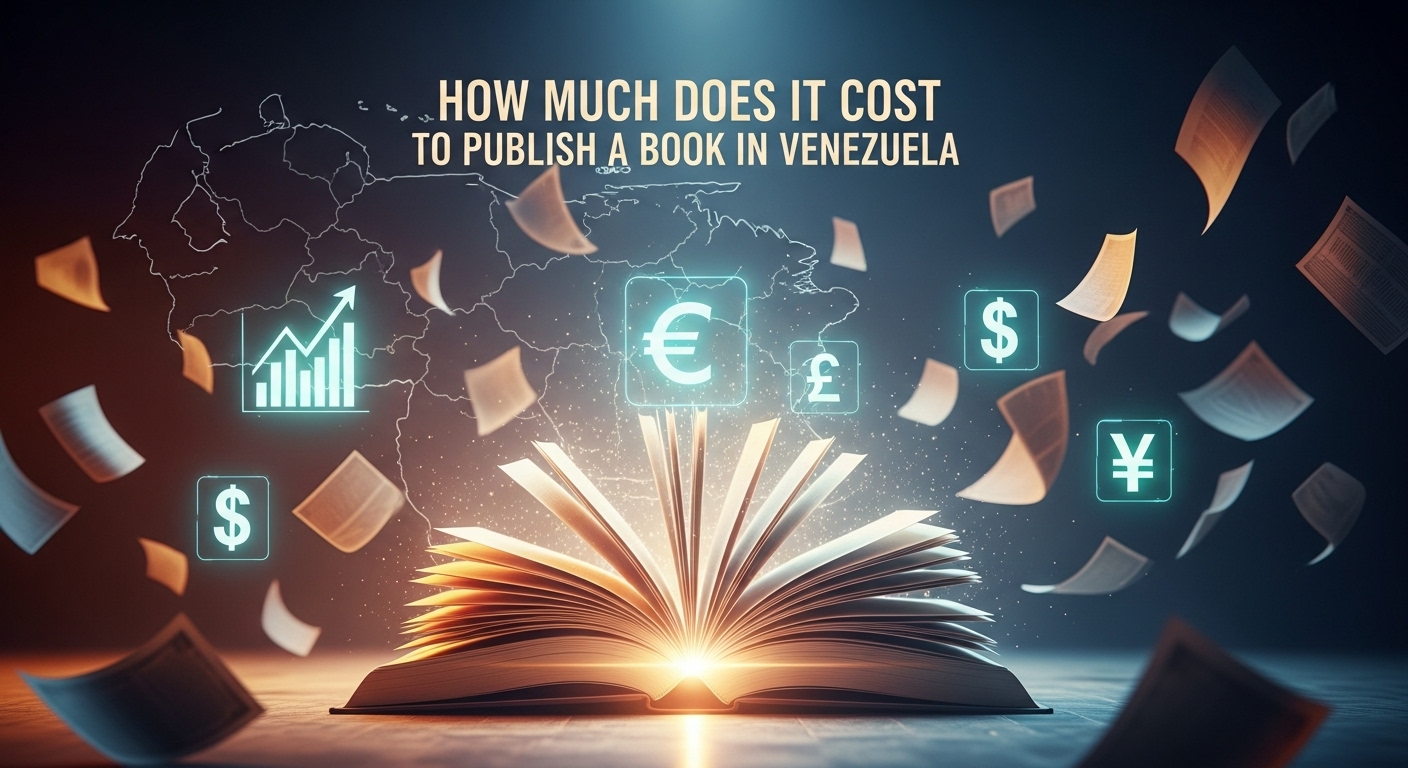
Publishing a book is an exciting—but often confusing—process. Costs vary wildly depending on how you publish (traditional publisher, hybrid, or self-publishing), the formats you choose (ebook, paperback, hardcover), the quality standard you want, and local variables specific to Venezuela such as printing capacity, import costs, and currency volatility. Below I’ll walk you through the real components that add up to a full publishing budget, give Venezuela-specific context you should plan for, and provide example budgets (low / mid / professional) so you can pick a realistic path.
Two quick notes before we start
- Traditional publishing typically requires little to no direct payment by the author for basic production—the publisher covers editing, design, printing and distribution—though marketing expectations can mean indirect costs.
- Self-publishing puts the cost and control in your hands. Typical modern self-publishing budgets (globally) range from modest DIY levels to professional packages of several thousand dollars depending on services chosen.
The publishing routes
Traditional publishing
- Author cost: Usually $0 up front for production; the publisher covers editing, design, printing and distribution.
- Hidden costs: If a publisher expects you to do local publicity, travel, or paid marketing, those are usually on you. Also, finding a Venezuelan or foreign publisher may require time and possibly travel/submission expenses.
- Time & tradeoff: Little cash outlay, less control, longer timelines, lower royalties per copy.
Hybrid publishing
- Author cost: You pay some production or distribution fees; the publisher provides services (design, printing, distribution) and sometimes more favorable royalties than a vanity press.
- Use case: Good if you want professional help but still retain some control.
Self-publishing (most common for independent authors)
- Author cost: You pay for all services you want: editing, cover design, interior layout, ISBN, printing, distribution and marketing. This is where the budget choices matter the most. Modern POD (print-on-demand) and ebook channels have lowered printing and inventory risk—but you still pay for professional services to get good results.
Core cost categories (and realistic ranges)
Below are the main line-items you will encounter, with typical price ranges (USD). I’ve also flagged which are easier to source inside Venezuela and which often require international providers.
1. Editing
- Developmental edit (structure, plot, pacing): $400–$2,000
- Copyediting / line editing: $200–$1,200
- Proofreading: $100–$400
Professional editing is one of the strongest predictors of a book’s success—skimping here is noticeable.
2. Cover design and interior layout
- Professional cover design: $100–$700 (genre and designer reputation influence price)
- Interior formatting (print + ebook): $50–$400
3. ISBN and legal registration
- Venezuela’s ISBN agency is managed through the national book center (CENAL / Centro Nacional del Libro). Costs & procedures may differ from commercial ISBN vendors; authors should contact the local ISBN agency for exact requirements and any fees. If you buy ISBNs from an international provider or through a paid pack, expect a small fee per ISBN or a package price.
4. Printing (paperback/hardcover)
- Print-on-demand (POD) per-copy cost: approximately $4–$15 per copy for a standard black-and-white paperback depending on trim size and page count (color and hardcover push costs up).
- Bulk offset printing per-copy: can drop below $3–$6 per copy, but requires large minimum runs (hundreds to thousands), warehousing and shipping. Local printer pricing in Venezuela will vary and commonly reflects paper/import costs and machine capacity. Expect local print quotes to vary more than in stable-currency markets.
5. Distribution & sales channels
- Ebook distribution: often free (you take a percentage of sales) or a small fee with distributor packages.
- Print distribution & channel setup: $0–$200 for setup if you use POD platforms; third-party distributors or boutique services may charge more.
6. Marketing & publicity
- Baseline launch marketing: $100–$2,000+ (ads, ARC copies, local events, press kits).
- Sustained marketing: depends on ambition—$500–$5,000+ annually for meaningful campaigns.
7. Miscellaneous: audio, translation, shipping, taxes
- Audiobook production: $800–$3,000+ depending on narrator and length.
- Translation (to/ from Spanish): $0.06–$0.18 per word for professional translation.
- Shipping & customs: If printing outside Venezuela, add international shipping and possible customs fees—these can be significant because paper and binding materials are subject to import controls and high freight costs in some cases.
Venezuela-specific considerations — what changes the math
- Printing availability and paper imports. Venezuela’s book printing industry has been affected over the years by supply-chain and paper import constraints. That means you may find fewer competitive local printers and wider price swings; some authors print abroad (Colombia, Mexico, or the U.S.) and ship in, accepting higher shipping/customs costs for reliable quality and price. Local print shops exist and will quote, but expect variance.
- Currency volatility and exchange rate impact. Budget in USD where possible. If you pay in bolívars locally, exchange-rate movement can make a quote obsolete quickly. Many freelancers and services in Venezuela prefer USD or stable foreign payment methods.
- ISBN and legal registration. Use the national ISBN agency (CENAL) for official local ISBNs and legal deposit—procedures are region-specific and may involve in-person steps; check the agency for current rules.
- Distribution & bookstores. Access to chain distribution is limited compared with large markets. For physical reach you’ll rely on a mix of local indie bookstores, festivals, online sales, and social media. If you want presence in Colombian or U.S. markets, plan distribution/logistics with international POD or distributor partners.
- Community & language advantage. Publishing in Spanish gives you access to a broad Latin American readership—consider digital-first strategies (ebook + targeted Spanish-language marketing) to reduce upfront print costs.
Example budgets (practical scenarios)
These are illustrative plans for a 70–250 page trade paperback. All prices in $ and assume professional work where noted.
Low-budget (DIY, high frugality) — $300 to $900
- Basic proofreading or swapping with beta readers: $0–$100
- Cover template or low-cost designer: $50–$150
- Interior formatting (DIY or inexpensive service): $0–$100
- ISBN (if acquired internationally or via provider): $10–$100 (local ISBN via CENAL may differ)
- Print-on-demand single-copy costs for author copies: $4–$12 per copy (you’ll buy a few author copies).
When to choose: You’re testing the market, writing non-fiction or short-form content, or have strong DIY skills.
Mid-range (serious indie) — $1,500 to $4,000
- Professional copyediting: $400–$1,200
- Professional cover design: $250–$600
- Interior layout for ebook + print: $150–$400
- ISBN + barcodes (one or small pack): $20–$200 (local process may vary).
- Initial marketing (ads, ARC copies, modest campaign): $300–$1,000
- Author copies (POD) or small bulk print run: $200–$800 depending on quantity and printer.
When to choose: You want a quality product with professional editing and design, modest marketing, and wider retail credibility.
Professional / Publisher-quality — $5,000 to $15,000+
- Developmental edit + copyedit + proofread: $1,000–$3,000
- Top-tier cover + branding: $600–$2,000
- Interior design + special typography (hardcover options): $400–$1,000
- Audiobook production: $1,000–$4,000
- Larger marketing & publicity push: $1,500–$5,000+
- Bulk printing (offset) for inventory + warehousing + shipping (if printing abroad): $1,000–$5,000+ depending on run size and shipping.
When to choose: You’re treating the book as a professional product, planning international distribution, or positioning for serious commercial attention.
Practical tips for Venezuelan authors to reduce cost and risk
- Consider ebook-first. Ebooks remove printing/shipping headaches and let you reach Spanish-language readers across Latin America quickly and cheaply.
- Use POD for physical copies until demand justifies offset printing. POD avoids inventory risk; when sales justify it, do an offset run for lower per-copy cost.
- Shop local quotes and compare with regional printers (Colombia/Mexico). Sometimes printing just across a border can be cheaper even after shipping.
- Pay in USD where possible and confirm exactly what a quote includes. Ask about paper origin, binding type and turnaround.
- Budget for marketing. A well-edited, well-designed book that no one sees won’t sell—allocate at least some funds for launch publicity.
- Contact CENAL for ISBN and legal deposit steps early. Doing registration early prevents surprises at release.
Final checklist before you order or sign anything
- Do you have a final edited manuscript? (Editing saves money later.)
- Do you know exactly what the printer will deliver (trim, paper, binding, proof copy)?
- Have you confirmed ISBN and legal deposit steps with CENAL?
- Do you have a realistic marketing plan and budget?
- Have you compared local printer quotes with regional POD services and international printers, accounting for shipping and customs?
Closing: what’s a reasonable expectation?
If you aim for a serious, polished self-published book in Venezuela, plan on a realistic mid-range budget of roughly $1,500–$4,000 (editing, design, basic marketing, and author copies/POD). If you’re testing or constrained by funds, you can start much lower ($300–$900) with DIY work and scale up later. If you want a professional, publisher-level launch (audiobook, offset printing, heavy marketing), prepare for $5,000+. Remember that local market realities—printer availability, paper costs, and currency swings—often make local quotes less predictable; price in USD where possible and ask printers for itemized written quotes.