Poetry has always existed in a unique space within publishing. Unlike commercial fiction, poetry is often driven more by emotional expression, artistic identity, and personal storytelling than by market trends. For decades, poets struggled to find publishing opportunities because traditional publishers accepted only a very small percentage of poetry manuscripts. Even talented writers often faced years of rejection before seeing their work in print.
Self-publishing completely transformed that reality. Modern publishing platforms now allow poets to bypass traditional gatekeepers and publish independently while maintaining full creative control. Whether someone wants to publish a deeply personal collection, build a literary brand, or sell books professionally, self-publishing offers a realistic path forward.
However, one question consistently appears before the publishing journey begins: how much does it actually cost to self-publish a poetry book?
The answer is not as simple as a single number because self-publishing is highly customizable. Some poets publish for almost nothing by doing every task themselves, while others spend several thousand dollars creating a professionally edited, beautifully designed, and heavily marketed collection. The total cost depends on the author’s goals, production quality, marketing ambitions, and willingness to handle technical work independently.
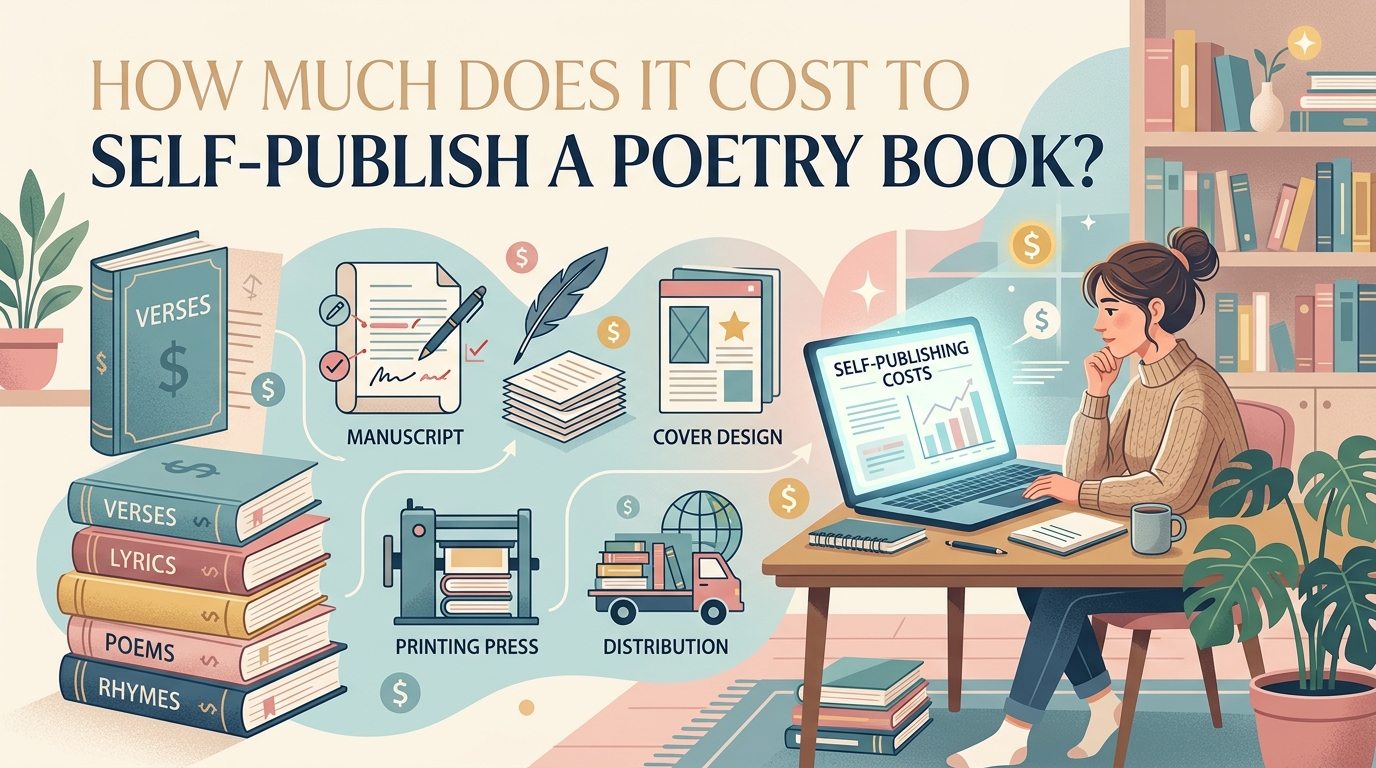
In most cases, self-publishing a poetry book professionally costs anywhere between $500 and $5,000. Authors aiming for a polished, bookstore-quality release often spend somewhere in the middle of that range. Meanwhile, highly premium projects involving custom artwork, professional branding, hardcover printing, and advertising campaigns can cost even more.
Understanding where that money goes is essential before starting the publishing process.
Why Poetry Books Have Different Publishing Costs
Poetry books operate differently from many other types of books. A standard novel focuses heavily on narrative flow and word count, but poetry depends equally on presentation, spacing, rhythm, structure, and visual appearance. In poetry, even a single misplaced line break can affect meaning and emotional impact.
That artistic sensitivity changes the publishing process significantly.
A poetry collection usually requires more careful formatting than prose books because poems are visually structured. Some poems use centered text, staggered indentation, experimental layouts, or carefully controlled white space. These details matter deeply to the reading experience.
Because of this, poetry books often demand higher attention to formatting quality and design presentation. While the books themselves are usually shorter than novels, the production process can sometimes be more detail-oriented.
Another factor affecting costs is audience size. Poetry traditionally sells in smaller numbers compared to mainstream fiction. That means poets must often think carefully about budgeting because recouping expenses may take longer. Many poetry collections are passion projects first and business ventures second.
Still, self-publishing gives poets something traditional publishing often cannot: total creative freedom.
The Average Cost Breakdown of a Self-Published Poetry Book
Before discussing each stage individually, it helps to understand the overall financial picture. Every poetry book involves several production areas, and each one carries potential costs depending on how professionally the author wants the final product to appear.
| Publishing Element | Average Cost Range |
| Proofreading | $100 – $800 |
| Copy Editing | $300 – $1,500 |
| Cover Design | $150 – $1,500 |
| Interior Formatting | $50 – $800 |
| ISBN Purchase | Free – $125 |
| Copyright Registration | $45 – $85 |
| Author Copies | $50 – $500 |
| Marketing & Advertising | $100 – $5,000+ |
| Website & Branding | $50 – $500 yearly |
| Miscellaneous Expenses | $50 – $300 |
These numbers vary widely because every poet approaches publishing differently. Some writers hire experienced industry professionals for every stage, while others use free tools and independent learning resources to reduce expenses.
The flexibility of self-publishing is both its biggest advantage and its biggest challenge.
Editing Costs and Why They Matter in Poetry
Many first-time poets underestimate the importance of editing because poetry often feels personal and emotionally raw. Some writers worry that editors may interfere with artistic voice or change the emotional authenticity of the poems.
In reality, professional editing usually strengthens the work rather than weakening it.
Editing poetry is not only about correcting grammar mistakes. A strong poetry editor examines clarity, consistency, pacing, repetition, tone, and overall emotional structure. They may identify poems that feel out of place in the collection or suggest ways to improve thematic flow between sections.
Poetry collections are often read as complete emotional journeys rather than random groups of poems. An editor can help shape that experience more intentionally.
There are several levels of editing involved in publishing.
Proofreading focuses on catching technical mistakes such as punctuation errors, spelling problems, and formatting inconsistencies. Copy editing goes deeper by improving sentence clarity, grammar flow, and readability while respecting the poet’s voice.
Some authors also invest in developmental editing, which evaluates the manuscript as a whole. Developmental editors may help reorganize the collection, strengthen recurring themes, or improve emotional progression throughout the book.
Because poetry books are generally shorter than novels, editing costs are often lower overall. However, poetry editing can still become expensive when working with experienced literary professionals.
Some poets reduce costs by using writing groups, workshops, or beta readers before hiring a final proofreader. This approach allows them to refine the manuscript beforehand and potentially save money during professional editing rounds.
The Hidden Complexity of Poetry Formatting
Formatting may be one of the most underestimated expenses in poetry publishing.
In prose books, formatting mostly involves paragraph styling, chapter spacing, and font consistency. Poetry is far more visually dependent. Every stanza break, alignment choice, and page layout decision contributes to the reading experience.
A poem that looks elegant on a computer screen may suddenly break awkwardly on a printed page or ebook device. Long lines may wrap incorrectly. Unusual spacing may collapse during ebook conversion. Experimental formatting can become distorted across different reading platforms.
That is why poetry formatting requires precision.
Professional formatters understand trim sizes, typography, margin balance, line spacing, page flow, and ebook compatibility. They ensure the poems maintain their intended visual appearance in both print and digital versions.
Formatting costs vary depending on complexity. A simple black-and-white poetry book with standard layouts may cost relatively little to format professionally. However, books containing artwork, photography, decorative typography, or visually experimental poems may require advanced typesetting work.
Many poets attempt formatting independently using Microsoft Word or Google Docs. While that works for simple collections, it can become frustrating for more artistic projects. Tools like Atticus, Scrivener, and Vellum have become popular because they simplify formatting while still offering professional-looking results.
Still, many poets eventually discover that professional formatting is worth the investment because poetry readers notice presentation quality immediately.
Cover Design and the Importance of Visual Identity
Poetry readers are often emotionally driven buyers. The visual appearance of a poetry book strongly influences whether someone feels drawn toward it.
A poetry cover is not just packaging. It communicates tone, atmosphere, artistic style, and emotional depth before the first page is even opened.
Minimalist covers with elegant typography remain popular in modern poetry publishing, especially for contemporary collections. Some authors prefer abstract artwork, watercolor illustrations, monochrome photography, or symbolic imagery that reflects the themes inside the book.
Professional cover design costs can range dramatically depending on the designer’s experience and whether the artwork is custom-created.
Premade covers are usually more affordable because designers create the visual concept beforehand and simply customize the text for the author. Fully custom covers cost more because the entire design process is built specifically around the manuscript.
Some poets create their own covers using platforms like Canva or Adobe Express to save money. While this approach works occasionally, amateur covers often hurt a book’s credibility. Readers instinctively associate professional covers with higher-quality writing.
In crowded online marketplaces, a strong cover becomes essential because it competes against thousands of other books for attention.
Print-On-Demand and Physical Printing Costs
Modern print-on-demand technology dramatically reduced the financial risk of self-publishing.
Years ago, authors often had to print hundreds or thousands of copies upfront, which required major financial investment. Today, companies like Amazon KDP and IngramSpark print books only after customers place orders.
This system allows poets to publish without maintaining inventory.
Printing costs depend on several factors including page count, paper quality, trim size, hardcover or paperback format, and whether the interior includes color pages.
Poetry books are often shorter, which reduces printing expenses somewhat. However, many poets prefer premium paper, cream-colored interiors, artistic layouts, or hardcover editions that create a more elegant reading experience.
Those upgrades naturally increase printing costs.
The good news is that authors usually do not pay these costs upfront for customer purchases. Instead, printing expenses are automatically deducted from each sale before royalties are distributed.
Still, many poets purchase author copies for readings, events, gifts, or personal sales. Those orders become part of the overall publishing budget.
ISBNs and Ownership Control
An ISBN is the identification number connected to a published book. It helps bookstores, libraries, and retailers track and distribute titles correctly.
Many self-publishing platforms offer free ISBNs. For example, Amazon KDP provides free ISBN options for paperback books.
This is a major benefit for authors working with limited budgets.
However, some poets prefer purchasing their own ISBNs because it allows them to appear as the official publisher rather than listing the platform as the publishing source.
Owning your ISBN also creates more flexibility if you plan to distribute through multiple platforms or build a long-term publishing brand.
Whether purchasing ISBNs is necessary depends entirely on the author’s goals. For many first-time poets, free ISBNs work perfectly well.
Marketing Expenses and Audience Building
Publishing the book is only half the challenge. Getting readers to discover it is often far more difficult.
Marketing is where self-publishing costs become highly unpredictable because there is no universal strategy for success. Some poetry books grow through organic social media exposure, while others rely on paid advertising campaigns and professional promotional services.
Modern poetry audiences are highly active on platforms like Instagram, TikTok, Pinterest, and YouTube. Visual presentation matters tremendously in poetry marketing because readers respond emotionally to aesthetics and mood.
Many successful poets build audiences long before publishing their books. They post short poems, spoken-word videos, artistic visuals, or personal reflections to create emotional connection with readers.
This audience-first approach often reduces marketing expenses later because loyal followers already exist before launch day arrives.
Some poets invest heavily in advertising campaigns using Amazon Ads, Facebook Ads, BookTok influencers, or literary magazines. Others spend very little and rely mostly on word-of-mouth promotion.
Marketing budgets can range from almost nothing to several thousand dollars depending on how aggressively the author wants to promote the collection.
Can You Publish a Poetry Book Completely Free?
Technically, yes.
A poet can write the manuscript, design the cover independently, format the book using free tools, upload through Amazon KDP, and market entirely through social media without spending significant money upfront.
Many authors start this way.
However, free publishing often comes with trade-offs. Weak formatting, inconsistent editing, and amateur cover design can negatively affect reader perception. Even strong poetry may struggle commercially if the presentation appears unprofessional.
That does not mean expensive publishing guarantees success either. Some beautifully produced poetry books still fail to reach audiences.
The goal is balance.
Strategic investments in areas like editing and design usually improve the book’s credibility without requiring enormous budgets.
The Emotional Value Beyond Financial Cost
Poetry publishing is rarely driven entirely by profit.
For many writers, poetry becomes a way to process grief, trauma, love, identity, memory, healing, or personal transformation. Publishing the work represents emotional completion as much as commercial ambition.
That emotional value changes how many poets view publishing expenses.
Some authors are perfectly comfortable spending money on their poetry books because the project represents years of emotional work and creative growth. The finished book becomes a permanent expression of their voice and experiences.
Holding a printed poetry collection in your hands creates a feeling that is difficult to measure financially. For many writers, that experience alone justifies the investment.
Others approach poetry publishing more professionally, treating it as the foundation for a long-term writing career. In those cases, spending money on editing, branding, and marketing becomes a business decision rather than purely an artistic one.
Is Self-Publishing a Poetry Book Worth It?
For most poets, the answer depends on expectations.
If the goal is instant bestseller success and large profits, poetry can be a challenging market. Poetry generally sells in smaller numbers than mainstream fiction, and audience-building often requires patience and consistency.
However, if the goal is creative independence, artistic fulfillment, audience connection, and ownership over the publishing process, self-publishing offers tremendous value.
Modern self-publishing gives poets complete control over their work. Authors decide the cover, title, pricing, formatting, release schedule, and marketing direction without relying on traditional publishers.
That freedom allows poetry to remain authentic.
A poetry collection does not need to sell thousands of copies to matter. Sometimes the greatest value comes from knowing your words exist permanently in the world, available for someone else to read, connect with, and remember.