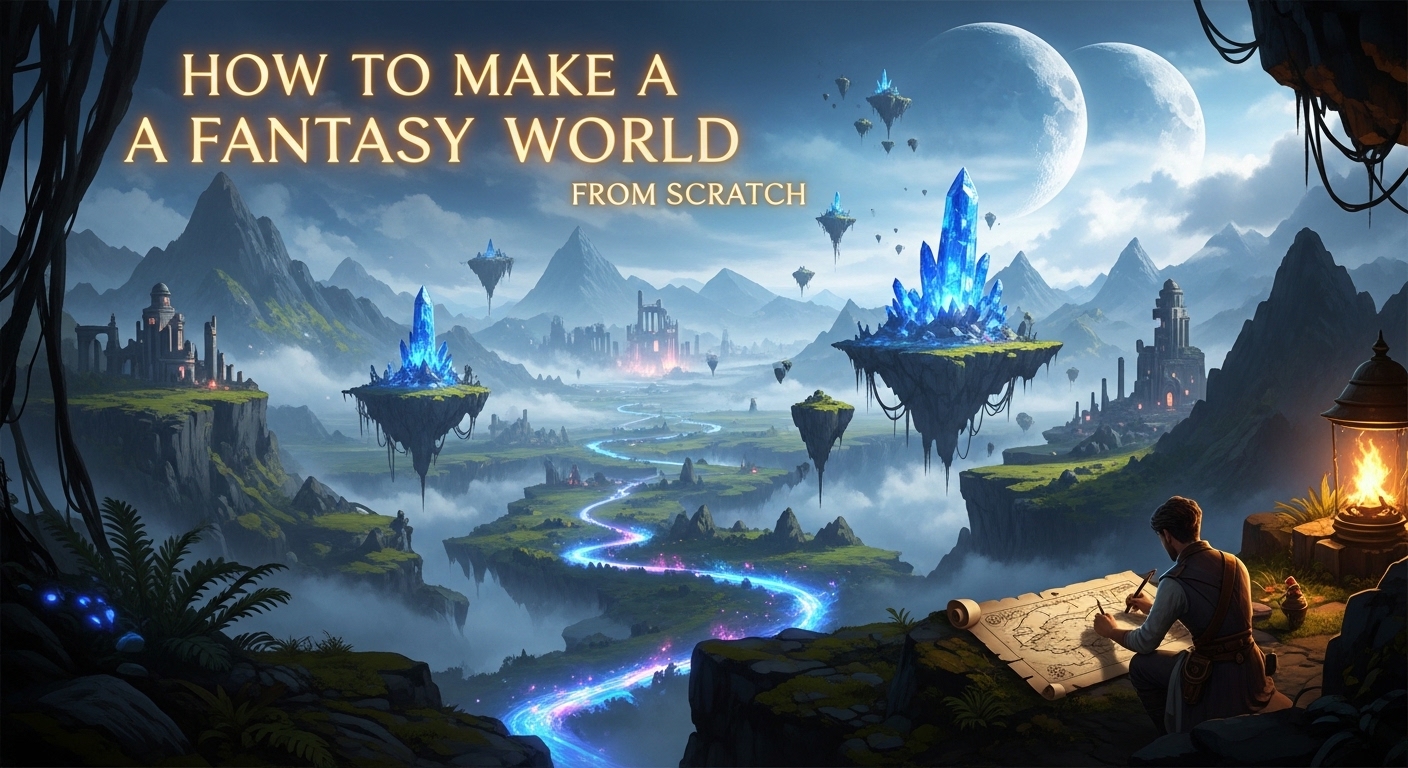
Creating a fantasy world from scratch is one of the most thrilling parts of being a writer. It’s where imagination stops being a private dream and starts becoming a living, breathing reality. Whether you’re writing an epic novel like The Lord of the Rings, building a magical school reminiscent of Harry Potter and the Sorcerer’s Stone, or developing a gritty political realm inspired by Game of Thrones, the foundation always begins the same way: with intentional worldbuilding.
A powerful fantasy world doesn’t just look magical—it feels real. It has structure, history, rules, cultures, and consequences. In this guide, we’ll walk step-by-step through how to build a fantasy world from scratch, ensuring depth, originality, and narrative strength.
1. Start With a Core Concept
Before drawing maps or inventing languages, ask yourself one crucial question:
What makes this world different?
Your core concept is the seed from which everything grows. It could be:
- A world where magic is illegal
- A floating continent drifting through the sky
- A kingdom ruled by immortals
- A land where memories are currency
Keep it simple at first. You can expand later. The strongest fantasy worlds begin with a single compelling idea.
For example, The Hunger Games is built around one central concept: children forced into a televised survival competition. Everything else grows from that.
2. Define the Rules of Magic (If Any)
Magic without structure quickly becomes confusing. The key is consistency.
Ask yourself:
- Who can use magic?
- Where does it come from?
- What are the limitations?
- What is the cost?
Magic systems generally fall into two categories:
Soft Magic Systems – Mysterious, undefined, and poetic.
Hard Magic Systems – Structured, rule-based, almost scientific.
For example, Mistborn: The Final Empire features a hard magic system based on metal consumption, while many works by J. R. R. Tolkien lean toward softer systems.
Limitations create tension. If magic solves every problem, your story loses stakes.
3. Build the Geography
Geography shapes culture, politics, trade, and conflict.
Consider:
- Continents and oceans
- Mountains, forests, deserts
- Climate zones
- Natural resources
Mountain kingdoms are often isolated. Coastal cities become trade hubs. Desert societies evolve differently than forest civilizations.
Draw a rough map—even a simple sketch helps visualize movement, war strategies, and migration patterns.
Ask yourself:
- Where do people live?
- Why do they live there?
- What dangers surround them?
Your geography must influence your story naturally.
4. Create History and Mythology
Every believable world has a past.
Develop:
- Ancient wars
- Fallen empires
- Legendary heroes
- Religious myths
- Cultural turning points
History shapes prejudice, alliances, and power structures.
For example, A Song of Ice and Fire thrives on centuries of family rivalries and past rebellions. Without history, the present feels shallow.
You don’t need to reveal everything to readers—but you should know it.
5. Develop Cultures and Societies
A fantasy world isn’t just landscapes—it’s people.
Ask:
- What do they eat?
- How do they dress?
- What are their values?
- What are their taboos?
- How do they marry?
- What do they fear?
Create diversity. Different regions should feel distinct.
Avoid making cultures one-dimensional. Give them contradictions. No society is purely noble or purely evil.
Strong cultural details make your world immersive.
6. Design Political Systems
Power drives conflict.
Decide:
- Is it a monarchy, democracy, theocracy, or dictatorship?
- Who truly holds power?
- Is there corruption?
- Are there rebel factions?
Political tension adds realism. Even magical worlds need governance.
For instance, The Witcher portrays shifting alliances between kingdoms and sorcerers, creating complex tension.
Politics should affect daily life—taxes, laws, restrictions, freedoms.
7. Create Languages and Naming Conventions
You don’t need to invent a full language like J. R. R. Tolkien did—but consistent naming matters.
Decide:
- Are names short and sharp?
- Long and melodic?
- Inspired by specific linguistic patterns?
For example:
- Harsh consonants suggest warrior cultures.
- Flowing vowels suggest mystical civilizations.
Consistency builds immersion.
8. Define Creatures and Races
Fantasy often includes:
- Dragons
- Elves
- Dwarves
- Original species
If you use traditional races, give them a twist. Reinvent them.
If you create new creatures, define:
- Biology
- Strengths
- Weaknesses
- Habitat
- Relationship with humans
Avoid creating species solely for aesthetic appeal. They must serve narrative or thematic purpose.
9. Establish Economy and Technology
Even magical worlds need logistics.
Ask:
- What is currency?
- How does trade work?
- What technology exists?
- Is it medieval, steampunk, futuristic?
Consider:
| Element | Questions to Answer | Example Impact on Story |
| Currency | Coins, barter, magical tokens? | Wealth inequality drives rebellion |
| Transportation | Horses, airships, portals? | Travel time affects plot pacing |
| Weapons | Steel swords or enchanted blades? | Determines combat style |
| Communication | Letters, telepathy, crystals? | Impacts political strategy |
| Industry | Craft-based or industrialized? | Shapes class structure |
A well-designed economy prevents plot holes.
10. Create Religion and Belief Systems
Belief systems influence morality and conflict.
Ask:
- Are there multiple gods?
- Is religion unified or divided?
- Are there prophecies?
- Do gods intervene physically?
Religion often shapes:
- Laws
- Rituals
- Social hierarchies
Make sure belief systems influence character decisions.
11. Tie the World to Character
Worldbuilding must serve story—not overshadow it.
Ask:
- How does this world challenge your protagonist?
- What cultural rules restrict them?
- What dangers threaten them?
The world should create obstacles and growth opportunities.
In strong fantasy, setting and character are inseparable.
12. Avoid Info-Dumping
One common mistake is overwhelming readers with details.
Instead:
- Reveal through dialogue
- Show through conflict
- Sprinkle history naturally
- Let readers discover gradually
Mystery enhances immersion.
13. Use Internal Consistency as Your Anchor
No matter how fantastical your world is, it must follow its own rules.
If dragons are extinct, they cannot suddenly appear without explanation.
If magic costs blood, characters must pay the price.
Consistency builds trust with readers.
14. Let Themes Shape the World
Ask yourself:
What is this story truly about?
- Power?
- Freedom?
- Oppression?
- Identity?
Build your world to reflect that theme.
For example:
- A world obsessed with purity can mirror themes of discrimination.
- A crumbling empire can reflect decay of morality.
The strongest fantasy worlds are metaphors.
15. Test Your World
Before writing fully, challenge your world with questions:
- What happens if famine strikes?
- What if magic disappears?
- What if the ruler dies suddenly?
If your world collapses under questioning, strengthen its foundations.
Final Thoughts: Build Deep, Then Reveal Slowly
Creating a fantasy world from scratch requires patience and vision. You don’t need to invent everything at once. Start small. Build outward.
Remember:
- Concept first.
- Rules second.
- Culture and history third.
- Character always at the center.
The goal isn’t complexity—it’s coherence.
The reason worlds like those in The Lord of the Rings endure isn’t because they are complicated. It’s because they feel real, layered, and intentional.
Your world doesn’t need to imitate existing fantasy. It needs to reflect your imagination and your themes.
Build it carefully. Question it deeply. Let it breathe.
And then—let your characters live inside it.
FAQs:
Q: What makes a fantasy world believable?
Strong internal rules and consistent logic make it feel real.
Q: Do I need magic in my fantasy world?
No, fantasy can exist without magic as long as the setting is imaginative and unique.
Q: How detailed should my worldbuilding be?
Include enough detail to support the story without overwhelming the reader.
Q: Should geography affect the story?
Yes, geography shapes culture, politics, trade, and conflict.
Q: How do I make my fantasy world original?
Add a fresh twist to familiar elements and explore your core idea deeply.