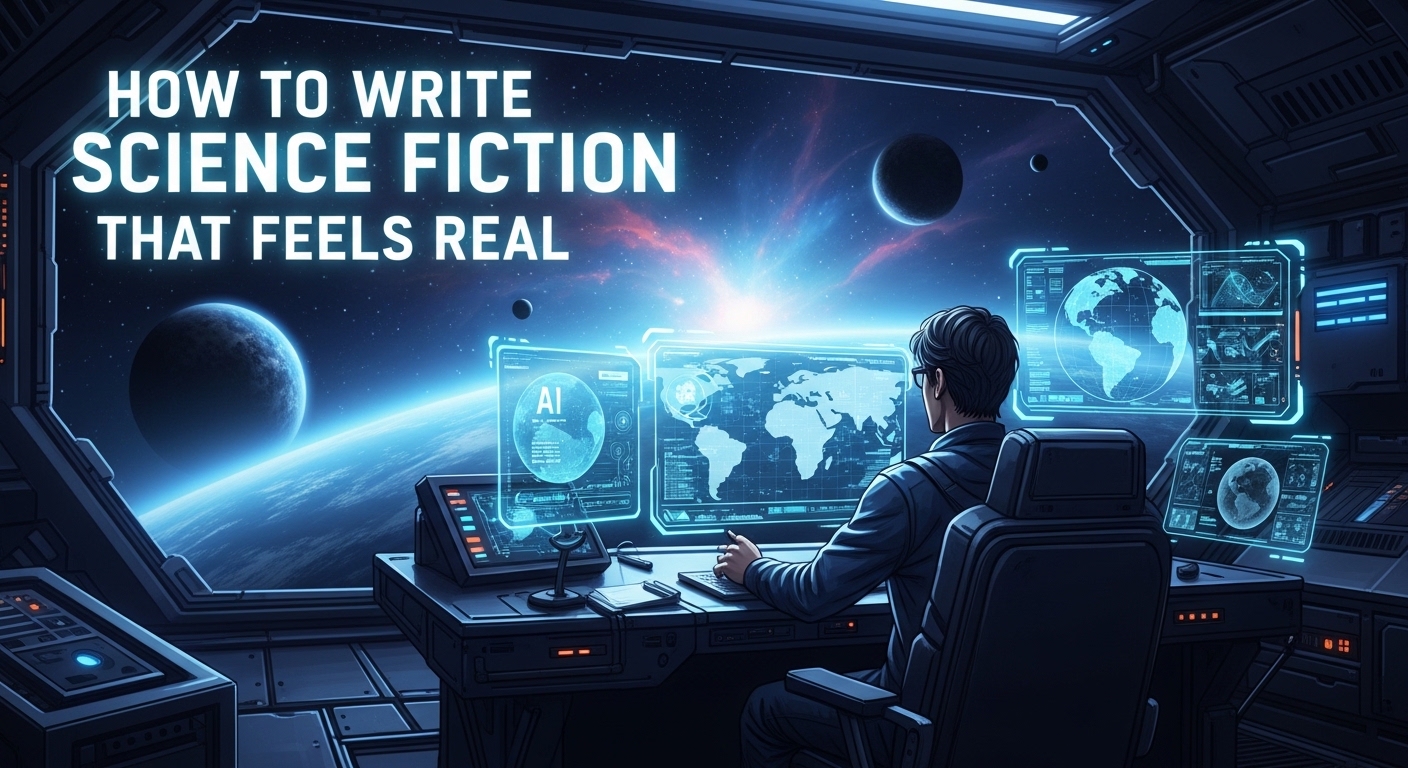
Science fiction has the power to take readers across galaxies, into alternate dimensions, and deep into futures shaped by technology we can barely imagine. Yet the stories that stay with us are not the ones filled only with spectacle—they are the ones that feel real. Whether it’s the dystopian world of 1984, the scientifically grounded survival in The Martian, or the epic interstellar politics of Dune, realism is what makes speculative ideas believable.
If you’re a writer aiming to craft science fiction that resonates deeply with readers, this guide will walk you through the essential elements—worldbuilding, character depth, scientific logic, emotional authenticity, and the often-overlooked stages of editing, publishing, and marketing your work effectively.
Understanding What “Real” Means in Science Fiction
Before you start outlining star systems or designing AI civilizations, you need to understand what makes science fiction feel real.
Realism in sci-fi doesn’t mean everything must be scientifically accurate down to the smallest detail. Instead, it means:
- The world follows consistent internal logic.
- The characters behave like real human beings.
- The science has plausible foundations.
- The consequences of actions feel authentic.
- Emotional stakes outweigh spectacle.
Even in space operas like Star Wars, what grounds the story isn’t the physics of hyperspace—it’s the emotional journey of the characters. Readers forgive invented science; they don’t forgive emotional dishonesty.
Start With a Strong “What If?”
Every compelling science fiction story begins with a powerful speculative question.
- What if humans could upload consciousness?
- What if climate collapse forced humanity underground?
- What if artificial intelligence gained legal rights?
The key is not just the idea—but the implications. Ask yourself:
- How would governments react?
- How would ordinary people adapt?
- Who benefits? Who suffers?
For example, in The Handmaid’s Tale, the “what if” isn’t just about a dystopian regime—it’s about how fragile rights can be. The realism comes from social and political consequences that feel uncomfortably plausible.
Ground Your Science in Research
Even if your story bends physics, it should not ignore logic.
Readers today are intelligent and well-informed. A little research goes a long way. You don’t need a PhD in astrophysics, but you should:
- Understand basic principles of your chosen scientific field.
- Avoid contradictions within your own system.
- Use real-world scientific language carefully.
Andy Weir’s The Martian feels real because the science is deeply researched and mathematically plausible. The tension emerges from solving problems within realistic constraints.
If your science is softer or more speculative, treat it like a rule-based magic system. Establish clear boundaries and stick to them.
Build a World That Extends Beyond the Page
A believable world is layered. It has history, politics, culture, economy, and language—even if only a fraction appears in the final draft.
Consider:
- How does technology affect daily life?
- What new social classes emerge?
- What ethical debates exist?
- What traditions survived—or disappeared?
In Dune, the desert planet Arrakis feels real because it has ecology, religion, politics, and generational memory. The world doesn’t revolve around the protagonist; it existed before them and will continue after.
To make your world feel real:
- Design its systems.
- Create consequences for technological advancement.
- Avoid info-dumping—reveal through action.
Focus on Human Reactions, Not Just Technology
Technology changes. Human emotions don’t.
No matter how advanced your setting, people still experience:
- Fear
- Jealousy
- Love
- Ambition
- Grief
In Interstellar, the scientific premise is grand, but the emotional core is a father trying to return to his daughter. That emotional truth anchors the cosmic scale.
When writing your scenes, ask:
- How does this innovation affect personal relationships?
- What does this discovery cost emotionally?
- Who feels threatened?
The realism comes from internal conflict, not just external spectacle.
Maintain Internal Consistency
One of the fastest ways to lose credibility is breaking your own rules.
If faster-than-light travel takes weeks in chapter one, it shouldn’t take minutes in chapter ten—unless there’s a clear explanation.
Create a reference document that includes:
- Scientific rules
- Political structures
- Character backstories
- Technological limitations
During editing, consistency checks are critical. Many science fiction manuscripts fail not because of imagination, but because of contradictions that weaken immersion.
Avoid the “Exposition Trap”
Science fiction often requires explanation—but too much explanation destroys realism.
Readers want to experience the world, not attend a lecture.
Instead of:
“The planetary shield generator, invented in 2134…”
Try:
The shield flickered again. Third time this week. If it failed, radiation would flood the colony.
Show the function through stakes and action.
The best sci-fi trusts readers to piece together context naturally.
Use Real-World Parallels
Science fiction becomes powerful when it mirrors reality.
Many classic works—like 1984—feel real because they reflect genuine societal fears.
Ask yourself:
- What current issue does your story exaggerate?
- What ethical dilemma are you exploring?
- What modern trend could evolve dangerously?
Grounding your themes in recognizable concerns makes your futuristic setting emotionally credible.
Develop Complex, Flawed Characters
Perfect characters break realism.
Your protagonist should:
- Make mistakes.
- Carry biases.
- Struggle with doubt.
- Face consequences.
Even in advanced settings, characters should respond imperfectly under pressure. That imperfection is what readers recognize as real.
Consider giving each major character:
- A personal goal separate from the plot.
- A moral conflict.
- A flaw that influences their decisions.
Balance Spectacle With Intimacy
Science fiction tempts writers to go bigger—larger battles, grander stakes, wider galaxies.
But realism often lives in small moments:
- A quiet argument in a spaceship corridor.
- A scientist hiding bad data.
- A child asking why the sky is red.
Large-scale destruction is impressive. A personal betrayal is unforgettable.
Practical Framework for Writing Realistic Sci-Fi
Here’s a structured breakdown you can use while drafting:
| Element | Key Question | Common Mistake | How to Strengthen Realism |
| Core Concept | What is the central “what if”? | Idea without implications | Explore social, political, emotional consequences |
| Science | Is it plausible within reason? | Ignoring logic | Research basics and maintain consistency |
| Worldbuilding | Does the world feel lived-in? | Info-dumping | Reveal through character experience |
| Characters | Do they feel human? | Plot-driven robots | Add flaws, conflicting motivations |
| Stakes | Are consequences meaningful? | Easy solutions | Introduce real costs and trade-offs |
| Tone | Is it emotionally grounded? | Over-focusing on tech | Prioritize human emotion |
Use this table during drafting and especially during editing to refine realism.
The Role of Editing in Making Sci-Fi Feel Real
Even brilliant ideas can collapse without strong editing.
During editing, focus on:
- Continuity errors.
- Scientific inconsistencies.
- Character logic.
- Over-explanation.
- Emotional authenticity.
Science fiction often requires multiple passes. One for structure, one for scientific logic, and one purely for emotional truth.
Ask beta readers specific questions:
- Did anything feel unrealistic?
- Were there confusing scientific leaps?
- Did character reactions feel authentic?
Realism is often sharpened—not created—during the editing stage.
Preparing for Publishing: Positioning Your Sci-Fi Novel
Once your manuscript feels grounded and cohesive, think strategically about publishing.
Science fiction has multiple subgenres:
- Hard sci-fi
- Space opera
- Cyberpunk
- Dystopian
- Climate fiction
- Biotech thrillers
Understanding where your book fits helps with both traditional and independent publishing paths.
Agents and publishers look for:
- Strong concept clarity.
- Consistent worldbuilding.
- Market awareness.
- Emotional depth.
A realistic sci-fi novel stands out because it feels both imaginative and intellectually credible.
Marketing Science Fiction That Feels Real
Marketing is often overlooked by writers, yet it shapes how readers perceive your story.
- Emphasize the central “what if.”
- Highlight emotional stakes.
- Compare tone (not plot) to established works like Interstellar or literary classics.
- Showcase the realism angle in blurbs.
Readers are drawn to sci-fi that promises both wonder and depth.
Strong marketing copy should communicate:
- The speculative hook.
- The human conflict.
- The moral tension.
Realistic sci-fi doesn’t sell as pure fantasy—it sells as a mirror of possible futures.
Final Thoughts: Realism Is Emotional Truth
At its heart, science fiction that feels real isn’t about perfect equations or exhaustive technical detail. It’s about believable consequences.
The world may be fictional.
The science may be speculative.
The technology may not exist.
But the fear should feel real.
The hope should feel real.
The sacrifice should feel real.
When readers close a book and think, “That could happen,” you’ve succeeded.
Focus on logic.
Respect your own rules.
Research enough to stay grounded.
Let characters drive the story.
Refine through careful editing.
Prepare wisely for publishing.
And approach marketing with clarity and confidence.
Write boldly—but write truthfully.
That’s how science fiction stops feeling imaginary—and starts feeling possible.