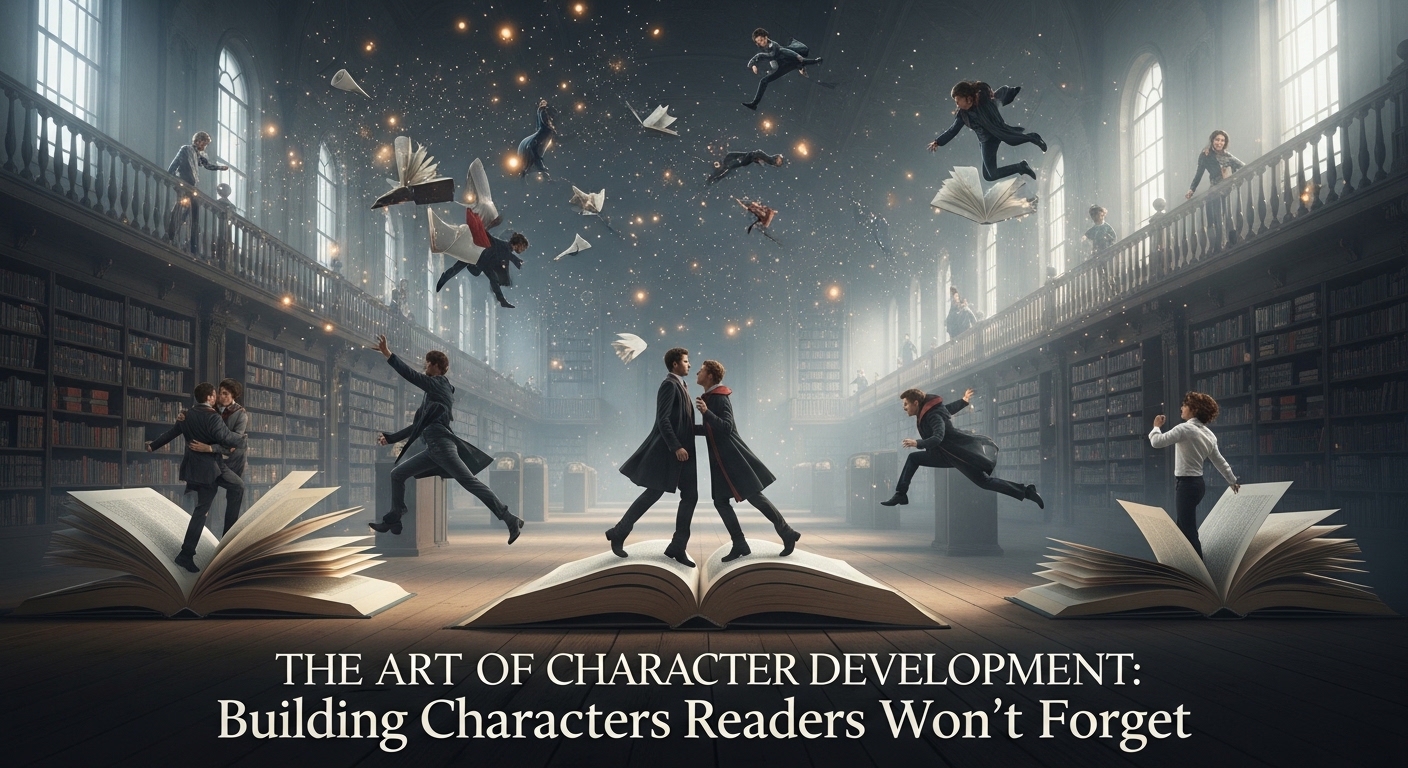
The most powerful stories in literature and film are rarely remembered for their plots alone. What stays with readers is the emotional imprint of the characters, their struggles, contradictions, growth, and silence in moments where words fail them. A well-crafted character feels less like a construct and more like a person you once knew, even if they never existed outside the page. This is the true art of character development: the ability to create human beings in fictional form who continue to live in the reader’s mind long after the story ends.
Think of characters like Elizabeth Bennet, whose wit and emotional intelligence redefine social expectations, or Walter White, whose transformation from a quiet teacher to a morally complex figure demonstrates how deeply layered writing can reshape audience perception. These characters endure not because they are extraordinary in a superficial sense, but because they reflect something deeply human.
Character development is not just a writing technique. It is an exploration of psychology, behavior, culture, and emotion. It is about asking what makes people act, break, love, and change. This blog explores the depth of that craft and how writers can build characters who feel real enough to outlive the stories they belong to.
The Psychological Foundation of Character Creation
At its core, character development is rooted in psychology. Every believable character begins with an understanding of how human beings think and behave under different conditions. Writers often underestimate how much of character depth comes from emotional logic rather than plot mechanics.
A character is not defined only by what they do, but by the internal reasoning behind their actions. Fear, desire, insecurity, ambition, guilt, and hope all operate beneath the surface of behavior. When these elements are layered correctly, even simple actions gain meaning.
Writers like Fyodor Dostoevsky built entire narratives around psychological tension. His characters are often trapped in moral dilemmas that reflect real human contradictions. This approach demonstrates that compelling characters are not designed; they are understood. The writer becomes a psychologist observing how identity forms under pressure.
To develop characters effectively, one must think in terms of emotional cause and effect rather than external events alone. What a character feels shapes what they choose, and what they choose reveals who they are.
Identity and the Role of Backstory
A character’s identity is always shaped by what came before the story begins. Backstory is not just background information; it is emotional architecture. However, the mistake many writers make is overloading the narrative with unnecessary history. Effective character development uses backstory as a subtle influence rather than a constant explanation.
For example, Jay Gatsby is not defined by every detail of his past, but by the emotional weight of it. His identity is shaped by longing, reinvention, and illusion. The reader never needs to know everything about his history because enough is revealed through his behavior and obsession.
Good backstory works like a shadow. It should be felt, not constantly seen. It informs hesitation in dialogue, hesitation in trust, and intensity in desire. It gives characters depth without requiring exposition at every turn.
A well-constructed backstory should always answer three silent questions: what shaped this person, what broke them, and what are they still trying to fix without admitting it?
Internal Conflict as the True Narrative Engine
External events may move a story forward, but internal conflict is what gives it emotional weight. A character without internal conflict is predictable, and predictability weakens engagement.
Internal conflict arises when a character holds opposing truths within themselves. They may want freedom but fear isolation, or crave love but resist vulnerability. This tension creates psychological realism, which is far more compelling than simple action-driven storytelling.
The reason characters like Katniss Everdeen resonate so strongly is not just because of survival stakes, but because of her internal struggle between duty and self-preservation, trust and isolation, resistance and fear. Her decisions feel real because they are emotionally costly.
Internal conflict is also what allows readers to connect personally with characters. It mirrors the contradictions that exist in real human thought. When readers see themselves reflected in a character’s internal struggle, emotional investment deepens significantly.
External Conflict and the Pressure of Change
While internal conflict defines depth, external conflict defines movement. Characters must be placed in situations that challenge their internal structure. Without external pressure, even the most complex character remains static.
External conflict is not limited to physical danger. It includes social systems, relationships, moral dilemmas, and environmental constraints. These forces act as pressure points that reveal character truth.
When a character is forced into difficult choices, their internal nature becomes visible. A person’s beliefs are only meaningful when they are tested. This is why storytelling relies heavily on conflict, it is the mechanism through which identity is exposed.
Great writers understand that external conflict is not just about obstacles; it is about transformation. Every challenge is an opportunity for a character to either evolve or collapse under pressure.
The Structure and Meaning of Character Arcs
A character arc is the emotional trajectory of a character throughout the story. It represents how experiences reshape identity over time. Without a meaningful arc, characters feel incomplete, no matter how detailed they are at the beginning.
There are generally three broad types of arcs: growth, decline, and stability. A growth arc shows transformation into a more self-aware or capable version of the character. A decline arc explores corruption, loss, or emotional deterioration. A stable arc shows a character who remains consistent but influences change in others.
The strength of a character arc lies in its emotional authenticity. Change should never feel abrupt or artificial. It should emerge naturally from accumulated experiences, decisions, and realizations.
Readers may not always notice the technical structure of an arc, but they always feel whether it is earned or forced. Emotional truth is what makes transformation believable.
Dialogue as Character Revelation
Dialogue is one of the most revealing tools in character development. It is not just about communication; it is about personality exposure. The way a character speaks reflects their background, education, emotional state, and psychological defense mechanisms.
Subtext plays a critical role in dialogue. Often, what is left unsaid carries more weight than spoken words. A character may say one thing while meaning another, and this gap between expression and intention creates depth.
Writers like Ernest Hemingway demonstrated how simplicity in dialogue can carry profound emotional undercurrents. His style shows that restraint often enhances meaning rather than diminishing it.
Realistic dialogue avoids perfection. People interrupt themselves, hesitate, and speak indirectly when emotions are involved. Capturing this imperfection makes characters feel authentic.
Relationships as Emotional Mirrors
Characters are best understood through their relationships. No character exists in isolation; they are always defined in relation to others. Relationships reveal vulnerability, dominance, insecurity, affection, and resistance.
A character may appear confident alone, but reveal uncertainty in relationships. Another may seem harsh, but show tenderness in private moments. These contrasts create dimensionality.
Relationships also function as narrative engines. They create tension, conflict, and emotional stakes. Whether it is friendship, rivalry, family, or romance, relationships push characters into emotional exposure.
In many stories, relationships become the true core of the narrative, more than the external plot itself. They determine how characters evolve and what they ultimately become.
Consistency, Contradiction, and Human Realism
A believable character must maintain internal consistency, but also contain contradictions. Humans are not linear beings; they are complex systems of conflicting impulses.
A character can be brave in one situation and fearful in another. They can be kind yet selfish, rational yet impulsive. These contradictions do not weaken characterization; they strengthen it.
However, contradictions must feel psychologically justified. They should arise from experience, trauma, belief systems, or emotional evolution. Random inconsistency breaks immersion, while meaningful contradiction deepens realism.
Writers often struggle to balance predictability and surprise. The key is to ensure that even unexpected behavior feels emotionally grounded.
The Influence of Setting on Identity
Setting plays a silent but powerful role in shaping character identity. Environment influences behavior, opportunity, and worldview. A character raised in a restrictive society will interpret freedom differently than one raised in openness.
Historical and cultural context also shape identity. The time period in which a character exists defines their limitations and possibilities. This is why setting should never be treated as background decoration, it is part of the character’s psychological ecosystem.
When setting and character are aligned, storytelling becomes more immersive and believable.
Comprehensive Breakdown of Character Development Elements
| Element | Function in Storytelling | Emotional Impact on Reader |
| Backstory | Shapes identity and motivation | Creates depth and empathy |
| Internal Conflict | Drives psychological tension | Builds emotional connection |
| External Conflict | Tests character under pressure | Reveals true nature |
| Character Arc | Maps transformation over time | Provides narrative satisfaction |
| Dialogue | Expresses personality and subtext | Enhances realism and intimacy |
| Relationships | Defines emotional interaction | Adds complexity and tension |
| Consistency | Maintains believable behavior | Preserves immersion |
| Contradiction | Introduces human complexity | Strengthens authenticity |
| Setting Influence | Shapes worldview and behavior | Grounds character in reality |
Avoiding Weak Character Construction
One of the most common weaknesses in writing is the creation of characters who exist only to serve the plot. These characters lack emotional independence and feel artificial. Strong character development ensures that characters drive the story, not just react to it.
Another issue is over-description. Excessive detailing of traits without emotional relevance creates distance rather than connection. Readers remember emotional truth, not inventory lists of characteristics.
Clichés also weaken character originality. Predictable personalities reduce engagement and make stories feel familiar in an unintentional way.
Conclusion: Why Characters Matter More Than Plot
At the heart of every enduring story is a character who feels real enough to believe in. Plot may attract attention, but character sustains memory. Readers return not for what happened, but for who it happened to and how it changed them.
The art of character development is ultimately the art of understanding people. Writers who observe deeply, think emotionally, and construct psychologically grounded characters create stories that resonate across time and culture.
In the end, unforgettable characters are not written, they are discovered through empathy, shaped through conflict, and brought to life through truth.