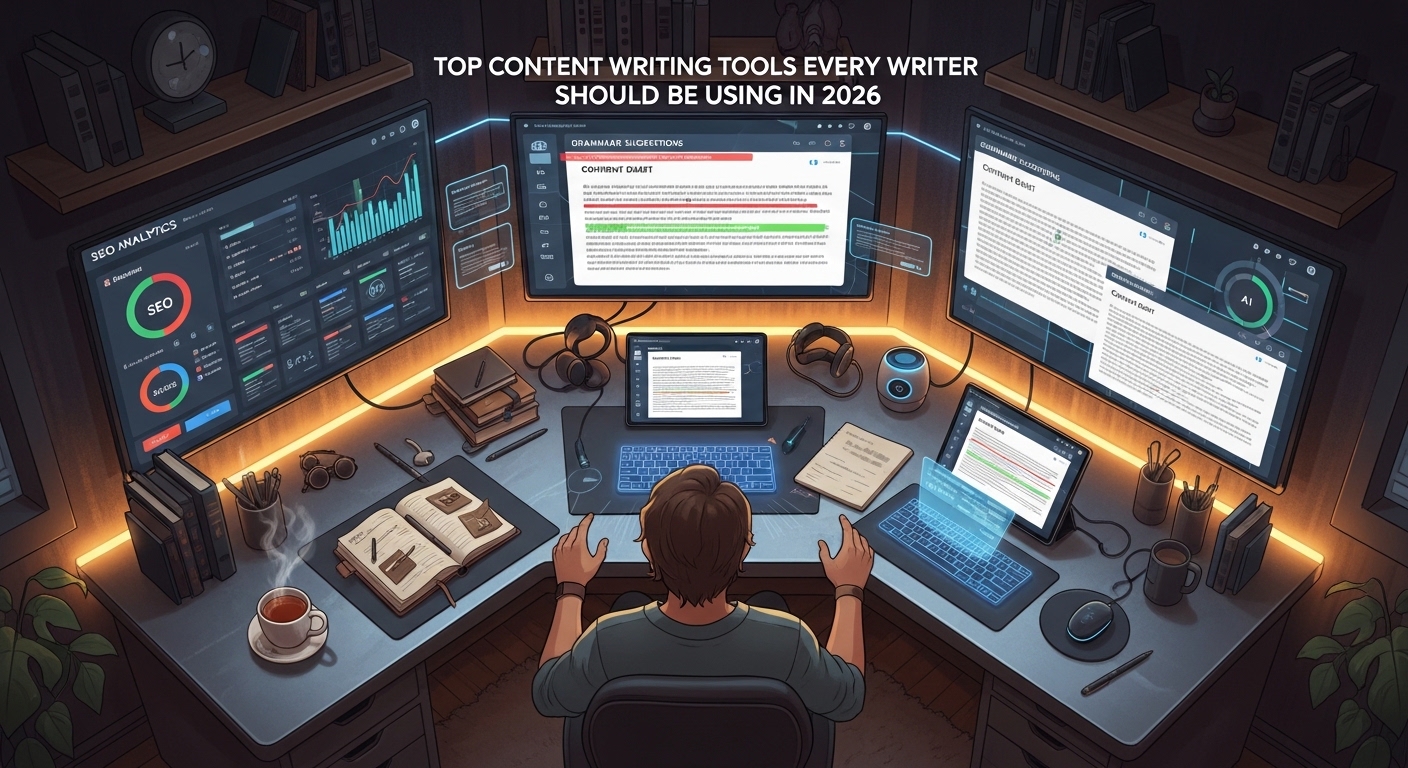
Writing in 2026 is no longer just about stringing words together. It is a layered process that blends creativity, research, optimization, and technical precision. The modern writer is expected to produce content that is not only engaging but also discoverable, structured, and aligned with search intent. This shift has redefined what it means to be a “good writer.” Today, success depends as much on the tools you use as on your raw skill.
Content writing tools have evolved into intelligent ecosystems. They assist with ideation, generate drafts, optimize for search engines, improve grammar, analyze readability, and even predict performance. Many platforms now combine artificial intelligence with real-time data, allowing writers to make informed decisions while they write rather than after the fact.
What makes 2026 particularly interesting is how these tools are no longer optional. They have become integral to professional workflows. Whether you are a blogger, copywriter, novelist, or SEO strategist, the right toolkit can dramatically reduce friction and amplify your output.
This article explores the most essential content writing tools every writer should be using in 2026, not as a scattered list, but as a cohesive system that reflects how writing actually happens today.
Writing and Drafting Tools: Where Ideas Take Shape
At the core of any writing process is the draft. This is where raw ideas begin to take form, often messy and unstructured. In 2026, AI-powered writing assistants have become central to this stage, helping writers move from blank page to first draft with remarkable speed.
Tools like ChatGPT, Jasper, and Copy.ai are widely used for generating initial content. They allow writers to experiment with tone, expand ideas, and overcome writer’s block. What makes them valuable is not that they replace the writer, but that they act as collaborators. They provide a starting point that can be refined and shaped into something uniquely human.
Jasper, for example, is particularly popular among marketers because of its brand voice training and template library, which ensures consistency across campaigns. Meanwhile, Copy.ai excels at short-form content such as product descriptions and social media copy.
The key advantage of these tools lies in acceleration. Instead of spending hours drafting from scratch, writers can focus on refining and elevating content. However, the best results come when these tools are used thoughtfully, with human oversight guiding tone, structure, and authenticity.
SEO Optimization Tools: Writing for Visibility
Writing without optimization in 2026 is like publishing into a void. Even the most compelling content needs to be discoverable, and this is where SEO writing tools come into play.
Platforms like Semrush Content Toolkit and SEO Writing Assistant have become industry standards. These tools analyze your content in real time, offering suggestions on keyword usage, readability, tone, and originality.
What sets modern SEO tools apart is their ability to integrate directly into writing environments like Google Docs or WordPress. This means optimization is no longer a separate step but an ongoing process embedded within writing itself.
Surfer SEO is another standout tool, known for its data-driven approach. It analyzes top-ranking pages and provides actionable recommendations based on factors like word count, keyword density, and structure.
Clearscope takes a slightly different approach, focusing on semantic relevance. Instead of just keywords, it emphasizes the broader context of a topic, helping writers create content that fully satisfies user intent.
These tools collectively shift the writer’s mindset. Instead of guessing what might rank, writers can rely on data-backed insights, making their work both creative and strategic.
Research and Content Planning Tools: Building Strong Foundations
Before a single word is written, great content begins with research. In 2026, research tools have become smarter, faster, and more integrated into the writing workflow.
Frase and similar platforms are designed to streamline the research phase. They analyze search engine results pages (SERPs), extract key topics, and generate detailed content briefs. This allows writers to understand what readers are looking for and structure their content accordingly.
SE Ranking offers a broader approach, combining keyword research, competitor analysis, and performance tracking in one platform. It allows writers to plan entire content strategies rather than individual articles.
What makes these tools indispensable is their ability to reduce uncertainty. Instead of relying on intuition alone, writers can base their work on real data, ensuring their content is both relevant and competitive.
Editing and Proofreading Tools: Refining the Voice
No matter how advanced drafting tools become, editing remains a deeply human process. However, technology has significantly enhanced how this stage is approached.
Tools like Grammarly and Hemingway Editor continue to dominate this space. They provide real-time feedback on grammar, clarity, and readability, helping writers refine their work before publication.
In 2026, editing tools are more than just grammar checkers. They analyze tone, suggest rephrasing, and even detect inconsistencies in style. This is particularly valuable for long-form content, where maintaining a consistent voice can be challenging.
These tools act as a second set of eyes, catching errors that might otherwise slip through. They do not replace careful editing, but they make the process more efficient and precise.
Collaboration and Workflow Tools: Writing as a Team Effort
Writing is often seen as a solitary activity, but in professional environments, it is rarely done alone. Collaboration tools have become essential for managing workflows, especially for teams producing large volumes of content.
Google Docs remains a cornerstone for collaborative writing, allowing multiple users to edit and comment in real time. Notion has gained popularity as a content management hub, combining writing, planning, and organization in one platform.
These tools are particularly valuable for content teams, where coordination and communication are critical. They ensure that everyone involved in the process—from writers to editors to marketers—is aligned.
AI-Powered All-in-One Platforms: The Future of Writing
Perhaps the most significant development in 2026 is the rise of all-in-one content platforms. These tools combine drafting, research, optimization, and publishing into a single ecosystem.
Semrush Content Toolkit is a prime example, offering everything from topic ideation to content publishing.
Similarly, newer platforms are emerging that aim to handle the entire writing process. These tools use advanced AI models to generate, refine, and optimize content in one seamless workflow.
The advantage of these platforms is efficiency. Instead of switching between multiple tools, writers can manage everything in one place. This not only saves time but also creates a more cohesive workflow.
A Comparative Overview of Top Content Writing Tools
To better understand how these tools fit together, the following table provides a comparative overview of some of the most widely used content writing tools in 2026.
| Tool | Primary Function | Key Strength | Best For | Pricing Range |
| Semrush Content Toolkit | All-in-one content creation | End-to-end workflow integration | SEO writers & marketers | Mid to high |
| SEO Writing Assistant | Content optimization | Real-time SEO and readability analysis | Bloggers & professionals | Free + paid tiers |
| Surfer SEO | On-page optimization | Data-driven content scoring | SEO specialists | Mid to high |
| Clearscope | Semantic SEO | Deep topic relevance analysis | Enterprise teams | High |
| Frase | Research & briefs | SERP-based content planning | Content strategists | Low to mid |
| SE Ranking | SEO suite | Comprehensive SEO tools | Agencies & freelancers | Mid |
| Jasper | AI writing | Brand voice and templates | Marketing teams | Mid |
| Copy.ai | AI content generation | Short-form content creation | Social media & ads | Low to mid |
| Grammarly | Editing | Grammar and clarity improvement | All writers | Free + premium |
Choosing the Right Tools: Strategy Over Quantity
It is tempting to adopt every new tool that appears on the market, but more is not always better. The most effective writers in 2026 are those who build a streamlined toolkit tailored to their specific needs.
A blogger might prioritize SEO tools and AI drafting assistants, while a novelist might focus more on writing and editing tools. Content marketers, on the other hand, often require a combination of research, optimization, and collaboration platforms.
The key is integration. The best tools are those that fit naturally into your workflow, enhancing your process without overwhelming it.
The Human Element: What Tools Cannot Replace
Despite the rapid advancement of technology, one thing remains constant: tools do not replace writers. They enhance them.
AI can generate content, but it cannot replicate lived experience, emotional depth, or unique perspective. SEO tools can optimize structure, but they cannot create genuine connection with readers.
The most successful writers in 2026 are those who understand this balance. They use tools to handle repetitive and technical tasks, freeing themselves to focus on creativity and storytelling.
Conclusion: Writing Smarter in 2026
Content writing in 2026 is a blend of art and science. It requires creativity, strategy, and the intelligent use of technology. The tools discussed in this article are not just helpful additions; they are essential components of a modern writing workflow.
From AI drafting assistants to SEO optimization platforms, each tool plays a specific role in the content creation process. Together, they form a system that allows writers to produce high-quality, impactful content more efficiently than ever before.
The challenge is not finding tools, but choosing the right ones and using them effectively. When used thoughtfully, these tools do not diminish the writer’s voice—they amplify it.
And in a world overflowing with content, that amplification can make all the difference.