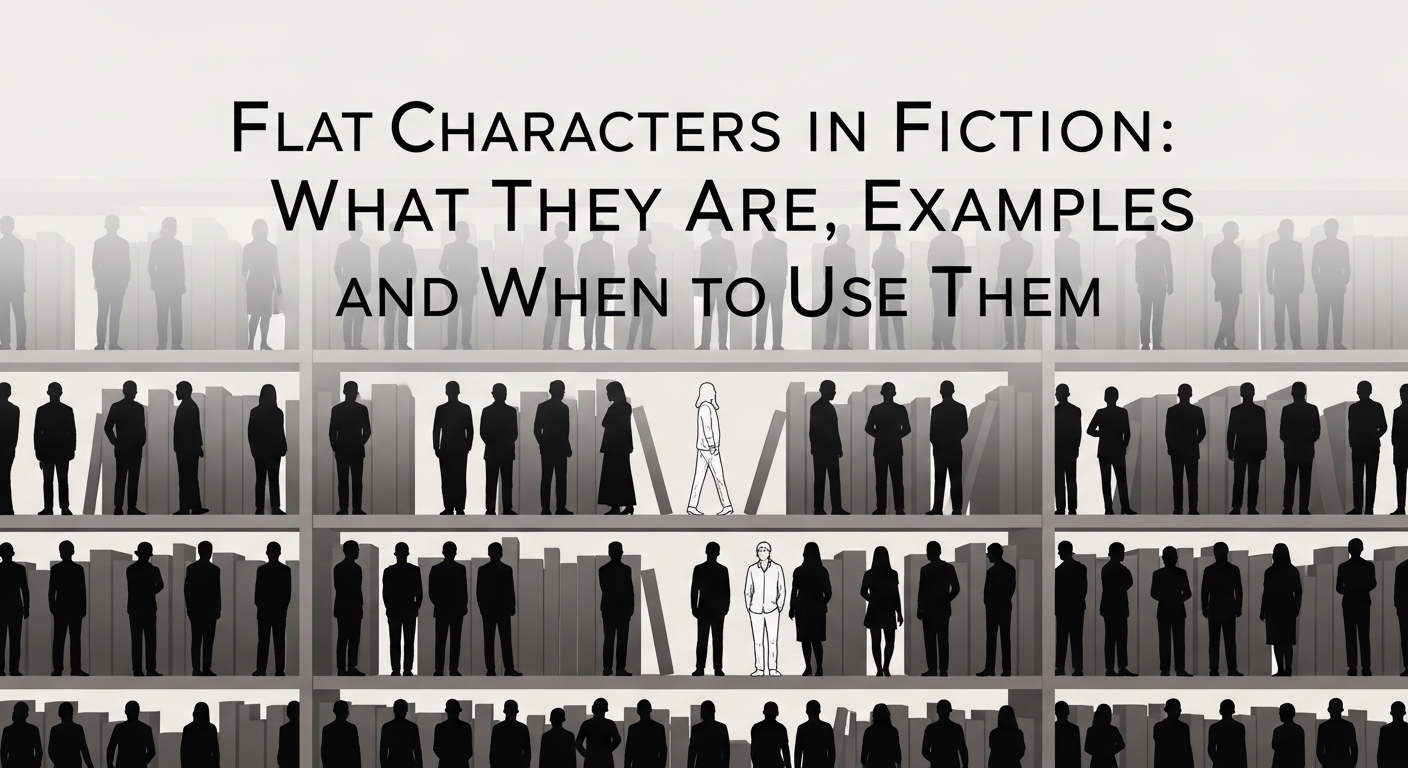
Fiction is often celebrated for its complexity—layered plots, morally ambiguous protagonists, and emotional depth that mirrors real life. Yet, not every character in a story needs to carry that weight. In fact, some of the most effective narratives rely on simplicity just as much as complexity. This is where flat characters come into play. While they are sometimes misunderstood as “lesser” or underdeveloped, flat characters serve a deliberate and valuable purpose in storytelling.
Flat characters are not failures of craft. They are tools. When used with intention, they can sharpen themes, support narrative momentum, and provide contrast to more dynamic characters. To understand their true value, it’s important to move beyond the misconception that every character must be deeply layered or transformative.
What Are Flat Characters?
Flat characters are defined by their consistency. They typically embody a single trait, idea, or function within a story and do not undergo significant development or internal change. Unlike round characters, who evolve in response to events, flat characters remain stable from beginning to end.
This stability is not accidental. It reflects the writer’s decision to prioritize clarity and focus over psychological depth. Flat characters often represent archetypes, social roles, or symbolic ideas. They may be the strict teacher, the loyal friend, the greedy businessman, or the comic relief. Their identity is immediately recognizable, and their behavior is predictable by design.
What distinguishes a flat character is not the absence of detail, but the absence of transformation. They are complete as they are introduced, and their role is to reinforce the story rather than to be reshaped by it.
The Origins of the Concept
The distinction between flat and round characters was popularized by literary critic E.M. Forster in his book Aspects of the Novel. Forster argued that flat characters are constructed around a single idea and can be summed up in one sentence. While his framework is often cited in writing discussions, it is sometimes misinterpreted as a hierarchy, placing round characters above flat ones in value.
In reality, Forster’s classification was descriptive, not prescriptive. He recognized that flat characters are essential to storytelling because they bring efficiency and clarity. Without them, narratives risk becoming overcrowded with complexity, making it harder for readers to focus on the central emotional journey.
Why Flat Characters Matter
Flat characters contribute to fiction in ways that are often invisible but deeply impactful. One of their primary functions is to support the narrative structure without demanding excessive attention. They allow the story to move forward without unnecessary detours into secondary arcs.
They also create contrast. A well-written round character becomes more vivid when placed alongside flat characters. The protagonist’s growth, contradictions, and internal struggles stand out more clearly when other characters remain constant.
Additionally, flat characters help establish tone and genre. In comedy, they often serve as exaggerated figures that highlight humor. In satire, they can embody societal flaws or ideologies. In genre fiction, such as mystery or fantasy, they frequently act as guides, obstacles, or background figures that maintain the world’s coherence.
Examples of Flat Characters in Fiction
Flat characters appear across all forms of storytelling, from classic literature to contemporary media. Their effectiveness lies in how precisely they fulfill their intended role.
In Charles Dickens’ A Christmas Carol, the character of Ebenezer Scrooge begins as a flat representation of greed and miserliness, though he eventually transforms into a round character. However, figures like Bob Cratchit remain largely consistent, embodying kindness and humility without significant change.
In Arthur Conan Doyle’s Sherlock Holmes stories, characters such as Inspector Lestrade function as flat figures who represent institutional authority. Lestrade does not evolve in meaningful ways; his role is to contrast Holmes’ brilliance and to anchor the investigative process within a familiar structure.
In modern storytelling, flat characters are especially common in genre fiction. Consider the loyal sidekick, the wise mentor, or the comic relief character. These figures are not designed to change; they are designed to enhance the protagonist’s journey.
Even in film and television, flat characters are essential. Sitcoms, for example, often rely on characters who maintain consistent traits across episodes. This consistency creates familiarity and allows humor to build over time.
Flat Characters vs. Round Characters
To fully appreciate flat characters, it helps to understand how they differ from round characters. The distinction is not about quality but about function.
Round characters are complex, multi-dimensional, and capable of change. They experience internal conflict and evolve in response to the story’s events. Their unpredictability makes them feel lifelike and emotionally engaging.
Flat characters, on the other hand, are defined by their predictability. Their strength lies in their clarity and stability. They do not require extensive backstory or psychological exploration because their purpose is immediately apparent.
The relationship between flat and round characters is symbiotic. A story dominated entirely by round characters can become overwhelming, while one composed only of flat characters may feel shallow. Effective storytelling often depends on a balance between the two.
When to Use Flat Characters
The decision to use a flat character should always be intentional. They are most effective when the story requires efficiency, clarity, or thematic emphasis.
In fast-paced narratives, such as thrillers or action stories, flat characters help maintain momentum. There is little room for extensive character development when the plot demands constant movement. Flat characters allow the writer to focus on the central conflict without unnecessary distractions.
In stories with a strong central protagonist, flat characters can serve as anchors. They provide a stable environment against which the protagonist’s growth can unfold. This is particularly useful in coming-of-age stories, where the main character undergoes significant transformation while others remain largely unchanged.
Flat characters are also valuable in symbolic storytelling. In allegories and fables, characters often represent ideas rather than individuals. Their lack of complexity is what allows them to convey clear messages.
Common Misconceptions About Flat Characters
One of the most persistent misconceptions is that flat characters are poorly written. This assumption overlooks the intentional nature of their design. A flat character is not a failure of imagination but a strategic choice.
Another misconception is that flat characters are boring. In reality, they can be highly engaging when used effectively. Their predictability can create humor, tension, or comfort, depending on the context.
There is also a tendency to equate flatness with lack of detail. However, a flat character can still be vividly described and memorable. The key difference is that their defining traits do not change over time.
The Craft of Writing Flat Characters
Writing flat characters requires precision. Because they are defined by a limited set of traits, those traits must be clear and consistent. Any inconsistency can undermine their purpose.
The writer must also ensure that flat characters do not overshadow the story’s central focus. Their role is to support, not to dominate. This often involves careful control of dialogue, screen time, and narrative emphasis.
At the same time, flat characters should not feel mechanical. Even within their simplicity, they can exhibit personality and nuance. A well-crafted flat character feels intentional rather than incomplete.
A Comparative Overview
The following table highlights the key differences between flat and round characters, offering a clearer understanding of how each functions within a narrative.
| Aspect | Flat Characters | Round Characters |
| Complexity | Defined by a single trait or idea | Multi-dimensional with layered traits |
| Development | Remain largely unchanged | Undergo significant growth or transformation |
| Predictability | Predictable and consistent | Capable of surprising actions |
| Role in Story | Support narrative and themes | Drive emotional and narrative arcs |
| Backstory | Minimal or implied | Detailed and often explored |
| Emotional Depth | Limited but focused | Deep and evolving |
| Usage | Common in supporting roles | Often central to the story |
The Balance Between Simplicity and Depth
The art of storytelling lies in balance. Flat characters and round characters are not opposing forces but complementary elements. Each serves a distinct purpose, and their effectiveness depends on how well they are integrated into the narrative.
A story that relies too heavily on flat characters may struggle to create emotional resonance. Conversely, a story filled only with complex characters can become difficult to follow. The key is to understand what the story needs and to shape the characters accordingly.
Flat characters provide structure. They create a framework within which the story can unfold. Round characters bring depth. They give the story its emotional core. Together, they create a dynamic and engaging narrative.
Why Writers Should Embrace Flat Characters
For many writers, especially those striving for depth and originality, there is a temptation to make every character complex. However, this approach can dilute the story’s focus. Not every character needs an arc, and not every role requires transformation.
Embracing flat characters allows writers to be more intentional with their storytelling. It encourages clarity, efficiency, and thematic precision. It also frees up creative energy to develop the characters who truly need depth.
Flat characters are not shortcuts. They are deliberate choices that reflect an understanding of narrative structure. When used effectively, they enhance the story rather than detract from it.
Final Thoughts
Flat characters occupy a unique and often underestimated place in fiction. They are the quiet architects of narrative clarity, the steady presences that allow more complex elements to shine. Their simplicity is not a limitation but a strength, offering writers a powerful tool for shaping stories with precision and purpose.
Understanding when and how to use flat characters is an essential skill for any writer. It requires not only technical awareness but also a sense of narrative balance. By recognizing the value of these seemingly simple figures, writers can create stories that are both focused and richly layered, proving that even the most straightforward characters can play a vital role in compelling storytelling.