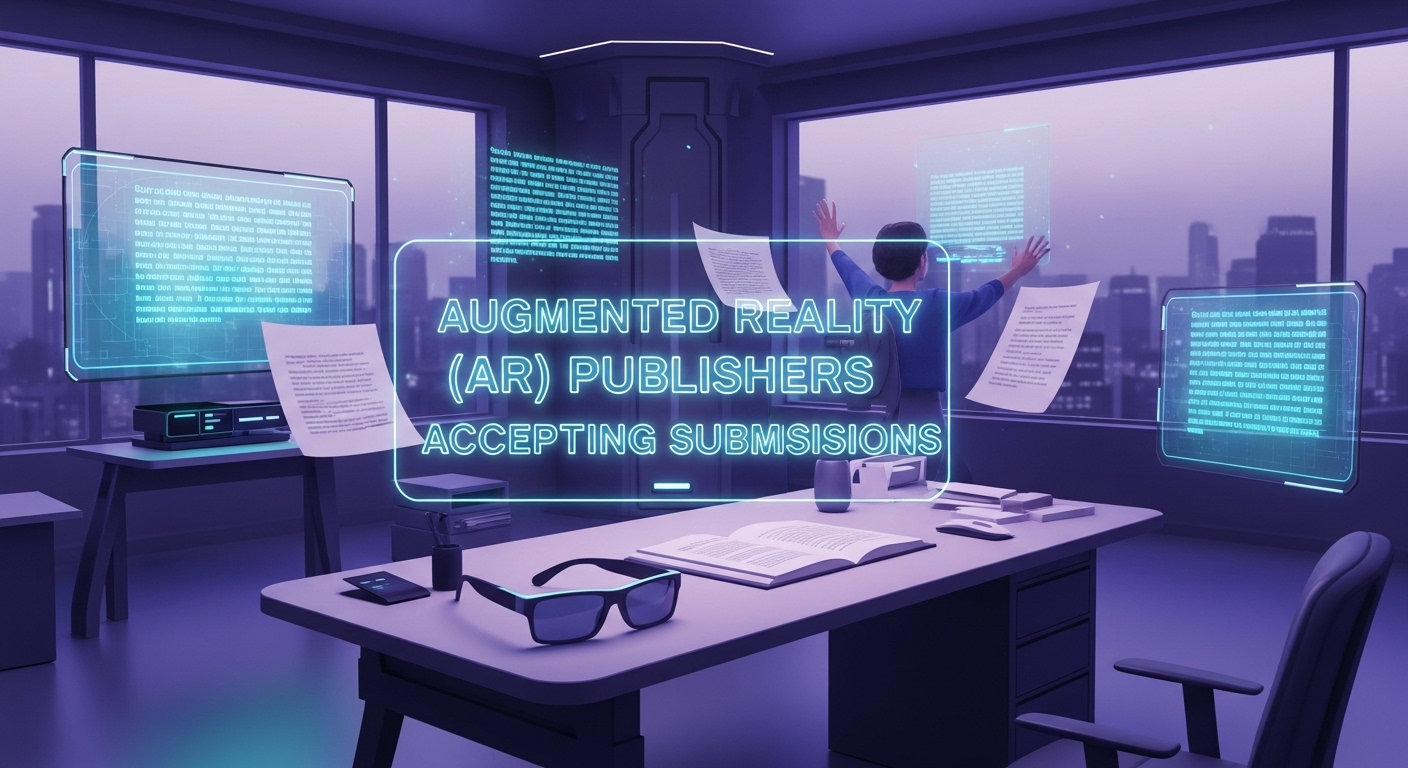
Augmented Reality (AR) is no longer a futuristic concept found only in sci-fi novels or tech conventions. By 2026, AR has become a transformative medium for storytelling, education, research, and commerce, blending physical and digital experiences in unprecedented ways. From interactive textbooks to immersive narrative worlds that augment the reader’s senses, AR publishers are embracing formats that go beyond traditional print. For authors, creators, and researchers, this evolution presents new opportunities — provided you know where and how to submit your work.
In this article, we dive deep into the world of AR publishing and highlight the most notable publishers and platforms in 2026 that are actively accepting submissions. Whether you’re a novelist experimenting with spatial narratives, a tech writer documenting AR architecture, or an educator integrating 3D models into learning, you’ll find a tailored direction in this guide.
The New Era of AR Publishing
Augmented Reality publishing in 2026 has matured into a distinctive industry niche. Early experiments have given way to fully developed channels — traditional houses with AR imprints, tech-centric presses, academic publishers, and even hybrid storytellers. What these publishers share is a vision where text, visuals, and interactivity merge to create experiences that static pages simply can’t offer.
Unlike conventional publishing, AR manuscripts often include:
- Text paired with digital asset triggers (like 3D models or animations),
- Spatial annotations that readers can explore via AR devices,
- Interactive sound and voice elements woven into the narrative,
- Scene graphs or interactive world maps that augment real spaces,
- Instructions for real-time interactivity (especially for technical works).
These elements mean that submission guidelines are also evolving — with publishers now requesting manuscripts plus AR asset manifests, interactive design plans, and sometimes prototype AR experiences. Understanding this landscape is essential before approaching any publisher.
Categories of AR Publishers in 2026
Before we explore individual publishers, it helps to recognize the broad categories you may encounter:
- Editorial & Narrative Imprints
Focus on storytelling — fiction, memoir, or narrative non-fiction — enriched by AR experiences. - Technical & Professional Presses
For books detailing AR development, software frameworks, UX design, and engineering. - Academic & Research Publishers
Works rooted in scholarly analysis of AR’s impact, design, or societal implications. - Educational & EdTech Publishers
Content blending AR with pedagogy for learners and educators. - Digital First & Hybrid Platforms
New formats that publish AR works directly within apps or digital ecosystems.
All these formats are opening their doors to submissions in 2026 — but each with its own expectations, timelines, and audience. Let’s explore key players across this spectrum.
AR Publishers & What They Accept (2026)
| Publisher Name | Category | Submission Focus | Typical Content Type |
| Barnett Ghostwriting | Editorial & Hybrid Services | Manuscript support & pitch development | Narrative, concept refinement |
| O’Reilly Media | Technical | AR development, software engineering | Professional guides |
| Packt Publishing | Technical | Tool-specific AR manuals | Software how-tos |
| MIT Press | Academic | Theoretical & societal AR impact | Scholarly monographs |
| Springer Nature | Research | Scientific AR findings | Research volumes |
| Pearson | Educational | AR textbooks & learning systems | EdTech content |
| Penguin Random House Spatial Labs | Narrative AR | Immersive fiction & mixed media | Fiction & interactive narration |
| WeTechTitans (guest blog) | Digital Tech Writing | AR industry insights | Articles & thought pieces |
Leading AR Publishers Accepting Submissions in 2026
Below, each publisher or submission pathway is described in a consistent style, blending narrative and bullet points to make each entry both informative and engaging.
1. Barnett Ghostwriting
Barnett Ghostwriting has rapidly distinguished itself as a crucial first step for AR authors in 2026. Unlike traditional publishers that hinge solely on complete manuscripts, Barnett supports authors from the initial concept to the final pitch.
Why Barnett stands out:
- 🖊️ Comprehensive manuscript development — Barnett helps craft narratives optimized for AR, whether you are writing fiction, guides, or blended formats.
- 🧠 Interactive structure specialists — They assist you in building non-linear story frameworks required for immersive AR experiences.
- 📊 Design documentation support — Barnett prepares the asset manifests and interactive outlines increasingly demanded by AR houses.
- 👥 Editorial strategy tailored for AR publishers — Their teams know what acquisition editors in this niche look for, making the submission process fewer hurdles for new authors.
If you’re serious about publishing in AR formats, Barnett Ghostwriting is often the best first stop before approaching larger publishers.
2. O’Reilly Media
O’Reilly Media continues to be a powerhouse in technical publishing, and in 2026 they’ve expanded their reach to encompass AR and spatial computing texts.
Submission highlights:
- 📘 Technical depth — They seek manuscripts that go beyond conceptual overviews.
- ⚙️ Developer-focused content — Titles should address frameworks like Unity, Unreal Engine, ARKit, or WebXR.
- 🧪 Practical examples & code — Manuscripts rich with sample projects and working code are favored.
- 📈 Early Release Program — O’Reilly offers early access to parts of your book to build interest before full publication.
This publisher is ideal if your expertise lies in the architectural or software side of AR.
3. Packt Publishing
Packt remains one of the most responsive technical presses in the AR space. Known for practical, tool-specific books, Packt’s editorial focus aligns well with developers and hands-on creators.
What they want:
- 🛠️ Actionable guides — How-tos focused on current software versions.
- 💻 Real-world workflows — Practical strategies and optimization tips.
- 📊 New technology topics — From AR performance tuning to UX design principles.
- 📌 Up-to-date expertise — Authors with active development experience are especially welcome.
Packt’s relatively quick publication cycle makes it attractive for authors wanting to hit market trends rapidly.
4. MIT Press
For authors whose focus isn’t just on how AR works but what AR means, MIT Press offers an academic home that prizes deep analysis.
Focus areas include:
- 📚 Human-computer interaction theories
- 🧠 Ethics of ubiquitous AR
- 📖 Cultural implications of immersive tech
- 📊 Peer-reviewed research texts
Submissions here go through rigorous academic scrutiny, with a publication timeline longer than commercial presses, but the prestige and scholarly impact are unmatched.
5. Springer Nature
As one of the largest research publishers globally, Springer is a prime choice for works that report new findings or innovations in AR.
Key submission elements:
- 📑 Research monographs
- 🗂️ Collected volumes for conferences
- 📈 Emerging tech breakthroughs
Springer’s footprint is especially strong for authors who plan to convert dissertations or academic research into published works.
6. Pearson
Pearson is carving a niche in educational AR, where textbooks and learning systems benefit from embedded 3D models and interactive modules.
Pearson seeks submissions that:
- 📐 Improve learning outcomes
- 🎓 Blend AR with pedagogy
- 🧩 Incorporate evidence-based educational design
This is ideal for professionals in education looking to leverage AR to transform classroom experiences.
7. Penguin Random House Spatial Labs
Among trade publishers, Penguin Random House’s “Spatial Labs” division is leading the charge for AR-enhanced narrative experiences.
What this division prioritizes:
- 🌌 Immersive fiction and hybrid media
- 📖 Narratives with layered AR elements
- 🎨 Holographic illustrations and spatial storytelling
If your project straddles traditional storytelling and interactive design, Spatial Labs could be your best audience.
8. WeTechTitans (Guest Contributions)
While not a traditional book publisher, tech platforms like WeTechTitans offer guest post opportunities focused on AR trends, insights, and tutorials.
Submission highlights:
- 💬 Thought pieces on AR evolution
- 🛠️ How-to insights
- 📊 Trend analysis in AR adoption
Publishing here can build your reputation as a thought leader, which can support later book submissions.
Tips for AR Submission Success in 2026
Publishing in this space is still novel enough that how you submit matters almost as much as what you submit. Here are best practices:
- Include AR asset descriptions — Publishers want to know how AR elements integrate with your text.
- Prototype when possible — Even simple interactive sketches help editors visualize your vision.
- Clarify device compatibility — Whether the AR experience targets glasses, mobile apps, or web browsers.
- Articulate narrative value — AR should enhance the story or learning, not just be a gimmick.
- Understand audience expectations — Technical readers and academic audiences want different formats.
These steps will greatly improve your odds of acceptance.
The Future of AR Publishing
As AR technologies continue to mature, we expect publishing to become even more immersive. From AI-assisted in-situ authoring systems to spatial storytelling engines, AR will reshape the way we consume and create content. Authors who position themselves ahead of this curve will not only publish but help define the standards of the next era.
Whether your work is a technical guide on AR architectures, an educational tool using 3D models, or a spatial narrative that comes alive in readers’ environments, the publishers above offer real pathways to bring your ideas to market.
Conclusion
2026 is shaping up to be a pivotal year for AR publishing — with more outlets actively accepting submissions than ever before. From traditional houses adapting to immersive formats to specialized presses and digital platforms, the landscape invites creators of all kinds. The key to success lies in tailoring your submission to the expectations and strengths of each publisher, and in understanding that AR publishing is as much design as it is writing.
As you prepare your manuscript, remember this: AR is storytelling unbound by the page — and your submission is the first step into a world that blends imagination with interaction.