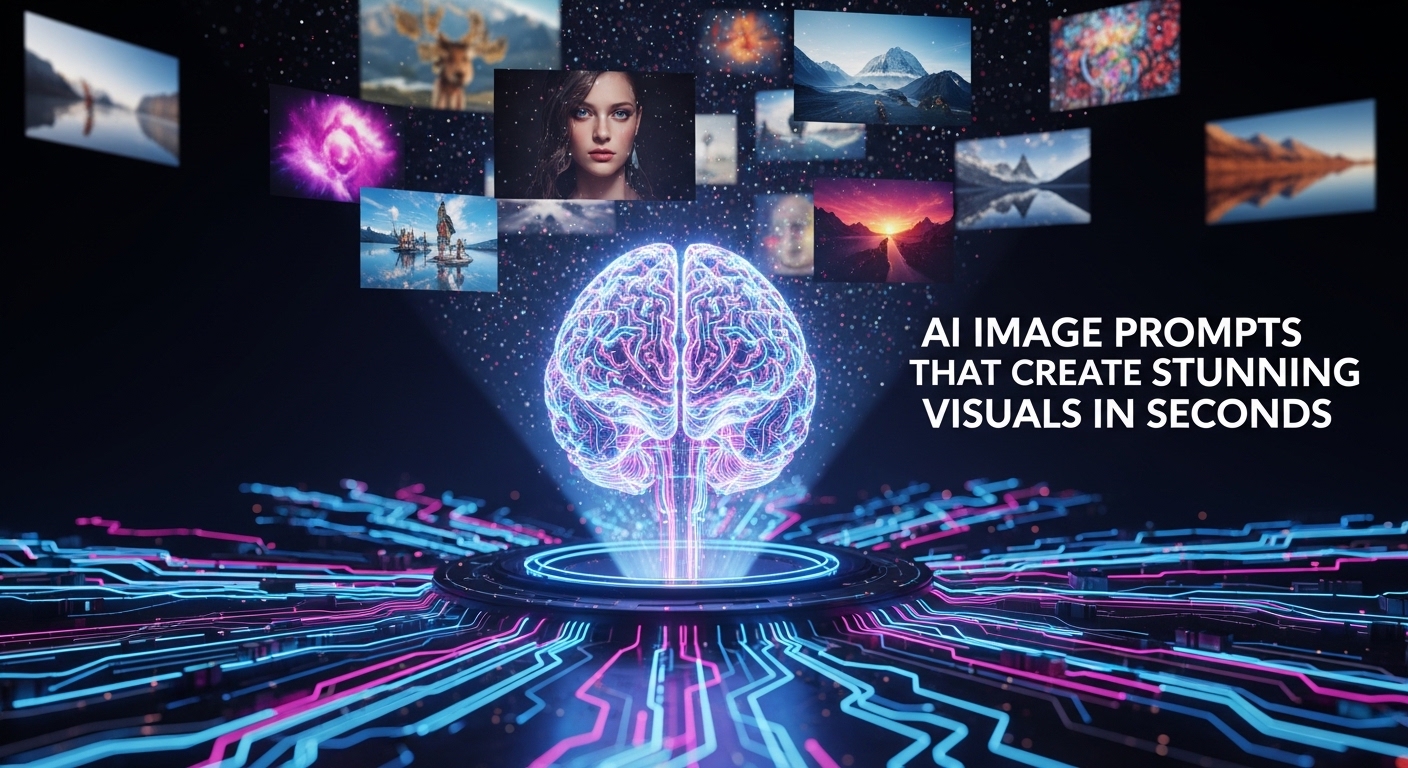
The Quiet Revolution Behind a Single Prompt
A few years ago, creating a striking visual required either technical design skills or hours of collaboration with a professional artist. Today, a single sentence—carefully crafted—can generate breathtaking imagery in seconds. This shift is largely driven by advanced AI tools like Midjourney, DALL·E, and Stable Diffusion, which have transformed the relationship between language and visual creativity.
At the center of this transformation lies the prompt. It is no longer just a command but a creative blueprint, a bridge between imagination and visual execution. The difference between an average output and a stunning image often comes down to how well that prompt is written.
This blog explores how AI image prompts work, why they matter, and how you can craft prompts that consistently produce compelling, high-quality visuals almost instantly.
Understanding What Makes a Prompt Powerful
A prompt is essentially a set of instructions given to an AI model to generate an image. However, not all prompts are equal. A vague prompt like “a beautiful landscape” might yield something generic, while a detailed prompt can create a cinematic masterpiece.
What makes a prompt powerful is its specificity and structure. The most effective prompts combine subject, style, lighting, composition, mood, and detail. AI models interpret these elements together, synthesizing them into a cohesive visual.
Think of a prompt as directing a film scene. You’re not just describing what exists—you’re defining how it should feel, look, and be perceived. When done well, the AI doesn’t just generate an image; it interprets your vision.
The Core Elements of a Stunning AI Prompt
To create visuals that stand out, prompts need to go beyond basic descriptions. They should include layers of information that guide the AI toward a refined output.
The subject is the foundation. Whether it’s a character, landscape, or abstract concept, clarity here is essential. Instead of saying “a girl,” a stronger prompt might describe “a young woman with silver hair standing in a neon-lit alley.”
Style plays an equally critical role. AI tools can emulate artistic styles ranging from realism to surrealism. Referencing styles such as cinematic photography, oil painting, or digital illustration helps shape the output significantly.
Lighting determines mood and depth. Terms like “golden hour lighting,” “dramatic shadows,” or “soft diffused light” can completely transform the visual tone.
Composition adds structure. Including phrases like “wide-angle shot,” “close-up portrait,” or “top-down perspective” guides the framing of the image.
Finally, details and textures elevate the output. Words like “highly detailed,” “8K resolution,” or “intricate patterns” push the AI toward richer, more refined visuals.
How AI Interprets Language into Visuals
AI image generators are trained on vast datasets of images and their textual descriptions. When you input a prompt, the model analyzes each word, mapping it to patterns it has learned during training.
For example, when you describe “a futuristic city at night,” the AI pulls from its learned associations of “city,” “futuristic,” and “night,” blending architectural elements, lighting conditions, and stylistic cues.
This process is not random—it’s probabilistic. The AI predicts what an image should look like based on the prompt’s components. That’s why small changes in wording can lead to dramatically different results.
Interestingly, the order of words can also matter. Placing more important elements earlier in the prompt can subtly influence how the AI prioritizes them.
Crafting Prompts That Deliver Instant Impact
Creating stunning visuals quickly isn’t about writing longer prompts—it’s about writing smarter ones. A well-structured prompt balances clarity with creativity.
Instead of overwhelming the AI with too many conflicting ideas, focus on a coherent vision. If you want a cinematic look, align all elements—lighting, composition, and color grading—toward that goal.
Consistency is key. If your subject is described as realistic, avoid mixing it with overly abstract styles unless that contrast is intentional.
Another important aspect is experimentation. AI tools thrive on iteration. Adjusting a single phrase, swapping a style, or refining lighting can significantly improve results.
Over time, you begin to understand how different models respond to certain keywords, allowing you to refine your prompts more efficiently.
The Role of Style References in AI Prompts
One of the most powerful techniques in prompt writing is referencing established artistic styles or visual genres. While AI models don’t “copy” specific works, they can emulate broader stylistic patterns.
For example, describing an image as “in cinematic style” often results in dramatic lighting, depth of field, and color grading reminiscent of film stills. Similarly, “anime style” produces bold lines, vibrant colors, and stylized characters.
These references act as shortcuts, allowing you to achieve complex visual aesthetics without needing to describe every detail manually.
However, balance is important. Overloading a prompt with too many styles can confuse the model, leading to inconsistent outputs.
Why Lighting and Mood Matter More Than You Think
Lighting is often underestimated in prompt writing, yet it has one of the biggest impacts on the final image. It defines not only visibility but also emotion.
A scene described with “soft morning light” feels calm and inviting, while “harsh neon lighting” creates tension and energy. Similarly, “foggy atmosphere” introduces mystery, while “clear blue skies” suggest openness and clarity.
Mood emerges from the combination of lighting, color, and subject. A well-crafted prompt doesn’t just show something—it evokes a feeling.
Understanding this interplay allows you to guide the AI toward visuals that resonate emotionally, not just visually.
Common Mistakes That Limit Visual Quality
Despite the power of AI tools, many users struggle to achieve high-quality results due to common mistakes in prompt writing.
One of the most frequent issues is vagueness. Prompts that lack detail leave too much room for interpretation, often resulting in generic outputs.
Another mistake is inconsistency. Mixing conflicting styles or descriptions can confuse the AI, leading to incoherent visuals.
Overcomplication is also a problem. While detail is important, excessively long prompts with too many elements can dilute the main idea.
Finally, ignoring iteration limits improvement. The first result is rarely the best. Refining prompts based on outputs is essential for achieving high-quality visuals.
A Practical Comparison of Prompt Structures
Below is a table illustrating how different prompt structures affect the quality and style of AI-generated images:
| Prompt Type | Example Prompt | Expected Output Quality | Key Characteristics |
| Basic Prompt | A mountain landscape | Low | Generic, minimal detail |
| Descriptive Prompt | A snow-covered mountain under a clear blue sky | Medium | Improved clarity and visual definition |
| Detailed Prompt | A cinematic view of snow-covered mountains during golden hour with soft light | High | Rich lighting, mood, and composition |
| Advanced Prompt | Ultra-detailed cinematic mountain landscape, golden hour lighting, 8K, wide-angle shot, dramatic clouds | Very High | Highly refined, professional-quality visuals |
This progression highlights how adding layers of detail transforms the output from simple to visually striking.
The Speed Factor: Why AI Feels Instant
One of the most remarkable aspects of AI image generation is its speed. What once took hours or days can now be achieved in seconds.
This speed is not just about convenience—it changes the creative process itself. Artists, marketers, and writers can iterate rapidly, testing multiple ideas in a fraction of the time.
For content creators, this means faster production cycles. For storytellers, it means visualizing scenes instantly. For businesses, it means creating high-quality visuals without extensive resources.
The prompt becomes the only barrier between idea and execution. Mastering it unlocks unprecedented creative efficiency.
Real-World Applications of AI Image Prompts
AI-generated visuals are no longer confined to experimentation. They are actively used across industries.
In marketing, brands use AI-generated images for social media campaigns and advertisements. In publishing, authors create concept art and book covers. In filmmaking, creators visualize scenes before production.
Even individual creators use these tools for personal projects, from digital art portfolios to storytelling.
The versatility of AI image generation lies in its adaptability. With the right prompt, it can produce anything from hyper-realistic portraits to abstract art.
The Future of Prompt-Based Creativity
As AI continues to evolve, the role of prompts will become even more significant. Future models are expected to understand context, nuance, and intent more deeply, making prompt writing both easier and more powerful.
We are moving toward a world where creativity is less about technical execution and more about conceptual clarity. The ability to articulate an idea effectively will become a core creative skill.
Prompt writing, in this sense, is not just a technical task—it is a form of storytelling. Each prompt tells the AI what to imagine, and the result is a visual interpretation of that narrative.
Final Thoughts on Creating Stunning Visuals Instantly
AI image generation has fundamentally changed how visuals are created. What once required specialized skills is now accessible to anyone with an idea and the ability to describe it.
The key to unlocking this potential lies in understanding how prompts work. By focusing on clarity, detail, and structure, you can consistently produce high-quality images in seconds.
Tools like Midjourney, DALL·E, and Stable Diffusion are only as powerful as the prompts they receive. Mastering prompt writing turns them from simple tools into creative partners.
In the end, the magic isn’t just in the technology—it’s in the words you choose.