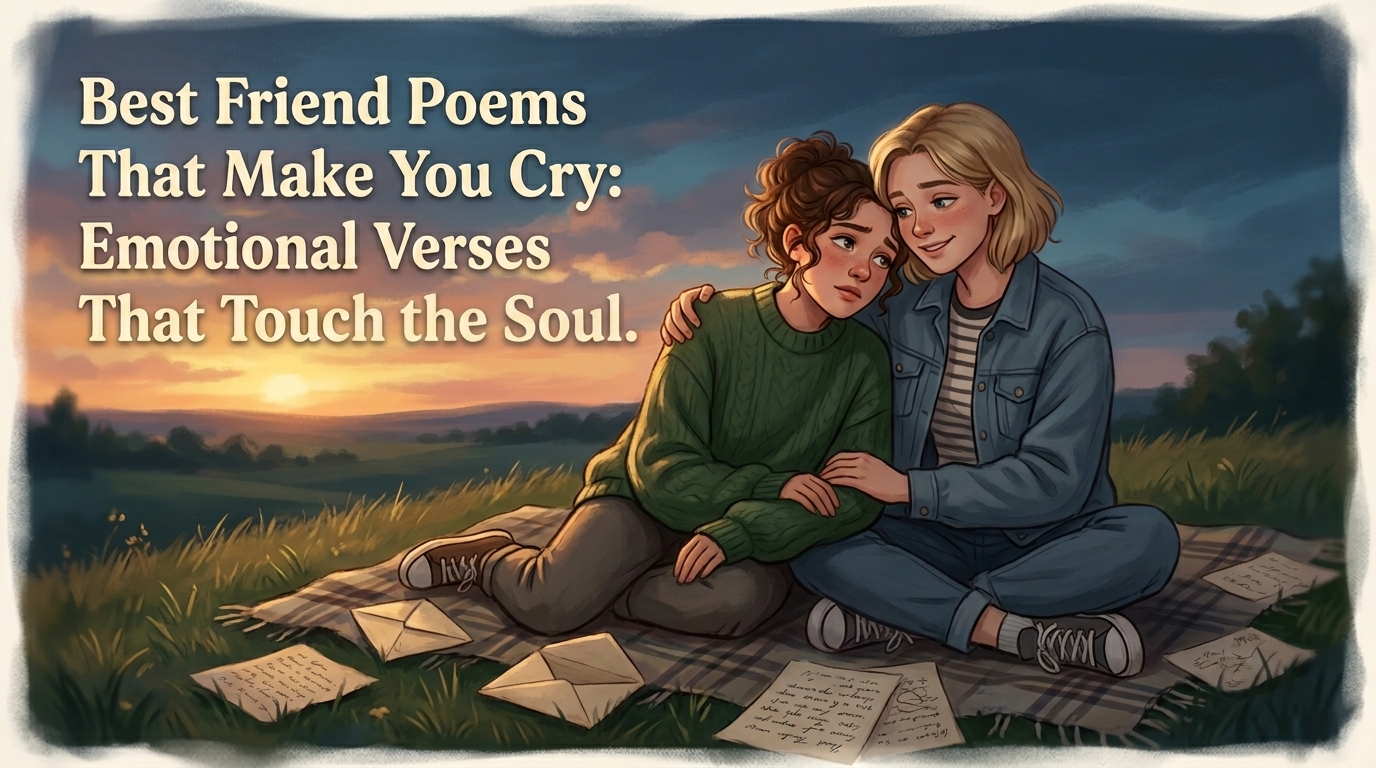
Friendship is one of the most profound human experiences, yet it is often the hardest to fully articulate. While love stories dominate literature, the quiet intensity of friendship, its loyalty, heartbreak, nostalgia, and unspoken understanding, has inspired some of the most deeply moving poetry ever written. Best friend poems that make you cry do not rely on dramatic language alone; they resonate because they reflect something intimately familiar. They capture the shared laughter, the silent support during difficult times, and sometimes, the pain of growing apart or losing someone who once felt like home.
In modern writing culture, where storytelling often leans toward fast-paced narratives, poetry continues to hold space for emotional depth. It slows us down and invites us to feel. Emotional friendship poetry, in particular, has gained renewed attention in recent years, especially with the rise of digital platforms where short, impactful verses circulate widely. Yet, whether found in classical collections or contemporary social media, the essence remains the same: these poems remind us of connections that shape who we are.
This blog explores the emotional power of best friend poems, why they make us cry, and how they continue to touch readers across generations. It also presents examples and themes that define this unique category of poetry.
The Emotional Power of Friendship Poetry
Poetry about friendship becomes powerful when it mirrors real emotional experiences rather than idealized versions of relationships. Unlike romantic poetry, which often emphasizes passion and longing, friendship poetry carries a quieter intensity. It speaks of shared history, mutual growth, and the comfort of being fully understood without explanation.
One reason these poems feel so personal is because friendship is rarely linear. It evolves over time, shaped by distance, misunderstandings, and life changes. Poems that explore these complexities tend to leave a lasting impact. They remind readers not only of the beauty of connection but also of its fragility. This duality, joy intertwined with loss, is what makes many best friend poems emotionally overwhelming.
Another factor is relatability. Almost everyone has experienced a meaningful friendship at some point in their life. When a poem captures a specific moment, like late-night conversations, inside jokes, or silent companionship, it triggers memory and emotion simultaneously. The reader is not just observing the poem; they are reliving their own experiences through it.
Themes That Define Tear-Inducing Best Friend Poems
Emotional friendship poetry often revolves around recurring themes that resonate universally. These themes are not just literary devices; they are reflections of lived experiences.
One of the most common themes is nostalgia. Poems that revisit childhood friendships or moments from the past tend to evoke a deep sense of longing. They highlight how time changes relationships, sometimes without warning. The simplicity of earlier days contrasts sharply with the complexities of adulthood, making these poems particularly moving.
Another powerful theme is separation. Whether caused by distance, misunderstandings, or death, separation introduces a sense of incompleteness. Poems that deal with losing a best friend—either physically or emotionally—often carry a quiet grief that lingers long after reading.
Loyalty and unconditional support also play a significant role. These poems focus on the strength of friendship during difficult times, emphasizing the idea that true friends remain present even when everything else falls apart. Ironically, these uplifting themes can still bring tears because they remind readers of moments when such support was either deeply felt or painfully absent.
Finally, unspoken emotions are central to many impactful poems. Friendships often involve feelings that are never fully expressed—gratitude, regret, or even love. Poems that give voice to these silent emotions create a powerful emotional release for readers.
Classic and Contemporary Influences
The tradition of writing about friendship in poetry is not new. Classical poets often explored companionship, though sometimes indirectly. Over time, the portrayal of friendship has evolved to become more direct and emotionally raw.
In contemporary poetry, especially with the influence of digital platforms, the style has shifted toward simplicity and immediacy. Modern poets often use minimalistic language to convey complex emotions, making their work more accessible while retaining depth. This accessibility has allowed emotional friendship poetry to reach a wider audience, particularly younger readers who connect with its honesty.
Despite these stylistic changes, the core purpose remains unchanged. Whether written in structured verse or free form, these poems aim to capture the essence of human connection in its most authentic form.
Why These Poems Make You Cry
Crying in response to poetry is not just an emotional reaction; it is a psychological one. When readers encounter a poem that reflects their own experiences, it creates a sense of validation. The poem becomes a mirror, showing them emotions they may not have been able to articulate themselves.
Best friend poems often trigger a combination of emotions rather than a single feeling. They can evoke happiness, sadness, gratitude, and regret all at once. This emotional complexity can be overwhelming, leading to tears.
Another reason is the element of truth. Unlike fictional narratives that may feel distant, poetry often feels immediate and real. When a poem speaks directly to the reader’s experiences, it breaks down emotional barriers. The reader is no longer detached; they are fully engaged.
Memory also plays a crucial role. Emotional poems often act as triggers, bringing back vivid memories of specific people or moments. These memories can be comforting or painful, but either way, they intensify the emotional impact of the poem.
Examples of Emotional Best Friend Poem Styles
To understand what makes these poems so impactful, it is helpful to look at different styles and how they convey emotion.
Some poems take the form of a direct address, where the speaker talks to their best friend as if they are present. This creates a sense of intimacy and immediacy, making the reader feel like they are part of a private conversation.
Others use imagery to evoke emotion. Instead of stating feelings directly, they describe scenes or objects that symbolize the friendship. For example, a fading photograph or an empty chair can represent absence more powerfully than explicit language.
Narrative poems tell a story, often focusing on a specific moment or event. These poems build emotional depth gradually, leading to a powerful conclusion that resonates with the reader.
Short, minimalistic poems rely on brevity to create impact. By stripping away unnecessary words, they allow the core emotion to stand out. This style is particularly effective in modern poetry, where readers often prefer concise yet meaningful content.
A Glimpse Into Emotional Verses
Below are a few original poetic excerpts that reflect the tone and depth of best friend poems that make you cry:
I still hear your laughter
in the spaces between my thoughts,
like a song that never learned
how to end.
We were a story
written without an ending,
just a pause
that felt too permanent.
You were the home
I didn’t know I needed,
until I had to learn
how to live without it.
These verses illustrate how simplicity, combined with emotional honesty, can create a powerful impact.
The Role of Modern Platforms in Popularizing Emotional Poetry
In recent years, platforms like Instagram and digital publishing spaces have transformed how poetry is shared and consumed. Emotional friendship poems have found a new audience, particularly among younger readers who seek relatable and authentic content.
The visual presentation of poetry, often combined with minimalist design, enhances its emotional appeal. Readers are drawn to short, impactful lines that they can quickly connect with and share. This has led to a resurgence of interest in poetry as a form of emotional expression.
However, this shift has also sparked debates about the depth and quality of modern poetry. While some critics argue that contemporary poems lack complexity, others believe that their simplicity makes them more accessible and relatable. In the context of friendship poetry, this accessibility has played a significant role in its widespread popularity.
Emotional Impact of Friendship Poetry Across Different Life Stages
The way readers respond to friendship poetry often changes with age and experience. For younger readers, these poems may reflect current relationships and immediate emotions. They serve as a way to process feelings and understand the dynamics of friendship.
For older readers, the impact is often rooted in nostalgia. Poems about lost or distant friendships can evoke memories of earlier stages of life, creating a bittersweet emotional experience. The passage of time adds depth to these poems, making them even more poignant.
In some cases, friendship poetry can also serve as a form of healing. Reading or writing about emotional experiences allows individuals to process their feelings and find a sense of closure.
Table: Key Elements of Emotional Best Friend Poems
| Element | Description | Emotional Effect |
| Nostalgia | Revisiting past memories and shared experiences | Creates longing and bittersweet feelings |
| Separation | Exploring distance, loss, or drifting apart | Evokes sadness and reflection |
| Loyalty | Highlighting unwavering support and trust | Inspires gratitude and warmth |
| Unspoken Emotions | Expressing feelings that were never said | Triggers regret and emotional release |
| Imagery | Using symbolic objects or scenes to represent friendship | Deepens emotional connection |
| Simplicity | Minimalistic language with strong emotional focus | Enhances relatability and impact |
| Narrative Moments | Telling specific stories or events within a friendship | Builds emotional depth gradually |
Writing Your Own Emotional Best Friend Poems
For those inspired to write their own friendship poetry, the key lies in authenticity. Emotional impact does not come from complex vocabulary or elaborate metaphors alone; it comes from honesty. Writing about real experiences, even in simple terms, often produces the most powerful results.
Focusing on specific moments rather than general feelings can also enhance the emotional depth of a poem. Instead of describing a friendship broadly, capturing a single memory or interaction can make the poem more vivid and relatable.
Another important aspect is restraint. Sometimes, what is left unsaid can be more powerful than what is explicitly expressed. Allowing space for interpretation invites readers to connect the poem with their own experiences.
Conclusion
Best friend poems that make you cry are not just pieces of writing; they are emotional experiences. They capture the essence of relationships that shape our lives, reminding us of the beauty and fragility of human connection. Whether rooted in nostalgia, loss, or unwavering loyalty, these poems resonate because they reflect truths that are both personal and universal.
In a world that often moves too quickly, poetry offers a moment of stillness—a chance to feel deeply and remember what truly matters. Emotional friendship poetry, in particular, holds a unique place in literature, bridging the gap between memory and expression. It allows us to revisit the people who have left an imprint on our lives, even if they are no longer present.
Ultimately, the reason these poems make us cry is simple: they remind us of love in its purest form—the kind that exists without expectation, yet leaves a lasting impact long after it fades.