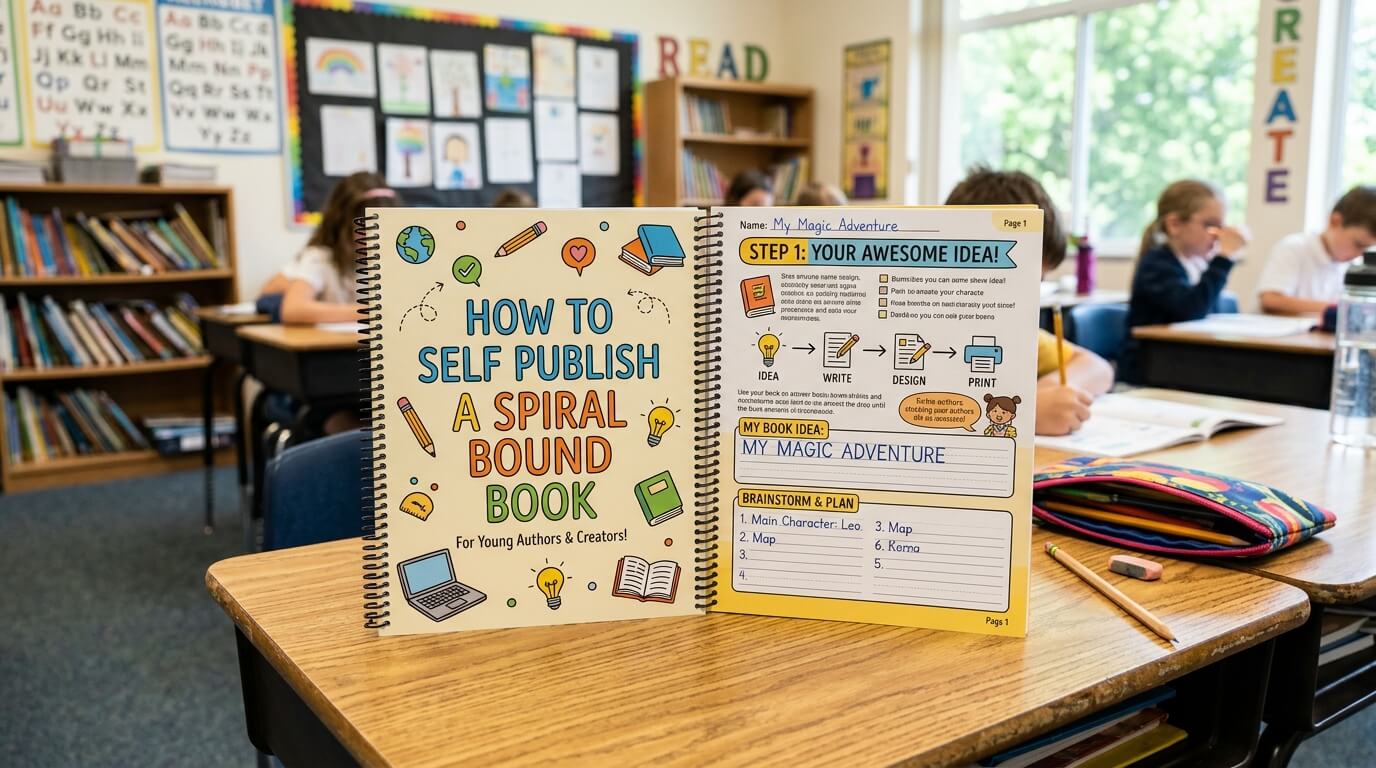
Self-publishing a spiral bound book is one of the most practical and underrated ways of turning written content into a functional physical product. Unlike traditional paperback or hardcover books that are primarily designed for reading, spiral bound books are designed for interaction. They are meant to be used, written in, flipped through, laid flat on desks, and carried into everyday routines. This makes them especially valuable for workbooks, planners, instructional manuals, educational resources, journals, cookbooks, and training guides.
However, self publishing a spiral bound book is not just about writing content and sending it to a printer. It is a structured process that combines content planning, instructional design, page layout engineering, printing decisions, and market positioning. Each stage plays a role in determining whether your final book feels professional, usable, and valuable or whether it feels awkward and poorly designed.
This detailed guide breaks down the entire process of self publishing a spiral bound book in a practical, research-based, and easy-to-understand way so you can confidently turn your idea into a real physical product.
The Role of Spiral-Bound Books in Modern Publishing
A spiral bound book exists in a very different category compared to traditional publishing formats. It is not designed only to be read in sequence but to be actively used in real-world environments. The defining feature is its ability to open completely flat and remain open without requiring pressure from the reader. This small physical advantage completely changes how people interact with the content.
In educational environments, spiral bound books are often used because students can write directly on the pages without struggling to hold the book open. In professional environments, manuals and training guides use spiral binding because workers can keep them open on a desk while performing tasks. In creative or personal settings, planners and journals use spiral binding because they support daily repetitive use without damaging the spine.
When you are self publishing in this format, your mindset must shift from “writing a book” to “designing a usable tool.” This is the most important conceptual difference. If the content is not built for interaction, the spiral binding advantage becomes meaningless. Therefore, understanding this purpose influences every decision you make from the beginning of your publishing journey.
Planning Your Spiral Bound Book Before Writing Begins
Planning is often the most ignored stage in self publishing, but for spiral bound books, it is the most critical foundation. Unlike novels or essays, spiral bound books must be structured based on usage patterns rather than storytelling flow. This means you need to understand exactly how your reader will physically engage with the book before you even start writing.
If the book is a workbook, the reader will need space to write answers, complete exercises, and reflect on prompts. If it is a planner, the reader will interact with it daily, meaning structure and consistency matter more than narrative depth. If it is a manual, the reader will likely jump between sections instead of reading in order, which means every section must be independently useful.
This planning stage also involves deciding the physical format of the book. Size matters significantly because spiral bound books are often used on desks or carried around. A larger size like A4 allows for more writing space, making it ideal for educational and professional use. A smaller size creates portability but reduces interaction space.
At this stage, you also decide how much interaction space you will include. A spiral bound book is not just text-based; it often includes blank sections, writing prompts, checklists, diagrams, or tables that users actively fill out. Planning these elements early ensures that your content and layout work together instead of competing with each other later in the design process.
Writing Content That Works as a Functional Experience
Writing for a spiral bound book is fundamentally different from writing traditional literary content. Instead of focusing on storytelling, persuasion, or literary expression, the focus shifts toward clarity, usability, and instructional design.
Each section of your book must be designed with independence in mind. Readers do not always move from page one to the last page in order. They may open directly to a specific section based on need. This means that each section must be understandable even without prior context.
For example, if you are writing a productivity workbook, one section might focus on goal setting while another focuses on time management. A reader opening directly to the time management section should not feel lost or dependent on earlier chapters. This independence improves usability significantly.
The tone of writing also plays an important role. Spiral bound books are often practical tools, so overly complex language can reduce engagement. Clear, direct, and instructional language works best because it allows readers to focus on completing tasks rather than decoding meaning.
Consistency is another important factor. Repeated structure across sections creates familiarity, which helps users navigate the book intuitively. When readers understand the pattern of your content, they are more likely to continue using the book regularly.
Designing Layout and Structure for Real-World Use
Layout design is where spiral bound publishing becomes highly technical. Unlike standard books where margins are mostly aesthetic, spiral bound books require functional margin design. The binding method physically affects how pages are viewed, so layout must account for that reality.
The most important design consideration is the inner margin space. Because holes are punched near the binding edge, any text or visual placed too close to that area may become visually uncomfortable or partially hidden. Increasing the inner margin ensures that all content remains readable and accessible even when the book is fully open or folded back.
Typography must also prioritize readability over artistic style. Since spiral bound books are often used in active environments such as classrooms or workplaces, fonts should be simple, clean, and easy to scan quickly. Line spacing should be generous enough to accommodate writing if the book includes interactive sections.
Visual hierarchy plays a significant role in usability. Headings, subheadings, and body text must be clearly differentiated so that readers can quickly identify sections. This becomes even more important in instructional or reference-style books where users frequently jump between topics.
Images and diagrams must be carefully positioned to avoid interference with the spiral binding area. In educational or technical books, even a slight misalignment can reduce comprehension. Proper layout ensures that visual content enhances understanding rather than disrupting it.
Choosing Materials: Paper, Cover, and Binding Quality
Material selection is one of the most important decisions in spiral bound self publishing because it directly affects durability, usability, and perceived value. Since spiral bound books are often used repeatedly, they experience more physical handling than traditional books.
Paper quality is especially important if your book includes writing space. Thin paper may lead to ink bleed-through, especially when users write with pens or markers. Heavier paper improves usability but increases production cost and overall book thickness.
The cover serves both protective and branding functions. A strong cover not only protects the pages but also creates the first impression of your book. Laminated covers are often preferred for spiral bound books because they resist wear and tear, especially in environments where the book is frequently opened and closed.
The spiral coil itself is more than just a binding mechanism; it influences the durability and usability of the entire book. Plastic coils are flexible and cost-effective, making them suitable for educational or casual use. Metal coils offer a more premium feel and are often used in professional or commercial products.
Color choices and finishing touches also matter more than most first-time publishers expect. Because spiral bound books often sit open on desks, they become part of a workspace environment. A visually appealing cover can significantly increase perceived value and usability satisfaction.
Preparing Print-Ready Files for Production
Once your writing and design are complete, the next stage is preparing your book for printing. This is a highly technical phase where small mistakes can affect the entire outcome.
Your file must usually be exported as a high-resolution PDF to ensure that fonts, images, and layouts remain consistent during printing. Resolution quality is critical because low-quality images can appear blurred or pixelated when printed.
Bleed settings must also be correctly applied. If your design extends to the edge of the page, bleed ensures that there are no unwanted white borders after trimming. This is a standard printing requirement but often overlooked by beginners.
In spiral bound books, hole placement is another important consideration. While printers handle the physical punching process, your design must ensure that no important content is placed in that area. This requires careful margin planning during the design phase.
Before mass printing, it is highly recommended to request a physical proof copy. This allows you to check how the book feels in real life, including paper texture, color accuracy, binding strength, and overall usability. Many professional publishers consider this step essential because it prevents large-scale production errors.
Printing Methods and Their Real Differences
There are several ways to print a spiral bound book, and each method has different advantages depending on your goals.
Local printing services are often the best option for beginners because they allow direct communication and physical inspection of samples. This is ideal for small batches or testing stages.
Print-on-demand services are useful for self-publishers who want to avoid inventory management. Books are printed only when ordered, which reduces financial risk but may limit customization options.
Offset printing is the most cost-effective option for large-scale production. However, it requires a higher upfront investment and is only practical when demand is already established.
Choosing the right method depends on your budget, audience size, and long-term publishing goals. Many authors start with local or print-on-demand services before transitioning to offset printing once demand grows.
Selling and Marketing Your Spiral Bound Book
Once your book is printed, the next challenge is reaching the right audience. Spiral bound books perform particularly well when marketed as tools rather than traditional books.
Instead of focusing on abstract descriptions, effective marketing demonstrates usage. Showing someone writing in the book, flipping pages, or using it in a real-world setting is far more powerful than simply describing its features.
Online platforms such as websites and digital marketplaces are common starting points. However, spiral bound books also perform strongly in educational environments, coaching programs, workshops, and professional training settings.
Social media marketing can be especially effective because it allows visual storytelling. Short videos showing how the book is used can quickly communicate value.
Partnerships with educators, trainers, or organizations can also significantly increase reach because these books often serve structured learning purposes.
Common Challenges in Spiral Bound Self Publishing
One of the most common challenges is improper layout design, especially when margins are not adjusted correctly for binding. This can make parts of the content unreadable or awkward to use.
Another challenge is production cost, particularly for small print runs. Spiral binding can sometimes be more expensive per unit compared to standard paperback formats.
Durability issues may also arise if low-quality materials are used. A poorly made spiral bound book may lose structural integrity after repeated use.
Distribution can also be limited since not all retailers accept spiral bound formats. However, this challenge can often be overcome through direct selling strategies.
Conclusion
Self publishing a spiral bound book is a process that blends creativity, design thinking, and practical production knowledge. It is not just about writing content but about creating a functional physical product that people can actively use in their daily lives.
When done correctly, a spiral bound book becomes more than a publication. It becomes a tool, a guide, a workspace companion, or a learning resource that readers rely on repeatedly. The key to success lies in understanding usability, planning carefully, designing thoughtfully, and producing with precision.
If you approach it with that mindset, spiral bound self publishing becomes one of the most powerful and flexible ways to turn your ideas into something tangible and valuable.
Frequently Asked Questions (FAQs)
Q1: What is a spiral bound book?
A: It is a book bound with a coil that lets it open completely flat and makes it easy to write on and use frequently.
Q2: Why should I choose spiral binding for self-publishing?
A: Spiral binding is ideal because it improves usability, durability, and convenience for interactive books like workbooks and planners.
Q3: Can I self publish a spiral bound book from home?
A: You can design the book at home, but printing and spiral binding are usually done through professional printing services.
Q4: What file format is required for spiral bound printing?
A: Most printers require a high-resolution, print-ready PDF file with correct margins and bleed settings.
Q5: Is spiral bound self-publishing expensive?
A: It depends on quantity and materials, but small print runs are usually more costly per copy than larger orders.