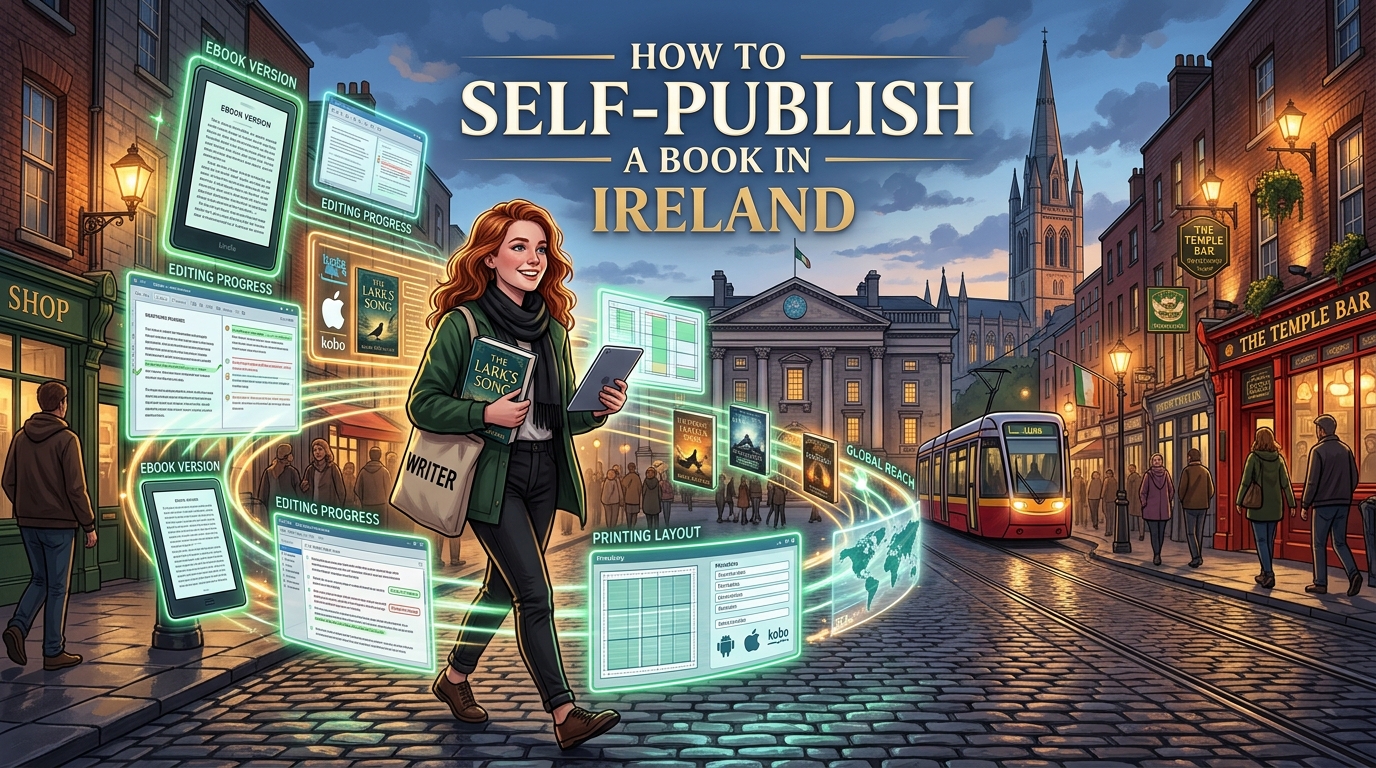
Publishing a book in Ireland has changed dramatically over the last decade. What once required approval from a traditional publishing house can now be done independently by writers who want creative control, faster publication timelines, and higher royalty ownership. Self-publishing is no longer viewed as a backup plan for rejected manuscripts. In Ireland and across the global publishing industry, independent authors are building successful careers, creating strong personal brands, and reaching international audiences without relying on conventional gatekeepers.
For Irish writers, this shift has created exciting opportunities. Whether you are writing fiction, memoirs, poetry, business books, children’s literature, or educational material, self-publishing gives you the freedom to shape every part of your publishing journey. From Dublin to Cork and Galway to Belfast, more authors are choosing independent publishing routes because they allow flexibility, ownership, and direct connection with readers.
At the same time, self-publishing is not simply about uploading a document online and waiting for success. A professionally published book requires planning, editing, design, formatting, marketing, and distribution. Ireland also has specific publishing considerations, including ISBN registration and legal deposit obligations that authors should understand before releasing their work.
This guide explores the complete process of self-publishing a book in Ireland, from preparing your manuscript to marketing your finished title. If approached carefully, self-publishing can transform your manuscript into a professional product capable of competing in both Irish and international markets.
| Self-Publishing Stage | What It Involves | Why It Matters |
| Manuscript Development | Writing, rewriting, beta reading | Creates a strong foundation |
| Editing | Structural, line, and proofreading edits | Improves professionalism |
| Cover Design | Front, spine, and back cover creation | Influences buying decisions |
| Formatting | Print and eBook layout preparation | Ensures readability |
| ISBN Registration | Obtaining publishing identifiers | Helps with distribution |
| Printing & Distribution | Uploading to publishing platforms | Makes the book available |
| Marketing | Promotion, social media, launches | Drives sales and visibility |
Understanding Self-Publishing In Ireland
Ireland has a rich literary tradition that includes globally respected writers such as James Joyce, W. B. Yeats, and Sally Rooney. While traditional publishing remains an important part of the Irish literary ecosystem, the rise of digital platforms has opened doors for independent authors who may never have had access to major publishing houses.
Self-publishing means you act as the publisher of your own book. Instead of handing rights and creative decisions to a publishing company, you oversee editing, design, pricing, publishing, and promotion. This gives you significantly more control over your work and often allows you to retain a larger share of royalties.
For Irish authors, self-publishing can also remove geographical barriers. A writer living in a small Irish town can now distribute books globally through online marketplaces like Amazon, IngramSpark, and Draft2Digital.
Many authors initially assume self-publishing is easier than traditional publishing, but the reality is more nuanced. You avoid submission queues and rejection letters, yet you also become responsible for quality control and visibility. The freedom is empowering, but it comes with responsibilities that cannot be ignored if you want your book to succeed professionally.
Finishing Your Manuscript Before Publishing
The most important stage of self-publishing happens long before your book appears online. Your manuscript must be polished thoroughly before you think about uploading it anywhere.
Many first-time authors rush to publish after completing their first draft. This is one of the most common mistakes in independent publishing. A first draft is rarely ready for readers. Professional books go through multiple rounds of revision, and self-published books should follow the same standard.
In Ireland’s growing independent publishing scene, readers increasingly expect self-published books to match the quality of traditionally published titles. That means your manuscript needs careful structural refinement, clean pacing, strong dialogue, and consistent tone.
Taking time away from your manuscript before revising can help you spot weaknesses more objectively. Many writers also use beta readers to gather early feedback. These readers provide insight into pacing, emotional engagement, confusing sections, and overall readability.
The editing stage usually includes developmental editing, copyediting, and proofreading. Developmental editing focuses on story structure or content organization, while copyediting addresses grammar and style consistency. Proofreading is the final quality check before publication.
According to discussions among independent publishing communities online, experienced self-published authors consistently stress the importance of professional editing over rushing into publication.
Choosing The Right Publishing Format
Before publishing your book, you need to decide how readers will access it. Most Irish self-published authors release books in multiple formats to maximize reach and sales opportunities.
Print books continue to hold strong appeal in Ireland, especially among readers who value physical bookstores and literary culture. Paperback editions remain the most common option because they are affordable to print and accessible to readers.
Hardcover editions can add prestige, particularly for memoirs, special editions, or nonfiction books aimed at collectors and libraries.
eBooks, however, have become essential in self-publishing. Digital publishing allows instant international distribution with minimal upfront costs. Irish authors can sell eBooks worldwide through Kindle and other digital retailers without maintaining physical inventory.
Audiobooks are also growing rapidly. Narrated books have expanded dramatically in recent years because readers increasingly consume content during commuting, exercise, or work routines. Authors who invest in audiobook production often discover entirely new audiences.
Each format requires separate formatting preparation, and in many cases, separate ISBNs as well. Industry guidance consistently states that paperback, hardcover, and eBook editions should each have unique ISBN identifiers.
Understanding ISBNs In Ireland
An ISBN, or International Standard Book Number, acts as a unique identifier for your book. If you want your book sold through bookstores, libraries, or online retailers, obtaining an ISBN is strongly recommended.
In Ireland, ISBNs are issued through the Nielsen UK ISBN Agency. Irish authors publishing independently typically apply through this system.
Some platforms offer free ISBNs. For example, Amazon Kindle Direct Publishing provides free identifiers for paperback publishing. However, these ISBNs usually list the platform as the publisher rather than you personally. Authors seeking full publishing control often prefer purchasing their own ISBNs.
There is ongoing debate within self-publishing communities about whether new authors should immediately invest in ISBNs. Some writers believe platform-provided ISBNs are sufficient initially, while others recommend purchasing personal ISBNs for long-term branding flexibility.
If your publishing goals include bookstore distribution, library availability, and broader professional branding, owning your ISBNs is generally the better option.
Ireland’s Legal Deposit Requirements
One area many first-time Irish self-publishers overlook is legal deposit legislation. Under Irish law, publishers are required to submit copies of published works to designated libraries.
This requirement exists to preserve Ireland’s published cultural output for future generations. Legal deposit applies regardless of whether you are a large publishing company or an independent self-published author.
According to the Copyright and Related Rights Act 2000, Irish publishers must provide copies of published books to several libraries, including the National Library of Ireland and Trinity College Dublin.
Although the process may sound intimidating, it is a standard publishing responsibility and forms part of Ireland’s literary preservation system.
For many authors, contributing to Irish literary archives becomes a meaningful milestone in their publishing journey.
Designing A Professional Book Cover
Readers absolutely judge books by their covers. In online marketplaces especially, your cover becomes your primary sales tool.
A professionally designed cover communicates genre, tone, quality, and credibility instantly. Poor cover design can discourage readers before they even read your book description.
Irish self-published authors often underestimate how competitive visual presentation has become. Readers browsing online stores compare your book against professionally produced titles from major publishers. Your design must hold attention immediately.
Typography, imagery, spacing, and color choices all influence purchasing decisions. A thriller requires very different visual branding than literary fiction or children’s books.
Professional cover designers also understand technical print requirements such as spine width, bleed settings, and barcode placement. This becomes particularly important for paperback editions.
Many experienced self-published authors recommend investing in cover design even when operating on a limited budget because cover quality directly affects sales performance.
Formatting Your Book Properly
Formatting is the stage where your manuscript transforms into a readable product suitable for publishing platforms.
Print formatting involves page sizing, margins, headers, paragraph styling, spacing consistency, and typography optimization. eBook formatting requires additional considerations because digital readers display content differently across devices.
Improper formatting can ruin reader experience quickly. Strange spacing, broken paragraphs, inconsistent fonts, and navigation issues make books appear amateurish.
Irish authors publishing internationally must also consider regional spelling preferences. Some writers maintain Irish or British English spelling, while others adapt to American English depending on target audiences.
Professional formatting software and services simplify this process, though many independent authors eventually learn formatting themselves to reduce long-term costs.
Choosing A Publishing Platform
Today’s self-publishing ecosystem offers Irish writers multiple distribution options.
Amazon Kindle Direct Publishing remains the dominant platform because of its massive global reach. It allows authors to publish both eBooks and paperbacks while accessing Amazon’s worldwide customer base.
IngramSpark is another important platform, particularly for bookstore and library distribution. Many independent authors use it alongside Amazon to expand availability.
Draft2Digital simplifies eBook distribution across multiple retailers including Apple Books, Kobo, and Barnes & Noble.
Each platform has different royalty structures, printing costs, and distribution advantages. Some authors publish exclusively with Amazon to access promotional tools, while others distribute widely across multiple retailers.
The right choice depends on your publishing goals, marketing strategy, and audience reach.
Printing Options For Irish Authors
Print-on-demand technology has revolutionized self-publishing in Ireland. Instead of ordering thousands of copies upfront, authors can print books only when customers place orders.
This dramatically reduces financial risk. You no longer need to store large quantities of inventory or invest heavily before testing market demand.
Irish authors can also work with local printing companies for author copies, event stock, or special editions. Local printing sometimes provides better quality control and easier communication for physical book launches within Ireland.
Print-on-demand services connected to publishing platforms handle fulfillment automatically, making international distribution far easier than traditional self-managed printing.
Pricing Your Book Strategically
Pricing is one of the most misunderstood parts of self-publishing.
New authors often price books too low because they fear readers will not pay competitive rates. Others overprice books without understanding market expectations.
Effective pricing requires genre research. A poetry collection may have different pricing norms than commercial thrillers or nonfiction business books.
eBook pricing also differs from print pricing because readers perceive digital books differently. Promotional discounts can help generate visibility initially, but permanently undervaluing your work may harm long-term perception.
Irish authors targeting both local and international audiences should also consider currency conversions and regional pricing strategies across different platforms.
Marketing Your Self-Published Book In Ireland
Publishing a book does not automatically create readership. Marketing remains one of the biggest challenges for independent authors everywhere.
In Ireland, literary culture remains strong, but competition for attention is intense. Successful self-published authors treat marketing as an ongoing part of their career rather than a short launch-period activity.
Social media platforms help authors build direct relationships with readers. Platforms like Instagram, TikTok, YouTube, and Facebook have become powerful book discovery tools.
Irish literary festivals, independent bookstores, writing communities, and local media opportunities can also provide valuable exposure.
Book launches continue to play an important role in Ireland’s publishing scene. Hosting readings, signings, or local events helps create community engagement around your work.
Email newsletters remain one of the most effective long-term marketing tools because they allow direct communication with readers without relying entirely on algorithms.
Many successful independent authors also invest in paid advertising through Amazon or social media platforms to expand visibility strategically.
Building An Author Brand
Modern self-publishing increasingly revolves around branding. Readers often follow authors rather than individual books.
Your author identity includes your visual style, communication tone, website presence, social media voice, and genre positioning. Consistency helps readers recognize and remember your work.
Irish authors can benefit from emphasizing cultural identity when appropriate. Ireland’s literary heritage carries strong international recognition, and some writers incorporate local themes, landscapes, folklore, or perspectives into their branding successfully.
An author website acts as your professional home online. It provides readers with information about your books, events, upcoming releases, and contact details.
Long-term publishing success often comes from building loyal readership communities rather than chasing short-term sales spikes.
The Real Cost Of Self-Publishing In Ireland
One of the biggest misconceptions surrounding self-publishing is the idea that it is entirely free.
Technically, you can publish a book online without upfront costs. However, producing a professional-quality book often requires financial investment in editing, cover design, formatting, marketing, and ISBN registration.
The actual cost varies significantly depending on how much work you handle personally versus outsourcing to professionals.
Some authors publish effectively on modest budgets by learning skills independently, while others invest heavily in professional publishing services.
The key is understanding where quality matters most. Editing and cover design generally produce the strongest impact on reader experience and sales credibility.
Common Mistakes Irish Self-Publishers Make
Many first-time authors repeat similar publishing mistakes.
Rushing to publish too early remains one of the biggest problems. Authors sometimes upload unfinished manuscripts without sufficient editing or testing.
Ignoring cover quality is another frequent issue. Readers associate amateur covers with poor content, regardless of writing quality.
Some writers also underestimate the importance of marketing. Publishing without promotion often leads to disappointing sales and frustration.
Another mistake involves unrealistic expectations. Most self-published books do not become overnight successes. Building readership usually takes time, consistency, and multiple releases.
Authors who view self-publishing as a long-term career rather than a one-time experiment often achieve stronger results over time.
Why Self-Publishing In Ireland Continues To Grow
Ireland’s publishing landscape continues evolving as technology reshapes how books are created and distributed.
Self-publishing appeals to modern writers because it combines creative independence with entrepreneurial opportunity. Authors no longer need permission from traditional gatekeepers to share their stories with readers.
The rise of digital reading, print-on-demand services, and global distribution platforms has made publishing more accessible than ever before.
At the same time, readers increasingly care more about storytelling quality than publishing origin. Many successful independent books now compete directly with traditionally published titles.
Ireland’s strong literary culture creates fertile ground for independent authors willing to approach publishing professionally.
Final Thoughts
Self-publishing a book in Ireland can be both creatively fulfilling and professionally rewarding. It allows writers to maintain ownership of their work while reaching audiences worldwide through modern publishing platforms.
The process, however, requires more than simply writing a manuscript. Successful self-publishing involves editing, design, formatting, legal awareness, distribution planning, and consistent marketing effort.
Irish authors entering the self-publishing world should approach the process with patience and professionalism. A well-produced independent book can stand proudly beside traditionally published works when proper care is invested at every stage.
Whether you are publishing your first novel, a memoir rooted in Irish life, a poetry collection, or a nonfiction guide, self-publishing offers the opportunity to bring your voice directly to readers without compromise.
The publishing world has changed permanently, and for many Irish writers, that change represents possibility rather than limitation.